Market lessons: Why the Australian dollar matters to grain prices

Market Lessons
Australian growers can see grain prices move even when the international commodity market has barely changed. One of the main reasons is the Australian dollar.
Most globally traded agricultural commodities are priced in US dollars. Australian growers, however, ultimately sell grain in Australian dollars. This means movements in the exchange rate can change the Australian value of a commodity before anything else in the market has moved.
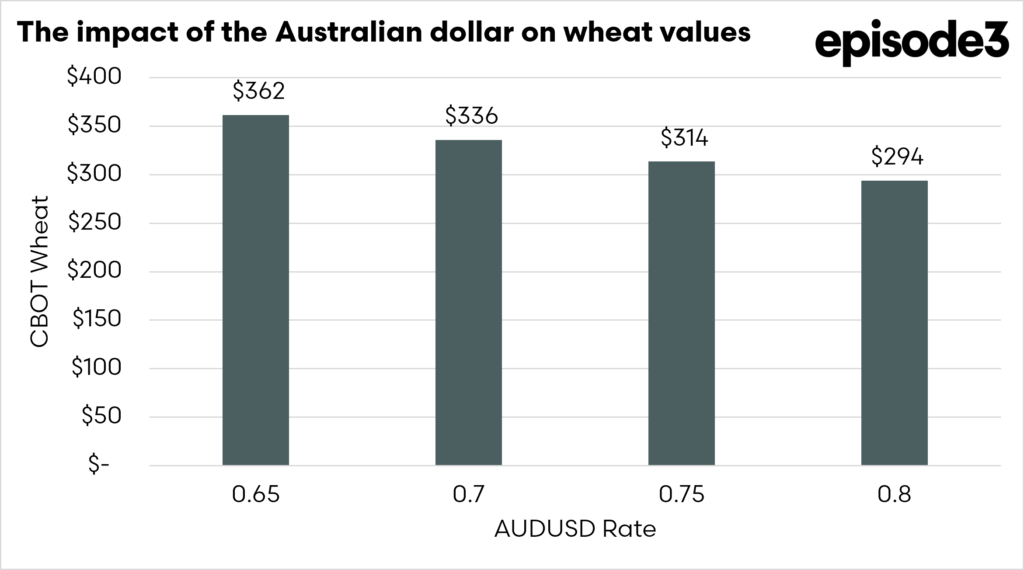
Consider wheat worth US$250/mt on the international market. If the Australian dollar is trading at US$0.70, that wheat is worth roughly A$357/mt before allowing for basis and other local market factors.
If the Australian dollar weakens to US$0.65, the same US$250/mt wheat is now worth around A$385/mt. The international wheat price has not moved, but its Australian-dollar value has increased by almost A$30/mt.
The opposite applies when the Australian dollar strengthens. If the currency moved from US$0.70 to US$0.75, that US$250/mt wheat would be worth about A$333/mt. Again, nothing has changed in the underlying wheat market, but the Australian value has fallen.
This is why a weaker Australian dollar is generally supportive of Australian grain prices. Australian grain becomes cheaper for overseas buyers in their currency, while the Australian-dollar value received by exporters increases. Some of that currency benefit can then flow back through export bids to growers.
A stronger Australian dollar generally works in the opposite direction. It can reduce the Australian-dollar value of international commodity prices and make Australian grain relatively more expensive in export markets.
Currency is not the only influence on a local grain bid. Futures prices, basis, freight, local supply, buyer demand and quality all matter. FX is simply another part of the price equation, and sometimes it can be a substantial one.
Growers do not need to become currency traders to understand this risk. The important thing is to recognise what has driven a price movement. If Chicago wheat has barely changed but Australian bids have strengthened, check what has happened to the Australian dollar.
Understanding this also helps when assessing whether a price opportunity is likely to persist. A grain rally driven by tighter global supplies is different from one created largely by a falling Australian dollar.
The lesson is that Australian grain prices are influenced by more than grain. Watching the Australian dollar alongside futures and local basis provides a much clearer picture of why the price at the farm gate is moving.