Market lessons: Forward selling give certainty, but not without risk

Market Lessons
Forward contracts are one of the simplest tools available to grain growers. You agree today to sell a set quantity of grain at an agreed price for delivery at a later date. That can be useful because it removes some uncertainty around revenue before harvest, particularly when prices are at a level that works for the farm business.
The important point is that a forward contract locks in a price, but it does not lock in production. The grower still carries the risk of producing enough grain, meeting the required quality specification and delivering it within the agreed period. That is why forward selling should be treated as a risk-management tool rather than simply a way of picking a price.
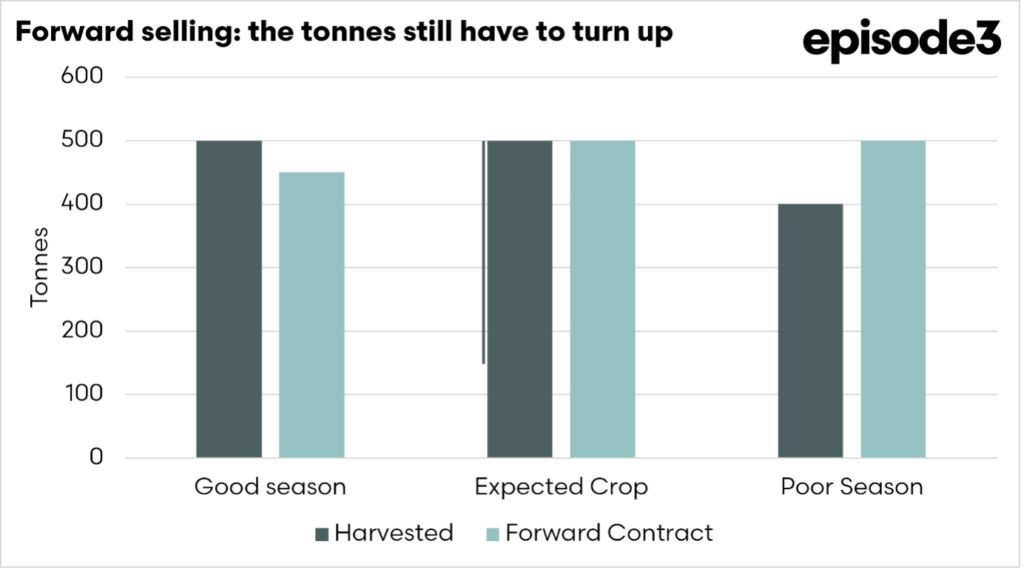
Consider a grower who sells 500 tonnes of wheat forward at A$320/mt. The chart shows three possible outcomes. In a good season, the grower harvests 550 tonnes, delivers the contracted 500 tonnes and has another 50 tonnes available to sell. If production comes in exactly at 500 tonnes, the contract is fully covered, and everything can be delivered as planned.
The problem becomes obvious in the third scenario. If the season turns poor and production falls to 400 tonnes, the 500-tonne contract remains unchanged. The grower now has a 100-tonne shortfall and may need to negotiate with the buyer, source replacement grain or face a washout.
The washout is generally calculated as the difference between your contract price and the price at the point of default. This means that if you have sold wheat at A$350, and then it was worth A$400 at the time of delivery, you, as a farmer, would be on the hook for A$50 per tonne. The removed price risk is replaced with production risk.
Quality can cause a similar problem. A grower might harvest enough grain overall, but if the contract requires a particular wheat grade and the grain fails to meet that specification, the tonnes available to fulfil the contract may still be insufficient.
Forward contracts can be very useful when used carefully. The aim is not necessarily to sell every expected tonne before harvest, but to contract enough grain to reduce price risk while leaving sufficient flexibility for seasonal and quality uncertainty.
Forward selling provides certainty, but that certainty comes with an obligation to deliver. Good risk management means thinking about both sides of that equation before signing the contract.