
Spring yardings rise, but lamb prices refuse to fall
Market Morsel
The October Sheep and Lamb Yarding Index (SLYI) indicates that the anticipated spring increase in livestock availability is becoming more widespread across southern Australia, although the response in sheep and lamb prices has been anything but conventional. Despite increased saleyard activity across most states, national lamb prices have risen sharply over the past four weeks, indicating that the additional supply is being absorbed without the usual downward pressure on prices.
For sheep, yarding indices increased across five of the six states during October, with Western Australia recording the strongest improvement. The WA sheep index increased from 34pc in September to 55pc in October, a substantial 21 percentage point lift. Victoria also recorded a notable increase, rising from 24pc to 36pc, while South Australia improved from 31pc to 35pc. Tasmania increased from 12pc to 30pc, while Queensland edged higher from 58pc to 63pc. NSW was the exception, with sheep yardings easing from 46pc to 42pc. The movements suggest the spring supply response is becoming more evident across the southern producing regions, particularly WA and Victoria, after an extended period of exceptionally tight sheep availability.
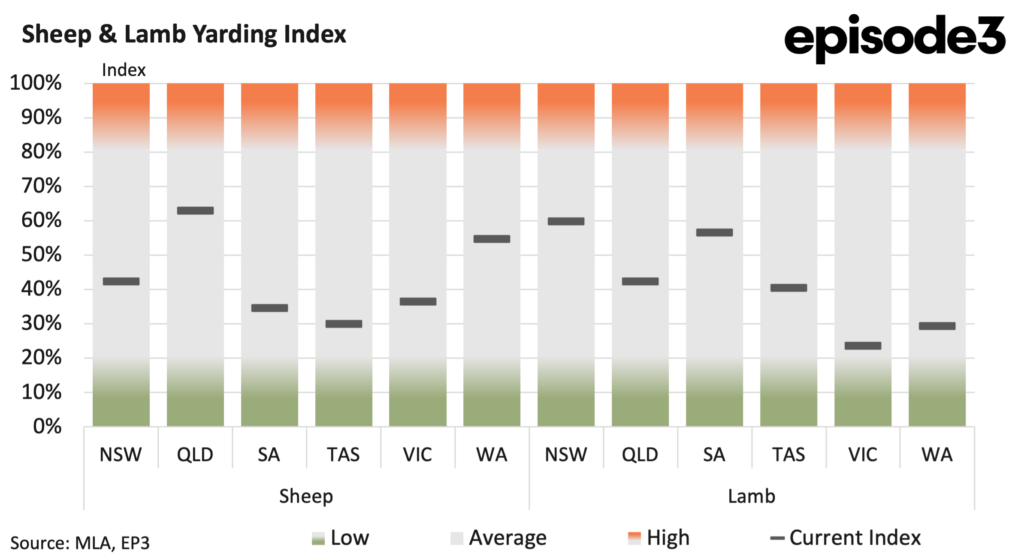
However, the lamb yarding figures provide an even more interesting picture. South Australia recorded a substantial increase from 33pc in September to 57pc in October, while Victoria strengthened from 8pc to 24pc. Western Australian lamb yardings increased from 19pc to 29pc, with Tasmania also recording a sharp improvement from 7pc to 40pc. Queensland was relatively unchanged, moving from 41pc to 42pc. NSW moved in the opposite direction, with its lamb yarding index declining from 79pc to 60pc.
Although NSW remains relatively elevated, the reduction suggests that the earlier concentration of spring lamb supply through NSW saleyards is beginning to ease as other producing regions increase their offerings. The October figures therefore point towards a broader geographical spread of spring livestock availability rather than a uniform increase across every state. Importantly, these indices measure relative saleyard throughput, meaning the state movements cannot simply be combined to calculate national livestock supply. Nevertheless, the expanding southern yardings would ordinarily be expected to place some pressure on livestock prices.
Instead, the latest MLA indicators show a remarkably different response. Trade lamb prices increased by approximately 65c/kg cwt over the past four weeks to 1,181c/kg. Light lamb recorded an even larger increase of approximately 136c/kg to 1,161c/kg, while Merino lamb strengthened by 86c/kg to 1,102c/kg. Heavy lamb prices increased by 100c/kg to 1,161c/kg, with restocker lamb gaining approximately 81c/kg to reach 1,218c/kg. Mutton also strengthened 46c/kg, taking the national indicator to 856c/kg.
The broad-based lamb price improvement suggests competition for suitable livestock remains relatively strong despite greater saleyard availability. Restocker demand is also contributing to the strength, with the restocker indicator remaining above the main processor lamb categories. The export market provides some explanation for why prices have remained resilient. Australian sheepmeat exports reached 36,193 tonnes during September, compared with 31,217 tonnes during July, representing an increase of approximately 16pc. China accounted for 8,616 tonnes during September, while the United States received 5,755 tonnes and other destinations collectively absorbed 21,823 tonnes. These volumes suggest international markets are continuing to provide important outlets for Australian sheepmeat, even with livestock prices remaining historically elevated.
However, stronger export volumes do not necessarily mean processors are receiving higher prices for the meat they sell. Indeed, the latest Sheep Processor Trading Conditions analysis showed export values across the four major destinations easing in July, highlighting the ongoing difficulty processors face in recovering elevated livestock procurement costs. September export volumes also combine lamb and mutton, making it difficult to determine whether international demand is specifically responsible for the stronger lamb price performance. The more likely explanation is that continued export demand, combined with uneven availability of slaughter-ready livestock, is helping support competition despite the emerging spring supply increase. The relatively modest improvement in mutton prices compared with lamb also suggests the demand and supply balance differs between the two categories.
For processors, the situation remains challenging. Additional livestock availability would normally offer some relief from high procurement costs, but the latest price movements indicate that any improvement in supply has yet to translate into cheaper lambs. The October SLYI therefore highlights an unusual spring market. Southern saleyard offerings are increasing, NSW lamb yardings are moderating, and export markets continue absorbing substantial volumes. Yet lamb prices are moving higher rather than lower, though this may be short-lived as the spring flush approaches.