
AI is coming for farming, just not the paddock you’re watching
The Snapshot
- On-farm physical work is among the safest in the economy from generative AI. Manual jobs score less than half the exposure of clerical and office roles.
- The real risk sits in the agribusiness back office. Clerks, bookkeepers, purchasing and logistics staff are the most exposed jobs in the country, and they run the ag supply chain.
- It’s already showing in the data. Since ChatGPT launched, the most-exposed occupations grew by 5.6%, compared with 9.5% for the least-exposed.
- Even safe producers aren’t fully insulated. If AI drives white-collar unemployment overseas, demand for premium exports like wagyu, lamb and superfine wool could be hit first, because luxury goods are the first thing stressed households drop.
- It’s still early, and it could break either way. Today’s AI is the worst it will ever be, and the same technology that threatens your customers’ incomes could just as easily grow them.
The Detail
If you believe the loudest voices in Silicon Valley, we are all doomed. Dario Amodei, the head of the AI company Anthropic, reckons artificial intelligence could wipe out half of all entry-level white-collar jobs and push unemployment to 15 or 20 per cent within five years. It is the sort of prediction that makes for terrifying reading, particularly if you happen to work in an office.
If you are reading this from the cab of a tractor, you could be forgiven for shrugging the whole thing off. Let the desk jockeys worry about the robots. There is no algorithm that can pull a calf or fix a broken fence at 2am. And you would be mostly right. But only mostly, and the part you would be missing is the part that matters most.
A new report from the Department of Employment and Workplace Relations, AI and employment in Australia, is the best look yet at whether any of this doom is showing up in the data. The short answer is that it is not, at least not much and not yet. The overall labour market remains strong, with unemployment sitting at 4.2 per cent, lower than at any point in the decade before COVID. But dig into the detail, and there is a story for agriculture hiding in plain sight, even though agriculture doesn’t merit a mention in the report.
Good news for the farmer.
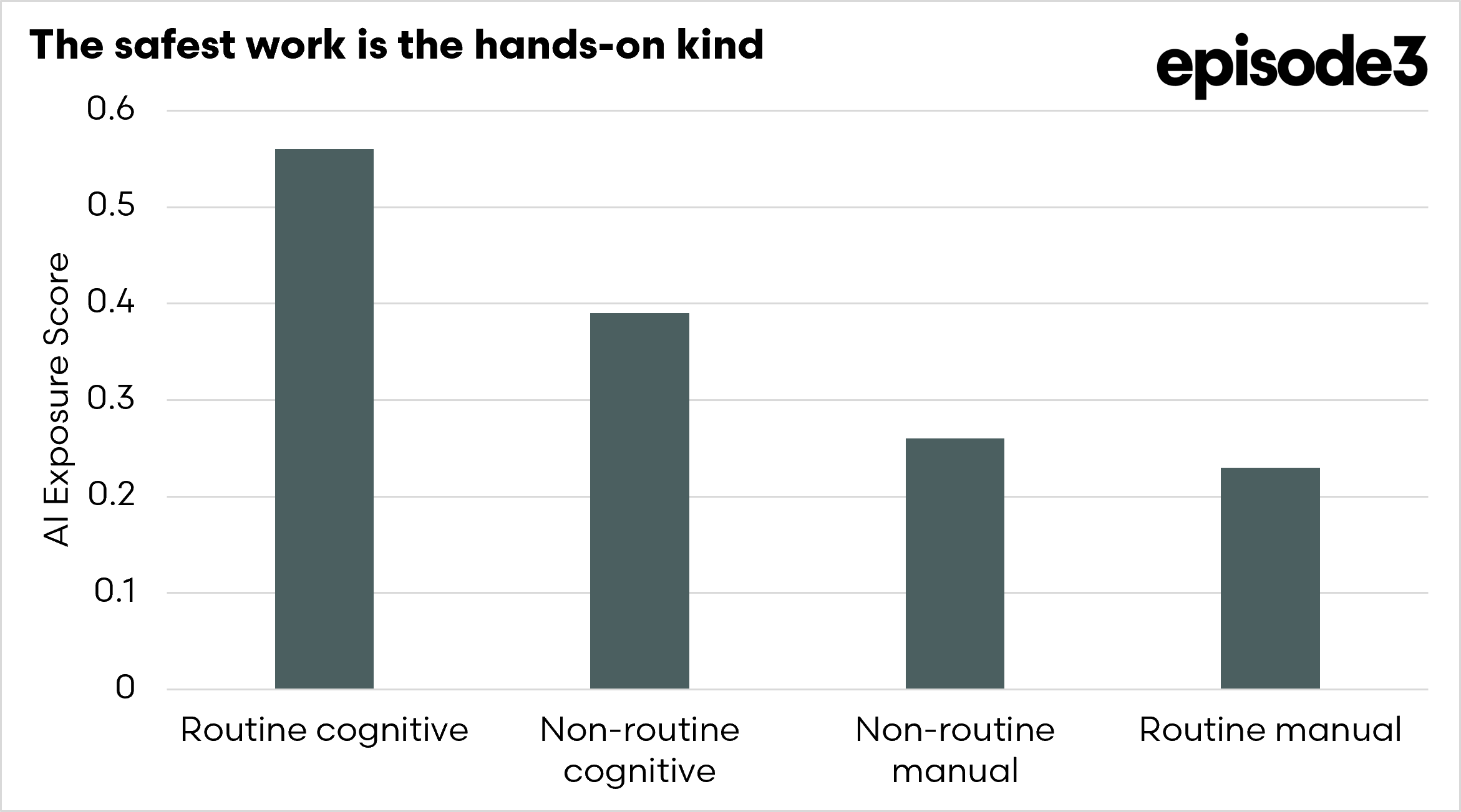
The report scores occupations by how exposed they are to automation from generative AI, the ChatGPT-style tools that everyone is talking about. The pattern is clear.
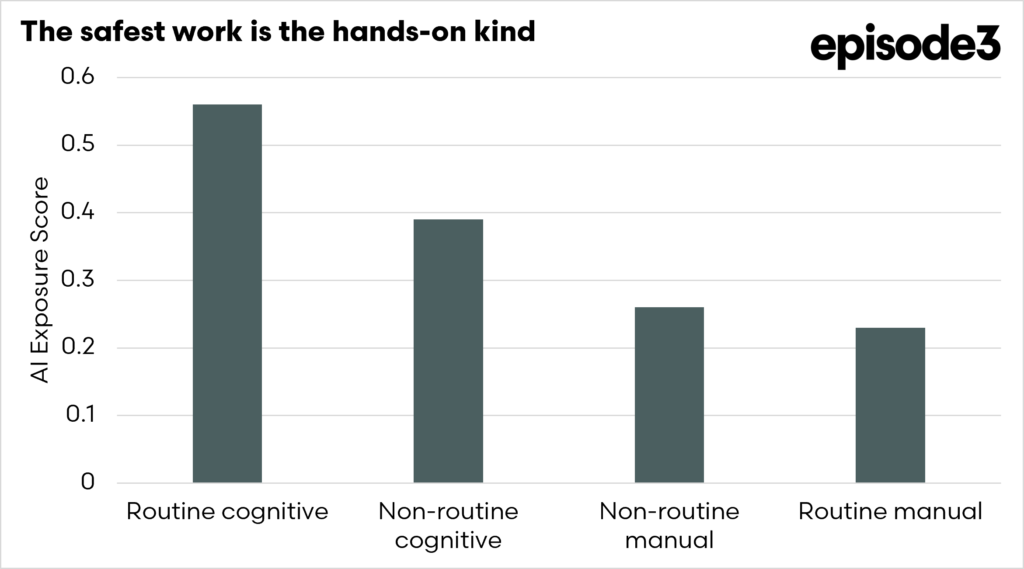
The jobs most at risk are what economists call routine cognitive: clerks, data-entry operators, telemarketers and administrators. This is predictable work, done with words and numbers, that a machine can now do in seconds. Physical work sits at the opposite end of the scale. On the report’s own measure, routine manual jobs carry less than half the exposure of routine cognitive ones. The least-exposed occupations named in the report are the likes of truck drivers, forklift drivers, carpenters and gardeners. This is hands-on, weather-and-mud, judgement-heavy work.
Nobody has yet built a language model that can chase pigs after they have escaped from the eco shelter (I speak from experience). On this measure, on-farm labour is about as insulated as work gets.
In fairness, the report does not actually name farmers or station hands anywhere, so I am reading across the broad categories rather than quoting a score for “farmer” But the direction is not in doubt. If you are worried about a chatbot taking your job as a farmer, you are probably safe.
Bad news for the office worker
Here is where the story turns, and where a good many people in agriculture should be paying closer attention.
Agriculture is not just people on tractors. It is an enormous supply chain, and that chain runs on precisely the kind of work the report flags as most exposed. General clerks. Purchasing and supply logistics clerks. Accounting clerks. Receptionists. Human resource clerks. Contract and program administrators. These are among the most exposed occupations in the country, and they are everywhere in agribusiness: the invoicing desk at the grain handler, the back office at the co-op, the admin team at the machinery dealership, the coordinators booking freight to port.
This is not merely a theory. The report found that since ChatGPT launched, employment in the most-exposed occupations grew by just 5.6 per cent, against 9.5 per cent for the least-exposed. The gap is already sitting there in the data.
The report cannot see the agricultural angle because it only measures occupations across the whole economy. A logistics clerk at a bank and a logistics clerk at a grain export terminal receive the same score, and the report has no idea that one of them helps move your harvest. That is a genuine blind spot, and to its credit, the department admits as much, listing industry and regional breakdowns as work still to be done.
So the disruption story for agriculture was never really on the farm. It is in the companies which service farming. And in many country towns, those white-collar agribusiness roles are among the few professional jobs on offer. When they soften, it lands hardest on the communities least able to absorb it.
Now for the part that should worry even the safe ones
Here is where I would stop the comfortable producer from feeling too comfortable.
Suppose the pessimists are even half right, and unemployment climbs toward 15 or 20 per cent across the wealthy world. That is not simply an office problem. It is a demand problem, and it points squarely at the premium end of Australian agriculture.
Wagyu, prime lamb and superfine wool are luxury goods in the truest economic sense. When incomes rise, people buy more of them. When incomes fall, they are the first things to go. A household under financial stress does not stop eating; it trades down. Wagyu becomes scotch fillet, which becomes mince, which becomes chicken, which becomes a bag of pasta. The merino base layer becomes a synthetic one off the discount rack. The premium is always the first casualty.
And most of our high-value products are not sold here at all. It is sold to affluent consumers in China, Japan, the United States and the Gulf. It is not Australian unemployment that matters most to a wagyu breeder or a superfine grower. It is global white-collar unemployment, in every wealthy market we sell into. The very producers who look safest from AI taking their jobs could turn out to be the most exposed to AI hollowing out their customers.
That is the sting in the tail. You can be entirely insulated from the technology itself and still be flattened by what it does three oceans away.
It is early, and worth remembering
Before anyone either panics or celebrates, one thing is worth holding onto. This is the very beginning.
The AI tools we are reacting to today are the worst versions of this technology we will ever use. We are standing at the start of the curve, not at the end. The report itself hints at this, noting that the negative signal for exposed jobs is clearer in the most recent quarters than it was immediately after ChatGPT arrived. These things tend to arrive slowly, and then all at once.
And it genuinely could break either way. If AI does what its boosters promise and lifts productivity and incomes right across the economy, demand for premium protein and natural fibre could grow rather than shrink. The same technology that might destroy your customers’ incomes could just as easily make them wealthier. Nobody yet knows which way it will fall, and that honest uncertainty is exactly why this is worth watching closely rather than dismissing it.
A revolution is coming to the way we all work. That does not automatically make it a good one, and there is no rule that says the pain and the benefits will be shared out fairly.
The person on the land is standing on some of the safest ground in the economy. But the person keeping their books, and the customer buying their wagyu, may be standing somewhere else entirely.