Black Sea risk rises, but grain markets refuse to panic

The Snapshot
- Black Sea disruption is worsening, with Ukraine cutting its grain export forecast as attacks restrict normal port movements.
- Global wheat prices stay surprisingly subdued, reflecting large crops and confidence that alternative export routes will keep some grain moving.
- Australian crop prospects have improved, particularly through Victoria and South Australia, while northern regions still need more rain.
- Canola was the standout local performer, gaining 2–3pc across most eastern ports alongside stronger European and Canadian oilseed markets.
- Input pressure eased slightly, with Australian urea down 3pc and fuel prices lower, although freight costs are still elevated.
The Detail
Russia and Ukraine are again finding it increasingly difficult to move grain through the Black Sea, but you would struggle to tell that from looking at wheat prices this week.
Ukraine has cut its 2026/27 grain export forecast to 38–40 million tonnes, down from 43 million tonnes previously, after repeated Russian attacks on the Odesa port hub. APK-Inform has made a similar adjustment, reducing its forecast to 39.4Mt, including lower wheat, barley and corn exports.
The problem is increasingly one of logistics rather than production. APK-Inform increased its estimate of Ukraine’s 2026 grain harvest to 60.5Mt. That leaves Ukraine in the unusual position of potentially harvesting more grain while having less capacity to move it to international buyers.
The consequences could become significant if the disruption persists. Ukraine estimates the lack of normal Black Sea exports could create an 11Mt shortfall in grain storage capacity. Kyiv is now looking at moving more grain by rail through Moldova to Romania’s Constanța port, while Russia is preparing subsidies for rail freight to redirect agricultural exports away from constrained routes around the Sea of Azov.
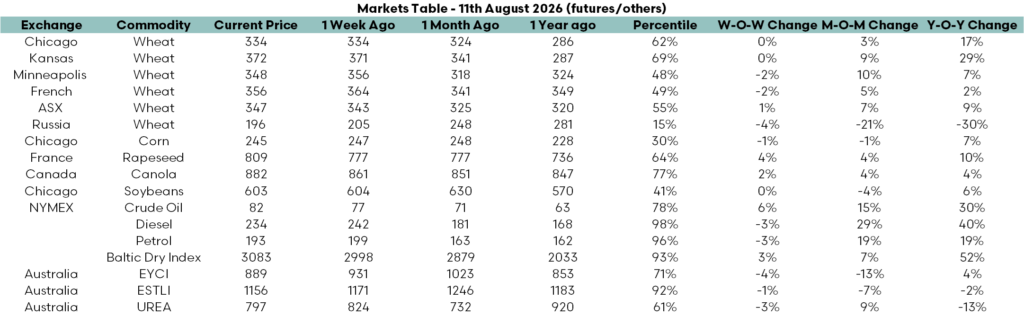
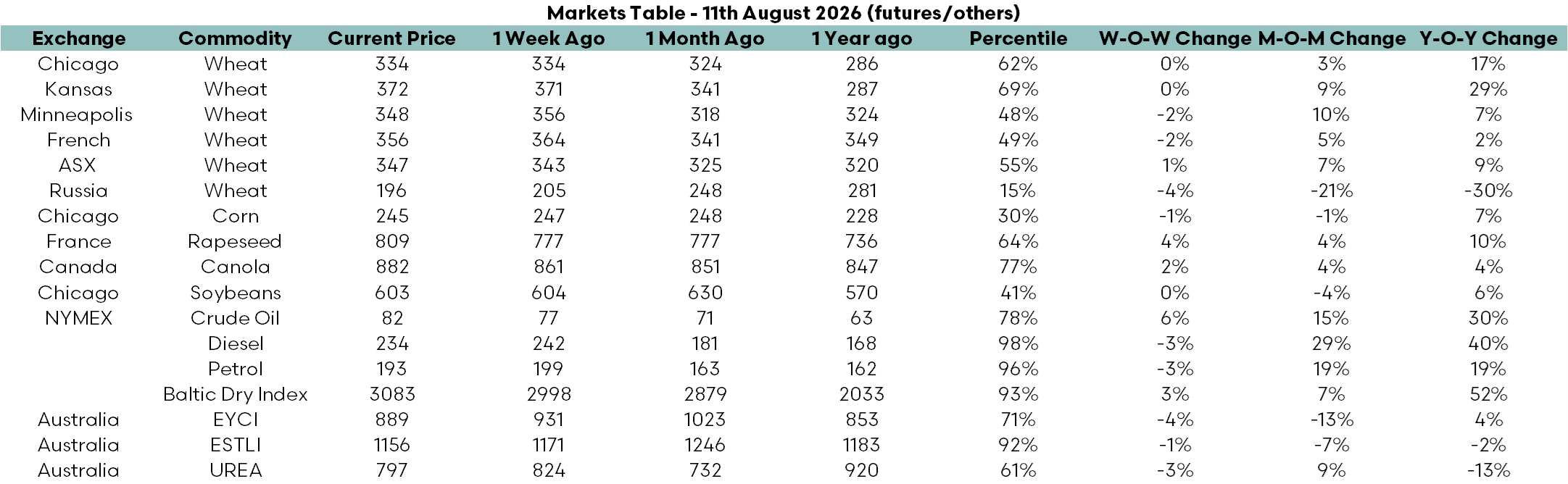
Yet wheat markets are refusing to panic. Chicago wheat was unchanged over the week at the equivalent of A$334/t in our market table, while French wheat fell 2pc and Minneapolis wheat lost 2pc. Russian wheat dropped another 4pc and is now 21pc lower than a month ago.
That tells us something important. Traders are clearly worried about Black Sea logistics, but they are not yet worried enough about global grain availability.
Both Ukraine and Russia are harvesting sizeable crops, and the assumption remains that grain will eventually find alternative routes to market. The Black Sea situation is therefore providing support underneath wheat rather than driving the sort of explosive rally that might occur if trade through the region stopped altogether.
Turkey remains one of the risks worth watching. Concerns briefly increased over the weekend that commercial shipping entering the Black Sea could face restrictions, although Turkish officials subsequently indicated traffic through the straits was continuing normally. Any material restriction there would be a much larger disruption to regional grain trade.
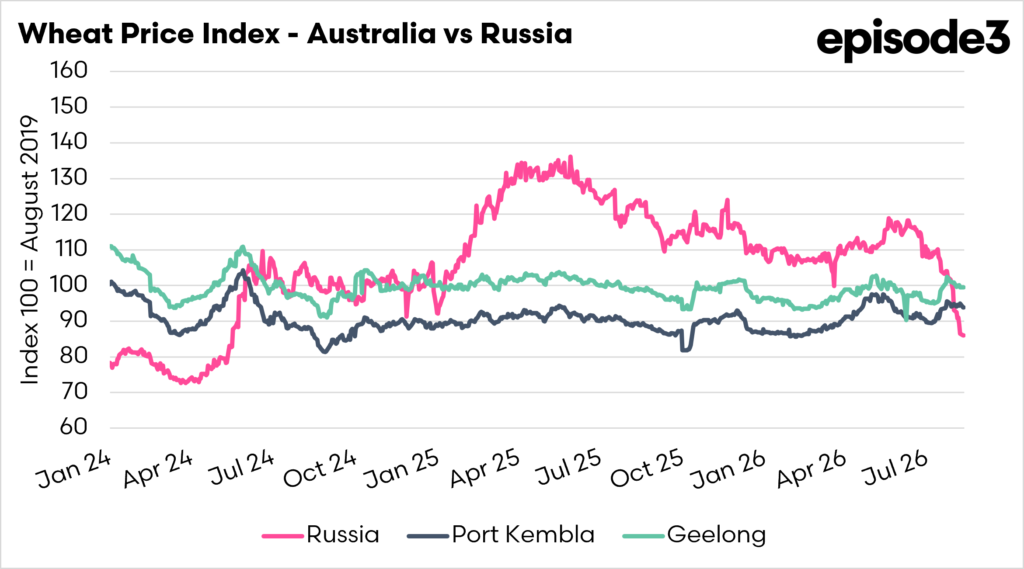
Closer to home, Australian grain markets have also had improving crop prospects to contend with. Recent rainfall has been particularly beneficial across Victoria and South Australia, where crop potential in some districts is exceptionally strong. Central cropping areas have received useful rain but will still need a favourable spring, while northern NSW and southern Queensland remain more dependent on further moisture.
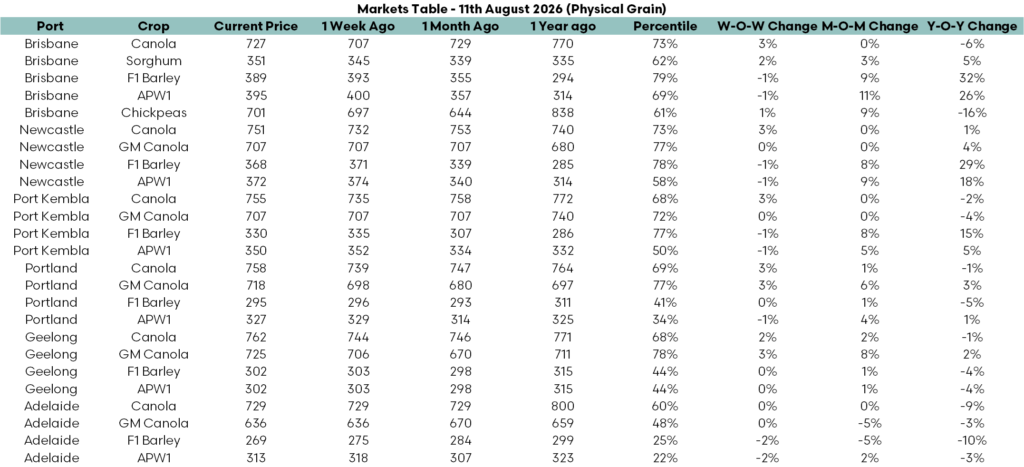
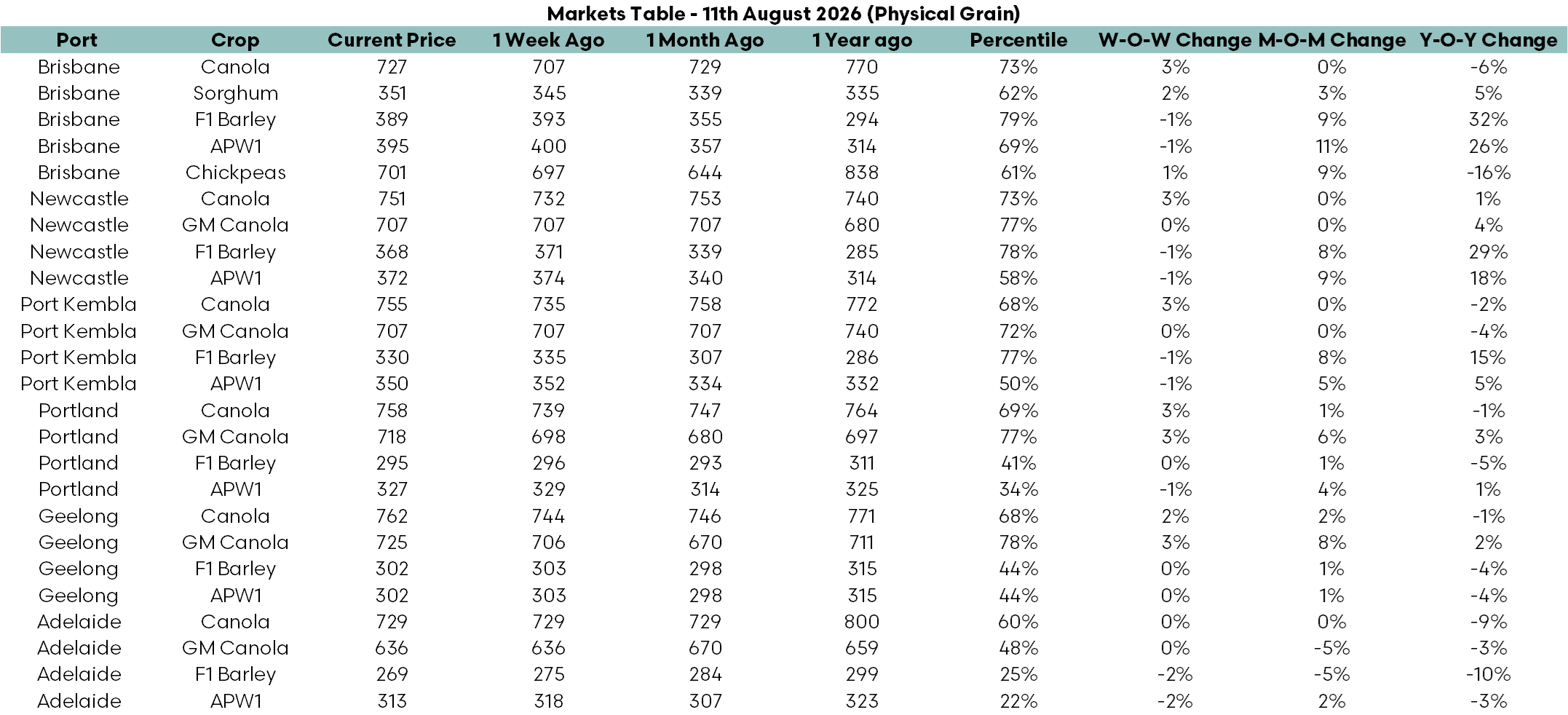
That improved outlook has helped keep wheat and barley values under pressure. Brisbane APW1 slipped 1pc to $395/t, Newcastle eased to $372/t, and Port Kembla fell to $350/t. Adelaide APW1 dropped 2pc to $313/t, while F1 barley there declined to $269/t.
Canola was the notable exception. Brisbane canola gained 3pc to $727/t, Newcastle rose to $751/t, and Port Kembla reached $755/t. Portland gained 3pc to $758/t, and Geelong rose 2pc to $762/t. Offshore markets offered support, with French rapeseed up 4pc and Canadian canola gaining 2pc.
There was also some welcome relief on the input side. Australian urea fell 3pc to $797/t as additional Chinese export availability shifted sentiment in the global nitrogen market. China is expected to release another 2.0–2.5Mt of urea export quotas, while Australia has already imported around 99pc of forecast seasonal requirements. Diesel and petrol both fell 3pc this week, although freight remains expensive, with the Baltic Dry Index gaining another 3pc.
Geopolitical and logistics risks are clearly rising, but large crops are preventing wheat prices from responding aggressively. Locally, improving production prospects are adding further pressure to cereals, while canola is providing the brighter spot on the board.