Calm Grain Markets, Chaotic Energy Markets

The Snapshot
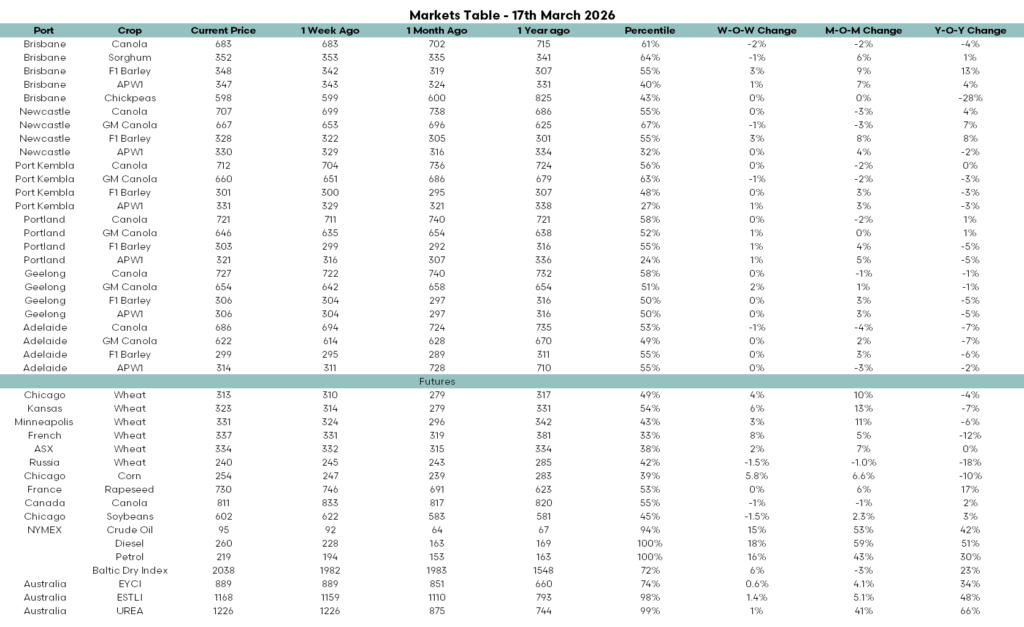
- Australian grain prices remain largely stable, with wheat sitting around the low–mid $300/t range across major ports.
- Barley has firmed slightly, with some markets up around 3% week-on-week and more than 10% higher year-on-year.
- Canola prices have softened, generally trading in the high $600s to low $700s per tonne.
- Global futures markets have been more volatile, with Chicago wheat rising about 10% over the past month.
- Energy markets are the real mover, with crude oil near US$95/bbl and diesel prices surging sharply, lifting production and freight costs.
The Detail
Grain markets across Australia have remained relatively steady in recent weeks, with price movements generally modest across the major export ports. While global markets have experienced bouts of volatility, particularly in oilseeds and energy markets, domestic grain prices have largely held within narrow trading ranges. For many growers and traders, the focus has increasingly shifted toward managing price risk and monitoring global signals rather than reacting to large moves in the physical market.
Across the East Coast ports, wheat prices have shown only limited week-to-week movement. Export values for APW wheat are broadly sitting in the low to mid-$300 per tonne range, depending on location. Newcastle APW1 is currently around $330 per tonne, Port Kembla roughly $331 per tonne, while southern ports such as Geelong and Portland are trading closer to the low $300s. Compared with a month ago, the market is marginally firmer, though the overall structure stays relatively stable. The absence of large price swings suggests a market that is currently well balanced between export demand, domestic consumption and available supply.
Barley markets have shown slightly firmer momentum. Feed barley prices across several ports have lifted modestly in recent weeks, with some markets recording gains of around three per cent week on week and stronger moves on a year-on-year basis. Brisbane F1 barley is trading near $348 per tonne, Newcastle barley around $328, while southern ports such as Portland and Geelong are sitting just above $300 per tonne. Compared with the same period last year, barley prices in some markets are more than ten per cent higher. The firmness reflects steady export demand and continued interest from international feed grain buyers.
Canola markets have softened slightly compared with cereals. Prices across the East Coast are generally sitting between the high $600s and low $700s per tonne, depending on port location. Brisbane canola is currently around $683 per tonne, Newcastle around $707, and Geelong around $727. Week-to-week changes have been relatively small, though prices are modestly lower than levels seen a month earlier. The softer tone reflects weakness in global vegetable oil markets, where movements in soybean futures and related oilseed contracts have placed pressure on the broader complex.
Global futures markets have displayed more volatility than the domestic physical market. Chicago wheat futures have strengthened over the past month, rising roughly ten per cent as traders responded to global supply signals and shifts in speculative positioning. Kansas and Minneapolis wheat markets have recorded similar gains. Corn futures have also moved higher over the same period, while European wheat markets have shown smaller but still notable increases. These movements highlight the sensitivity of global grain markets to macroeconomic developments, currency movements and geopolitical events.
Oilseed markets have been particularly reactive to international developments. Canadian canola futures have eased slightly in recent weeks, while Chicago soybean markets have experienced sharp daily swings amid uncertainty surrounding trade negotiations between the United States and China. European rapeseed prices remain firm on a longer-term basis and are still well above year-ago levels, although short-term movements continue to track fluctuations in the global vegetable oil complex.
The most significant price movements across the broader commodity landscape have occurred in energy markets rather than grains themselves. Crude oil prices have risen sharply and are now trading around US$95 per barrel. This represents an increase of roughly fifteen per cent over the past week and more than fifty per cent compared with a month earlier.
Fuel markets have followed a similar trajectory. Diesel prices have climbed by around 18% week-on-week and are nearly 60% higher than a month ago. Petrol prices have also risen sharply, gaining approximately 16 per cent over the past week and more than 40 per cent over the past month. These increases have occurred alongside heightened geopolitical tension in the Middle East, which has contributed to volatility in oil markets and uncertainty around key shipping routes.
Freight markets have also strengthened. The Baltic Dry Index has moved higher in recent weeks and now sits well above year-ago levels, indicating firmer demand for bulk shipping capacity. Rising freight costs could affect export margins and trade flows if the trend continues.
Overall, the current market environment presents a clear contrast. Australian grain prices themselves remain relatively stable across most ports, with movements generally limited to small weekly adjustments. In contrast, energy markets are experiencing much larger swings. For growers, traders and exporters, this divergence highlights that the most significant pressures in the coming months may come less from grain price volatility and more from the broader cost environment surrounding production and transport.