
Do wheat buyers really pass on the falls faster than the rallies?

The Snapshot
- Large CBOT moves above A$10/t were not passed through faster on the downside across Australia.
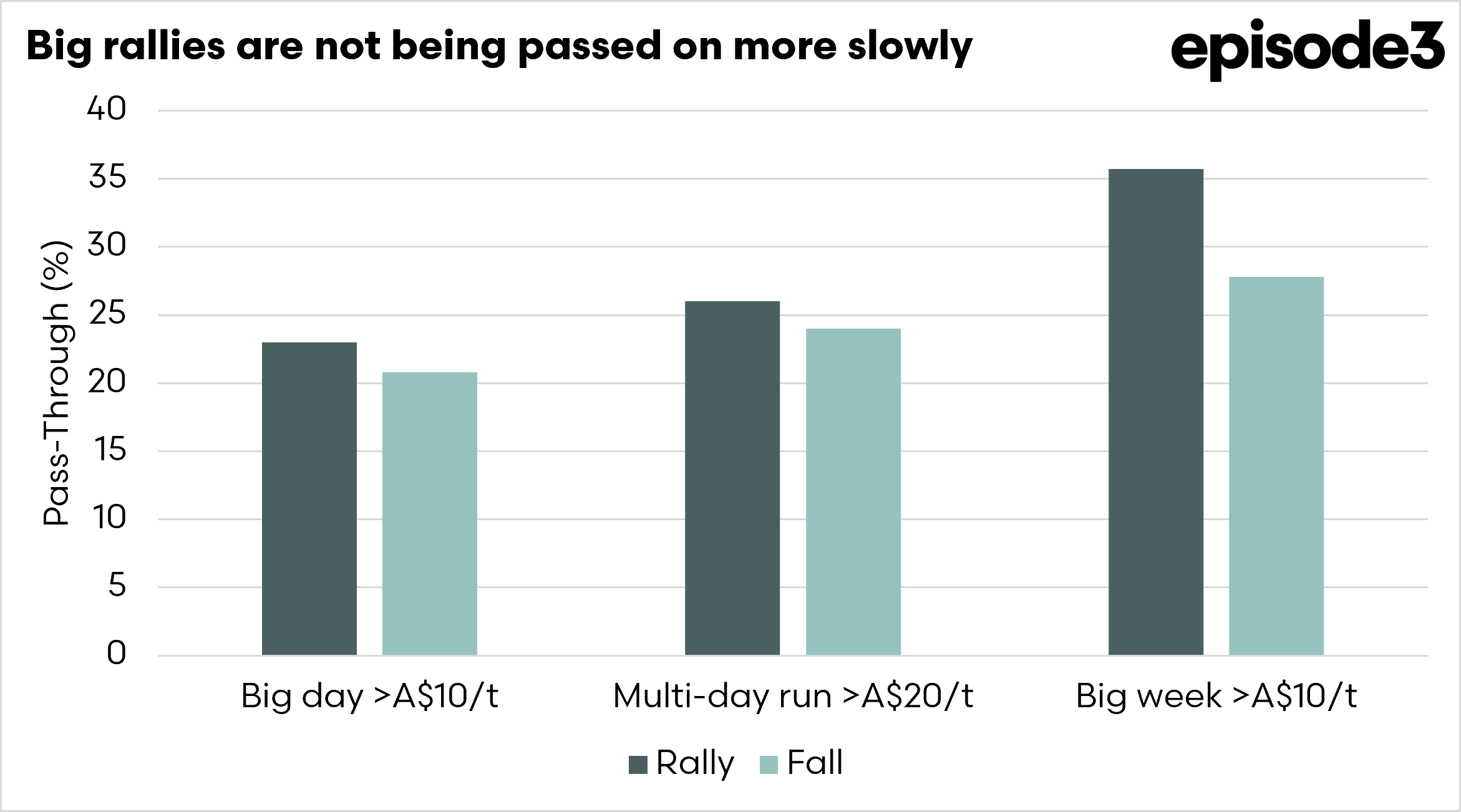
- On the first trading day, ports passed through about 23pc of major rallies versus 21pc of major falls.
- Port Kembla was the clearest exception, with falls generally reflected faster than rallies.
- Strong multi-day runs and big weekly moves also showed no consistent bias against rallies.
- Over nearly 11 years, the data suggests the common grower belief is more perception than broad market reality.
The Detail
A complaint has circulated in grain farming for as long as I have been working. When Chicago rallies, Australian buyers take the day off and don’t pass on the rise. When Chicago falls, though, the price can somehow be adjusted before you have woken up. It is one of those beliefs that feels true because most growers can remember a few very good examples. A strong offshore rally comes through, and the local bid barely moves; then one ugly night in Chicago arrives, and suddenly the trade is very efficient at working out its market moves.
The question is whether that happens often enough to show up in the data. To test it, I went through almost 11 years of wheat prices from September 2015 to August 2026, comparing CBOT wheat futures, converted into Australian dollars per tonne, with physical wheat prices at Adelaide, Port Lincoln, Portland, Geelong, Brisbane, Port Kembla and Kwinana. First, ignore the small stuff. An A$2/t move in Chicago is not really the sort of event growers complain about, so the main test looked at days when CBOT moved by more than A$10/t.
Across the dataset, there were 157 major rallies and 113 major falls, with the average rally worth about A$16.75/t and the average fall about A$16.36/t. Because of the time difference between Australia and the United States, the sensible comparison is between the CBOT move and the Australian cash price on the following trading day. That gives Australian buyers a fair chance to react to what happened offshore and avoids pretending an Australian bid should somehow anticipate a US market move that has not yet occurred.
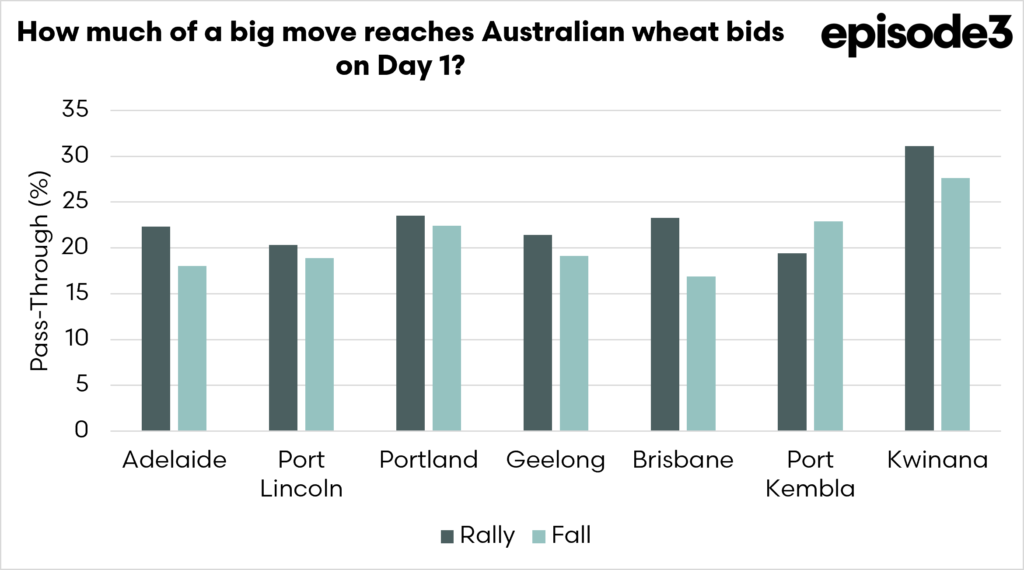
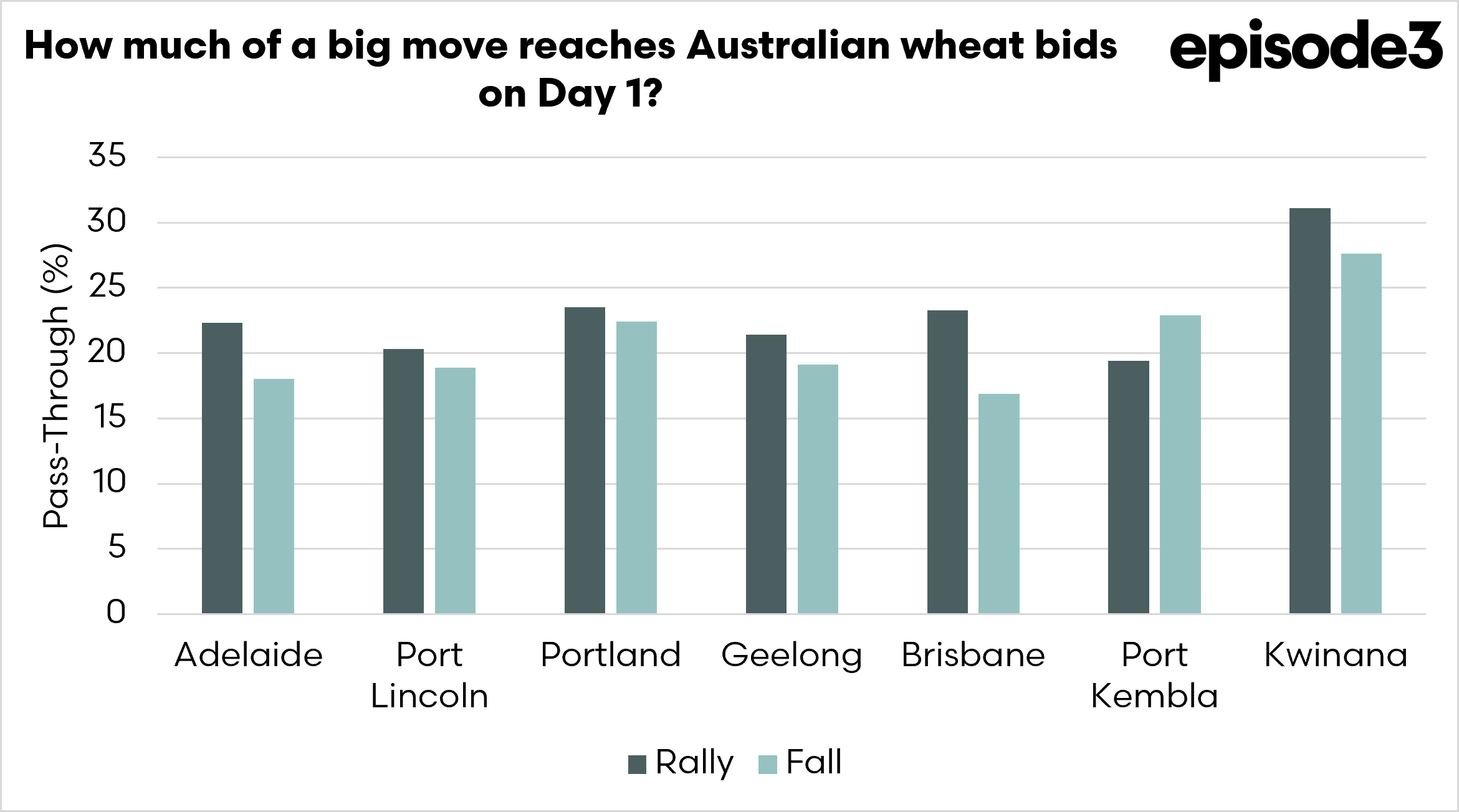
If the usual farmer complaint is right, the result should be obvious. Big falls should be passed through faster and harder than big rallies. At a national level, that was not what happened. Across the seven ports, the average first-day response after a major rally was about 23pc of the CBOT move, while after a major fall it was about 21pc. In dollar terms, a typical A$16 to A$17/t move in Chicago produced an Australian move of roughly A$3 to A$5/t on the first trading day. More importantly, there was no clear national evidence that buyers were systematically quicker to cut prices than raise them.
That does not mean every port behaved the same way, and this is where it gets more interesting. Port Kembla was the clearest market where the grower complaint had some support, with major falls tending to reach 20pc and 25pc pass-through faster than major rallies. Brisbane was closer to the opposite, with rallies tending to come through faster than falls, while Kwinana was the quickest market overall and reacted strongly in both directions. The broader point is that there was no neat Australia-wide pattern where every buyer was apparently asleep on the way up and wide awake on the way down.
Of course, markets do not always move once and then politely stop. Sometimes Chicago gets a head of steam and keeps going for several days. The most recent example in the dataset was a three-day move of about +A$23/t, +A$5/t and +A$14/t. That is really one sustained rally of about A$42/t, not two large days with an inconveniently small day sitting between them. So, I also looked at strong multi-day runs where CBOT moved by more than A$20/t in the same direction.
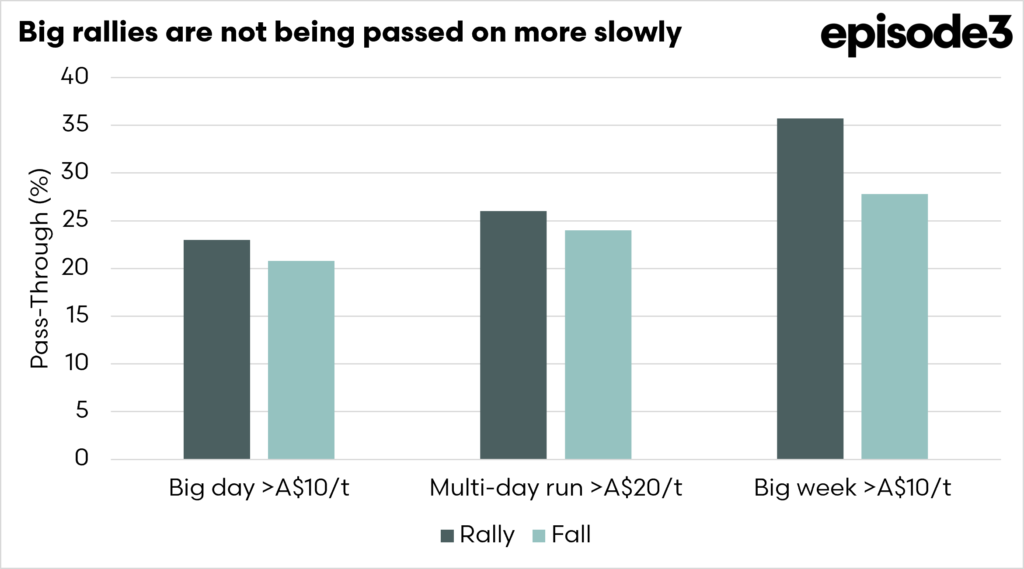
The result was much the same. After strong upward runs, Australian prices passed through slightly more of the international move than they did after strong downward runs, and again there was no convincing evidence that the downside was being treated more aggressively. This matters because sustained runs are probably closer to the way growers experience the market. Nobody standing in a paddock cares whether the move came in one spectacular session or over three consecutive days. What matters is that Chicago has moved A$30, A$40 or A$50/t and the grower wants to know how much of that move has appeared in the local bid.
The weekly numbers tell a similar story. There were 79 weeks where average CBOT prices rose by more than A$10/t and 79 weeks where they fell by more than A$10/t. During the strong rising weeks, Australian ports passed through about 36pc of the move, compared with about 28pc during strong falling weeks. That is an awkward result for the idea that buyers sit on every rally and gleefully hand over every fall, because once the noise of individual days is smoothed out, the upside response is, if anything, stronger.
There is an important point here, though. Australian wheat prices are not supposed to move dollar-for-dollar with CBOT because Chicago is a reference market, not an Australian physical wheat price. Local prices are also driven by Australian supply, export demand, domestic demand, quality, freight, stocks, and competition between buyers. Basis can strengthen or weaken for legitimate reasons while Chicago is moving in the other direction, so the test is not whether an A$20/t move in Chicago should automatically become A$20/t at Kwinana or Geelong.
The question is much simpler: when Chicago makes a serious move, does the Australian market behave differently depending on whether that move is up or down? Across almost 11 years of data, the strongest version of the farmer complaint does not stand up particularly well. Some ports see falls arrive faster, and Port Kembla is the clearest example. Still, when you focus on genuinely large daily moves, strong multi-day runs and major weekly movements, there is no consistent evidence that Australian wheat buyers are faster to pass on the downside than the upside.
In fact, on several of the stronger tests, the upside response was larger. The perception probably survives because price cuts are more memorable. A A$10/t fall that appears quickly tends to stick in the mind, while a A$10/t rally that arrives as A$3 today, A$4 tomorrow and A$3 the day after feels a lot less exciting. That may not be quite as satisfying as blaming the bloke on the other side of the bid screen, but over nearly 11 years of data, the story is a lot less sinister than many growers might expect.