
Wheat market rallies.

The Snapshot
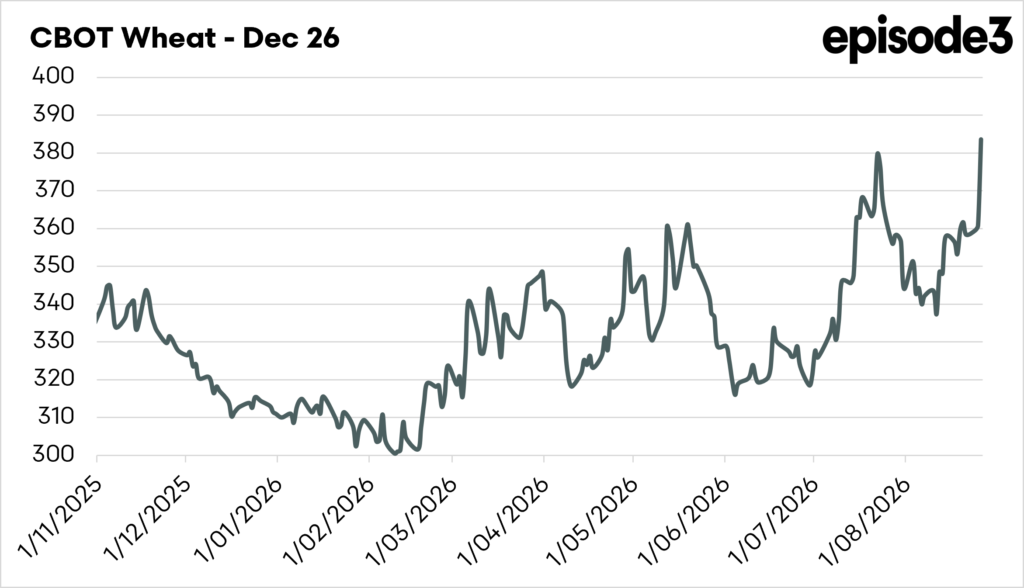
- Wheat jumped about A$23/t overnight as escalating Russia-Ukraine tensions pushed Black Sea export risk back into the market.
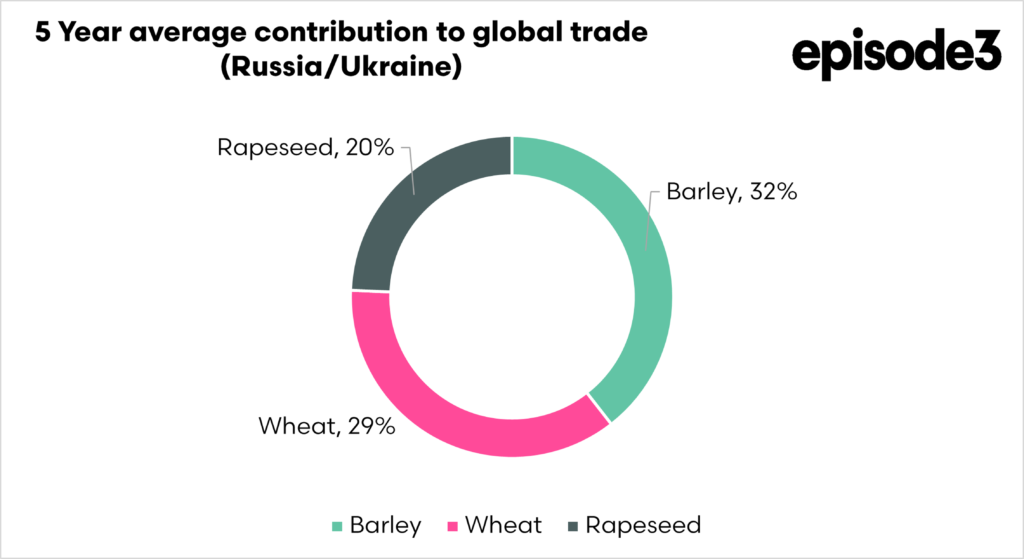
- Russia and Ukraine account for roughly one-third of global exportable wheat and barley, so disruption there can move prices quickly.
- Ukraine’s alternative export routes are under pressure, with congestion on the Danube adding cost and slowing grain movements.
- Growers should avoid getting greedy during fast rallies, because wheat peaks can disappear just as quickly as they arrive.
- Averaging up pricing is the safer approach, selling some grain into strength rather than trying to pick the absolute top.
The Detail
Global wheat futures have just been handed another reminder of how quickly grain markets can move, with the market jumping around A$23/t overnight as traders reacted to the latest escalation in the war between Russia and Ukraine. This is something episode 3 has been flagging for the past two months, that wheat is undervalued and the market was not pricing in the risk. Chicago wheat hit its daily trading limit after reports that Russia was considering stepping up ballistic missile attacks on Kyiv and other critical infrastructure, while grain movements through the Black Sea remain heavily disrupted.
That matters because Russia and Ukraine are not minor players in the world grain trade. Together, they account for roughly one-third of the world’s exportable wheat and barley, so when either country’s ability to move grain becomes uncertain, buyers start thinking about where replacement tonnes might come from and what price they may need to pay.
Ukraine has already been forced to divert more grain through its Danube ports after attacks restricted movements through its major Black Sea terminals. That route is now under pressure as well, with dozens of vessels waiting around the Sulina Canal and only a small number able to move towards Ukrainian ports each day. There is still grain available, but the problem is increasingly about getting it from where it is produced to where it is required.
Markets do not need an actual shortage to rally. They only need enough uncertainty that buyers start worrying a shortage might develop, and that is exactly what we are seeing now. Once that fear enters the market, futures can move quickly because traders are trying to price a risk that is almost impossible to quantify.
The temptation when prices suddenly jump $20 or $30/t is to at once start wondering how much further they might go. Another $20? Another $50? Could we revisit some of the extraordinary prices seen after the original Russian invasion in 2022? Possibly, but there is an equally important question for growers to ask, and that is what happens if the reason for the rally disappears.
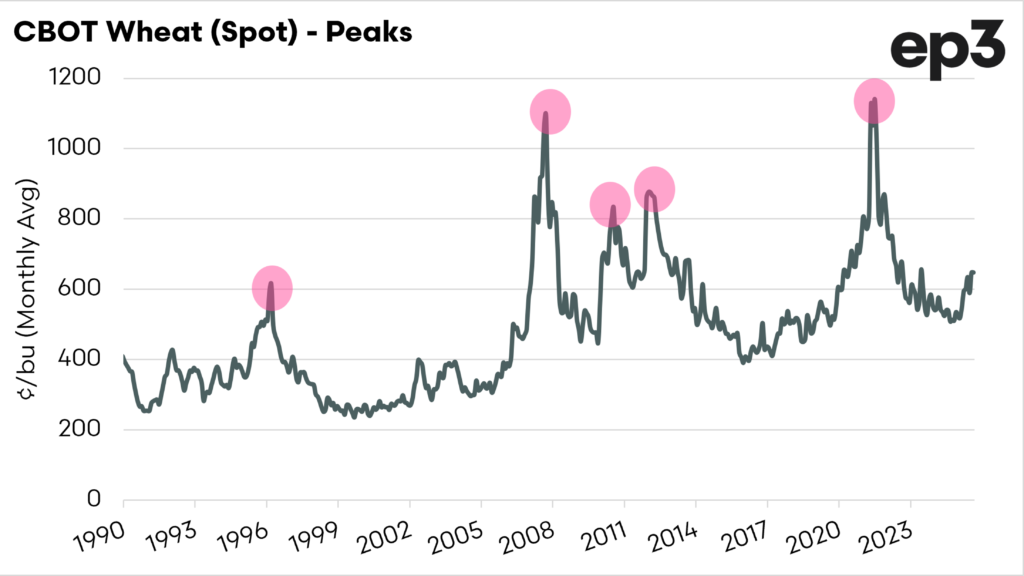
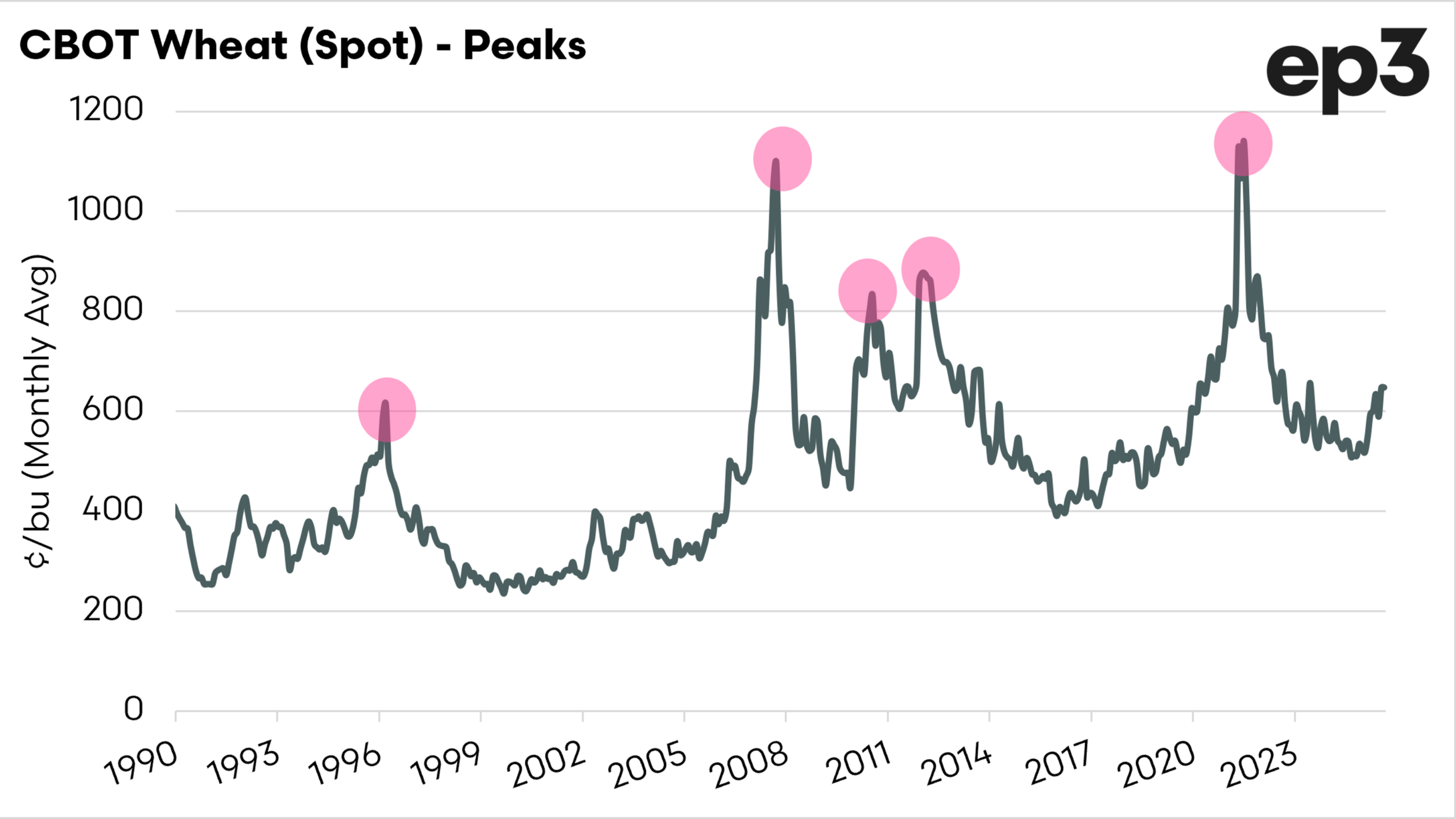
Wheat has a long history of producing spectacular rallies followed by equally spectacular falls. In analyses of major wheat market peaks going back to 1990, the market rose by an average of about 40pc in the year leading into the peak, only to fall around 37pc the following year. Looking six months either side of the peak produced a similar pattern, with an average rise of 24pc beforehand and a decline of 23pc afterwards.
The lesson from those periods was no-one can accurately identify the top. The lesson was that wheat can turn very quickly, and it rarely gives growers much warning when the rally is finished. In 1996, 2008 and 2011, some of the largest monthly falls occurred immediately after the market had peaked, with wheat falling 19pc, 20pc and 12pc respectively in the month following the high.
That is particularly relevant when a rally is being driven by war. If attacks in the Black Sea intensify and exports become even more restricted, wheat could certainly move higher. But if there is an agreement to protect ports and commercial shipping, a ceasefire, or simply evidence that Russian and Ukrainian grain is moving more freely, a sizeable chunk of the risk premium could disappear very quickly.
Nobody knows which comes next, and that is exactly why growers need to avoid becoming greedy when markets suddenly move in their favour. That does not mean rushing out and selling everything because wheat has jumped A$23/t overnight, but it does mean recognising that the market has just presented a better pricing opportunity than it did yesterday.
Good grain marketing is rarely about selling everything at the absolute top. That is mostly luck. It is about recognising when the market has unexpectedly given you something and deciding whether it is worth taking some of it before the opportunity disappears again. If you sell in small portions, you can average through a rally.
War has handed wheat another rally. The important question for growers is not whether this is the top, but whether the price sitting in front of them today is good enough to justify taking some risk off the table.