
Can We Track Fertiliser Ships Before They Hit the Dock?

The Snapshot
- We have built a working proof of concept tool that tracks fertiliser shipments heading to Australian ports before they arrive
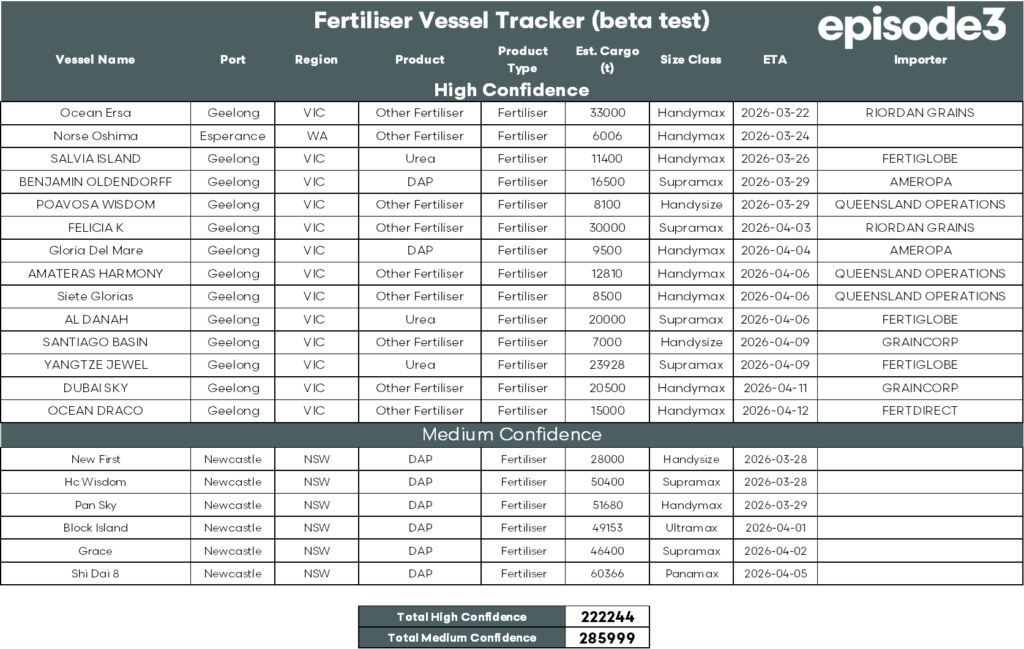
- Early testing has successfully identified confirmed shipments across multiple ports, including vessel names, tonnages, arrival dates and end customers
- The data is sourced independently of the fertiliser industry, giving farmers objective supply intelligence not filtered through commercial interests
- The tool is not comprehensive, in that it doesn’t cover all ports.
- Industry and government funding would allow us to significantly increase accuracy, expand port coverage and deliver this intelligence directly to farmers
The Detail
Here is a question worth asking. When a fertiliser shipment is delayed, prices spike or supply tightens, who finds out first? The honest answer is not the farmer.
Farmers are often the last to know about supply disruptions, relying on information that flows through the same companies selling them the product. That is not a criticism of anyone in particular. It is just how the system works. But it does not have to stay that way.
Over the past several months, we have been quietly building a tool designed to change that dynamic.
What We Built
The tool draws on a combination of publicly available shipping data and commercial data sources to monitor bulk vessels heading to Australian ports. It cross-references multiple signals to assess the likelihood of fertiliser cargo on any given vessel, and can identify confirmed shipments with known tonnages, port destinations, berthing schedules and customer details.
In plain terms, we can see fertiliser coming before it gets here.
In early testing, the tool successfully identified confirmed fertiliser shipments across Newcastle, Geelong, Esperance and other Australian ports. Some of those shipments were confirmed with full details, including tonnage, importer and arrival date.
Critically, this data is compiled entirely independently of the fertiliser industry. It is not sourced from suppliers, importers or distributors. It comes from shipping infrastructure and public port records. That independence matters.
Where We Are
The results so far are better than we expected. We have successfully identified and confirmed fertiliser shipments across multiple Australian ports, complete with vessel names, tonnages, arrival dates and end customers. The tool works in principle but needs refinement.
What we are focused on now is accuracy. There are known limitations in how cargo is declared across the global shipping industry, and we are not going to pretend otherwise. But we know precisely where those gaps are, and we have a clear, structured path to closing them. This is an engineering and resourcing problem, not a conceptual one.
In my view, we are closer to a production-ready tool. The foundation is solid. The method is proven. What we need now is the investment to build it out properly.
What Comes Next
With very small, targeted funding from industry or government, we could move this from a promising proof of concept to a genuinely reliable tool that serves Australian farmers at scale.
The ACM network gives us a ready-made distribution channel to more than 300,000 subscribers across rural and regional Australia, including farmers, agronomists and agricultural businesses. The intelligence exists. The audience exists. The gap between the two is resourcing.
In my view, independent fertiliser supply tracking is exactly the kind of tool that should exist in Australian agriculture. Farmers deserve access to the same forward visibility that traders and importers already have.