
To EV or not to EV, that is the question.
The Snapshot
- Australia’s fuel system is structurally vulnerable, relying on imports, limited reserves and just-in-time shipping, which creates real risk in a disruption scenario
- EVs act as a pressure valve by removing fuel demand, with each vehicle displacing roughly 1,400 litres of fuel per year, and the impact scaling meaningfully as adoption rises
- The benefits are concentrated in cities, where EVs replace petrol use in short-distance, predictable travel that is well suited to current battery range and home charging
- EVs will not solve the full problem, particularly for diesel-heavy sectors like agriculture, freight and mining, where electrification remains difficult in the near term
- Encouraging urban EV uptake frees up fuel for sectors that genuinely depend on it, reducing competition for supply and improving overall fuel system resilience
The Detail
Getting city commuters to switch to electric vehicles would reduce the risk of fuel undersupply in Australia. We look at the numbers.
Australia has a structural fuel supply issue, which we are all experiencing at the present. The country imports most of its refined fuels, holds relatively limited reserves, and relies on a just in time logistics system that depends on ships arriving when expected.
That is where electric vehicles enter the conversation, not as a complete solution, but as a practical pressure valve.
An EV removes fuel demand. Using simple assumptions, a vehicle travelling 15,000 kilometres per year and consuming around 9.5 litres per 100 kilometres displaces roughly 1,400 litres of fuel annually when replaced by an EV. At current ownership levels, that impact is modest. But scale changes everything.
If EV adoption continues to grow, the cumulative effect becomes meaningful at a national level. The table below sets out a series of illustrative scenarios, assuming a fleet of around 20 million vehicles and average usage as outlined above.
At 50 per cent EV ownership, you are removing roughly half of Australia’s current road fuel demand. Not evenly, but meaningfully.
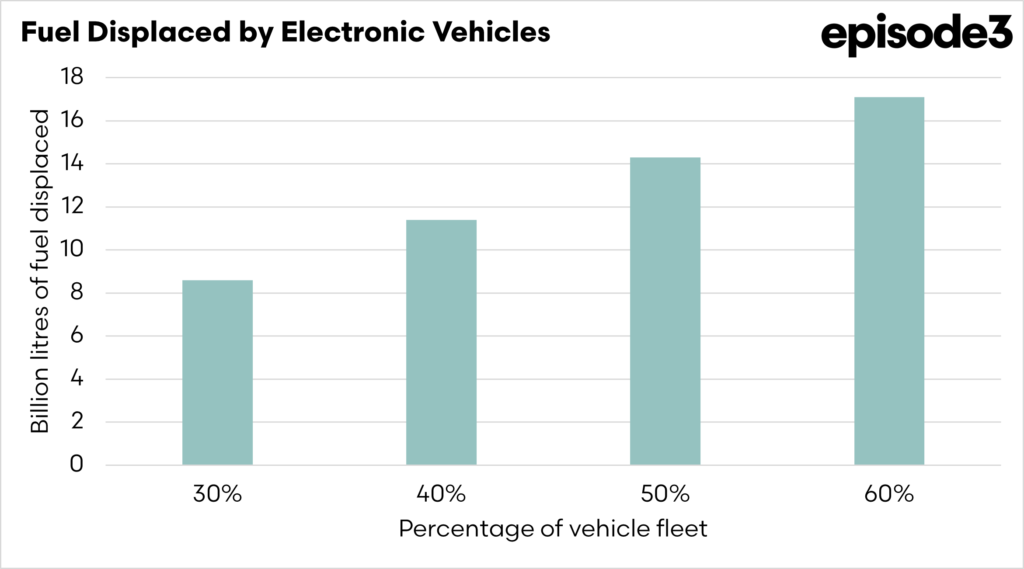
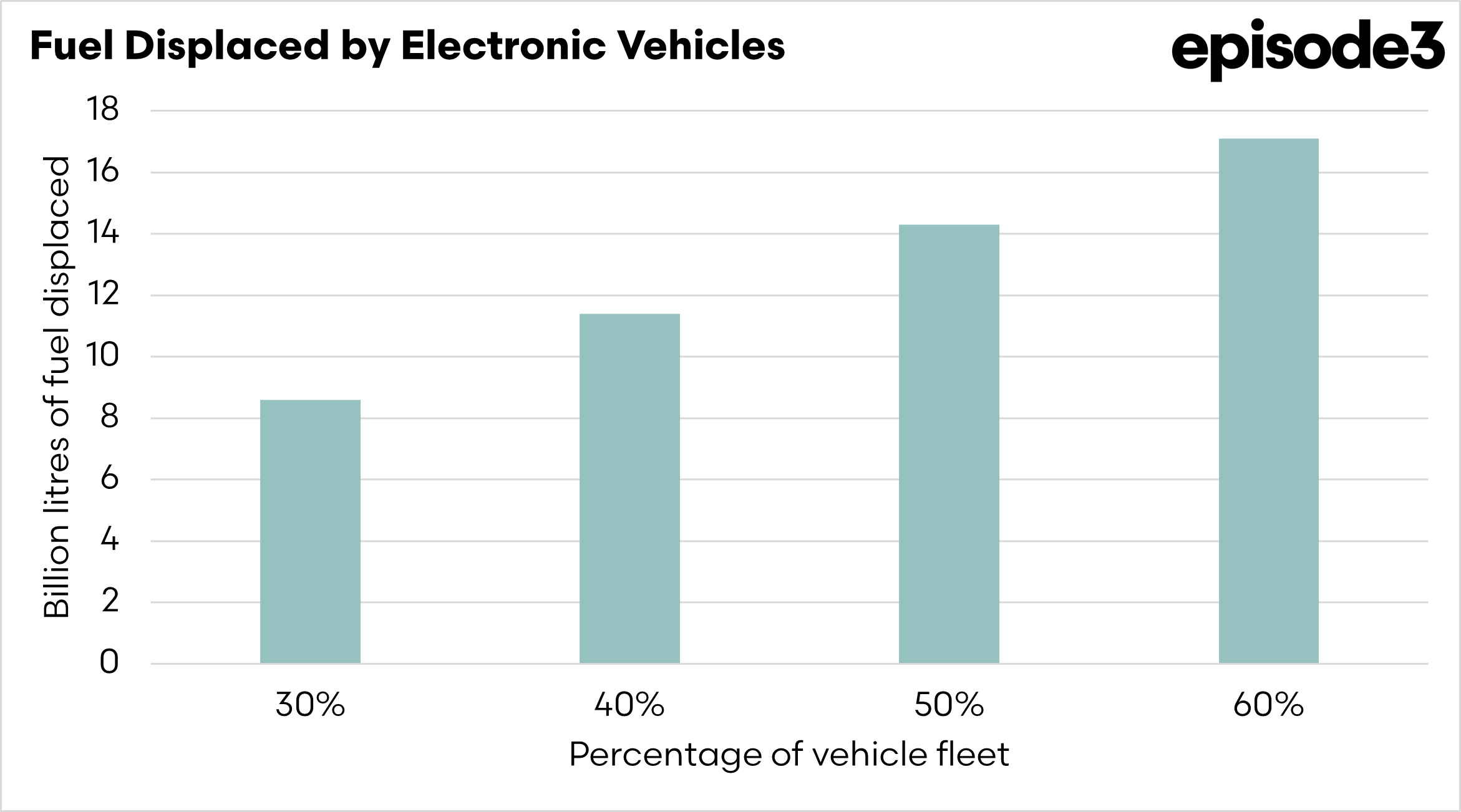
These are large numbers. Australia’s total road fuel consumption sits at roughly 30 billion litres per year. On paper, higher levels of EV adoption could remove a substantial share of that demand.
EVs are not going to replace all fuel use, and won’t solve all of the diesel issue in agriculture. The early impact is heavily skewed toward petrol, as EV adoption is concentrated there. Passenger vehicles in metropolitan areas are the easiest part of the fleet to electrify. They travel shorter, more predictable distances and can be charged at home or at work.
Diesel, by contrast, underpins the sectors that are hardest to electrify. Agriculture, freight, mining and regional transport all rely on diesel for a reason. These are high-intensity operations in which vehicles need to cover long distances, carry heavy loads, and refuel quickly. A ute in the paddock or a truck on a long haul route does not have the same flexibility as a car in the suburbs.
So EVs will not solve Australia’s fuel problem on their own. But they do not need to.
The real value lies in where they reduce demand. When a metro driver switches to an EV, they step out of the liquid fuel market. They no longer draw on petrol supply, and they reduce the overall volume of fuel that needs to be imported, shipped and distributed across the country. That reduction creates space in the system.
In a normal market, that space simply means lower demand. In a constrained market, it means something more important. It means less competition for the available supply. It means a greater ability to prioritise fuel toward the sectors that genuinely depend on it.
Encouraging EV uptake in cities is not about forcing change onto farmers or regional operators who cannot easily adopt the technology. It is about recognising that urban drivers are in a position to switch with relatively little disruption. The average Australian vehicle travels around 30-40 kilometres per day. In cities, that figure is often lower. Modern EVs comfortably cover these distances, and most charging can occur overnight at home.
Range anxiety is often overstated. For most urban users, the daily task is well within the capabilities of current vehicles. The issue is not technical feasibility. It is behavioural.
If those urban users transition to EVs, the benefits extend beyond the individual. Every litre of petrol not consumed in a city is a litre that does not need to be sourced internationally or moved through domestic supply chains. That matters in a country where fuel logistics are a known point of vulnerability.
The framing here is important. EVs are not a one size fits all solution, and they are not a replacement for diesel in critical industries any time soon. But they are a tool. Used in the right place, they reduce demand where substitution is easiest and support supply where substitution is hardest.
Every EV on a city street is one less vehicle drawing from Australia’s fuel reserves. It is one less claim on imports, shipping capacity and storage infrastructure. On its own, that is a small change. Scaled across millions of vehicles, it becomes a meaningful buffer.
EVs will not fix Australia’s fuel security challenges. But they can make those challenges more manageable. And in a system where resilience matters, every bit of demand that can be removed without disrupting productivity is worth taking seriously.