
Global cattle pricing update October 2026

Global cattle price update - October 2026
Australian cattle prices continued to strengthen through October, with local heavy steer values recording the strongest monthly gain among the four major beef producing nations tracked by EP3.
The latest global cattle price comparison shows Australian heavy steer prices lifting 5pc to 471Ac/kg live weight, extending the recovery seen through September. US cattle prices also strengthened, gaining 2pc to 701Ac/kg lwt, while Brazilian prices increased 2pc to 351Ac/kg lwt. Argentina was the only market to move lower, easing 1pc to 446Ac/kg lwt.
The result has improved Australia’s relative position against the US, while pushing local cattle prices further above Argentina and Brazil. Australian heavy steer prices are now trading at a 33pc discount to the US, a 6pc premium to Argentina and a 34pc premium to Brazil. The US remains the most expensive cattle market in the comparison, despite the substantial correction seen since prices peaked above 800Ac/kg lwt earlier in 2026. At 701Ac/kg lwt, US prices are still significantly higher than those of its major export competitors.
The underlying issue remains tight cattle supplies following several years of drought-driven herd liquidation. While prices have retreated from their earlier highs, the US cattle herd has not recovered sufficiently to remove the supply pressure supporting domestic values. For Australian beef exporters, this continues to provide a useful competitive advantage. Even with Australian heavy steer prices strengthening, the substantial discount to US cattle values helps Australian product remain competitive in shared export markets.
This is particularly important in Japan and South Korea, where Australian and US beef compete directly. The South Korean market is especially interesting given the safeguard tariff on Australian beef, which increased from 5pc to 24pc after the quota was triggered earlier in the year. That additional tariff increases the landed cost of Australian product, but high US cattle prices continue to provide some protection against a significant loss of competitiveness.
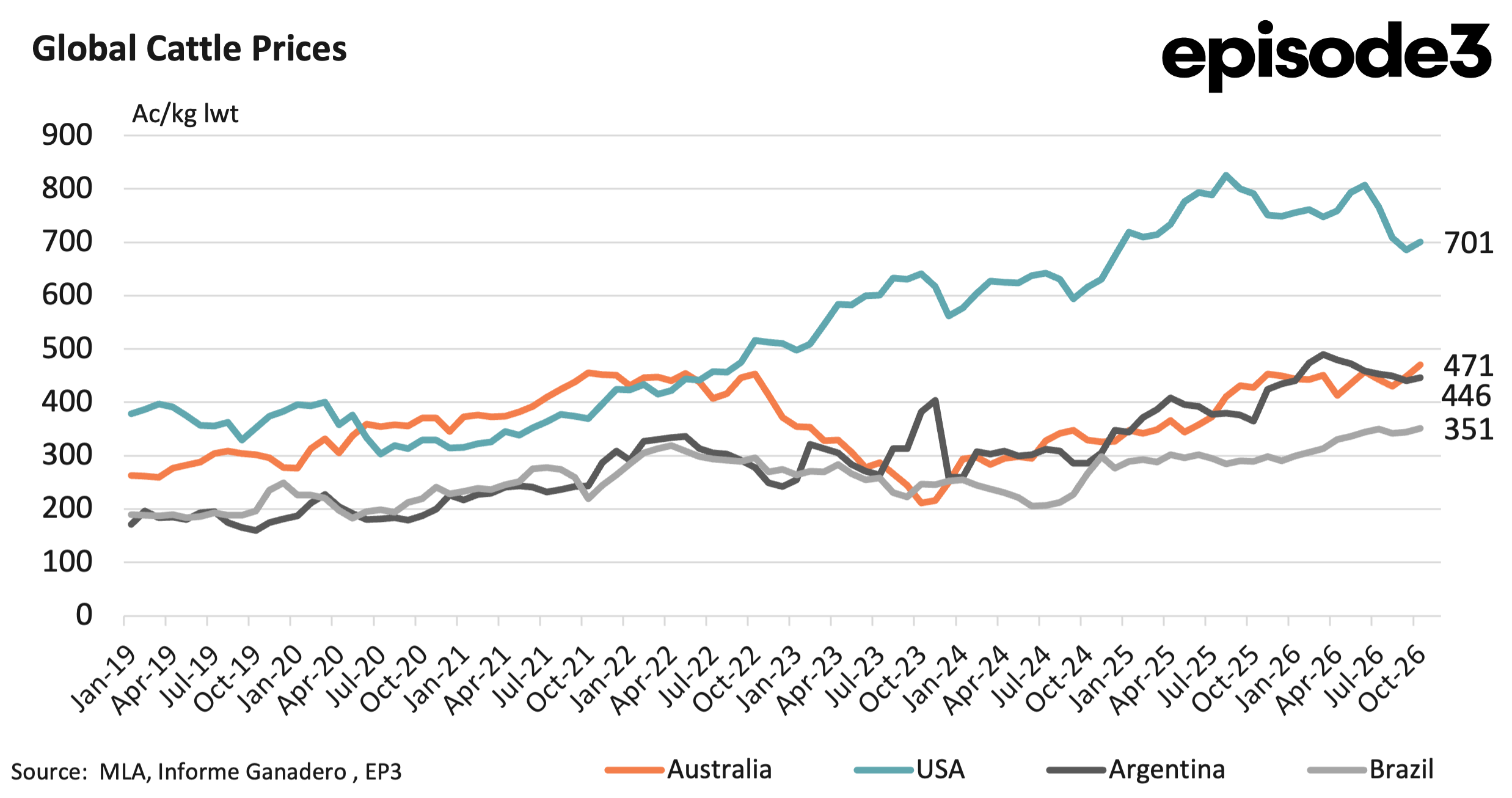
Argentina presents a different story. At 446Ac/kg lwt, Argentine heavy steer prices have slipped below Australian levels, with the Australian premium widening to 6pc. Earlier in 2026, Argentine cattle were trading above Australia, but the recent strengthening in local prices has reversed that relationship. The shift is worth watching, particularly given Argentina’s ability to compete in international beef markets, particularly into China, when currency and export policy settings are favourable.
Brazil remains the lowest-priced market in the comparison. Brazilian heavy steer prices increased 2pc through October to 351Ac/kg lwt, continuing the gradual strengthening evident over recent months. Despite that lift, Australian cattle remain 34pc more expensive than Brazilian cattle. That is a substantial premium and highlights the competitive challenge Australia faces in price-sensitive markets. Brazil’s large cattle herd, lower production costs and significant export capacity provide it with advantages when competing primarily on price. For Australia, this is particularly relevant in China, where Brazilian beef continues to represent a major competitive threat.
The October results highlight Australia’s improving cattle market, but also the competing pressures facing exporters. Higher livestock prices are positive for Australian producers, although they also increase procurement costs for processors. Australia retains a substantial price advantage against the US, but its premium over South American competitors has widened. The question is whether strong international demand can continue supporting Australian cattle prices without undermining export competitiveness. For now, Australia remains positioned between the high-priced US market and the cheaper South American suppliers. October has delivered another positive month for Australian producers, but the narrowing discount to the US and widening premium to Brazil will be important trends to monitor through the remainder of 2026.