
Goatmeat export update January 2026
January 2026 - Goat Meat Export Update
Australia’s goat meat export performance in January 2026 reflects a market undergoing a marked reshuffle in destination mix, with total volumes softer year on year but still sitting comfortably above longer term seasonal norms.
Total exports for the month reached 3,440 tonnes. This represented a 15 percent decline compared with January last year, signalling a moderation in supply or demand relative to the elevated flows seen in early 2025. However, when measured against the January five year average, exports were 76 percent higher, underlining the structural expansion that has taken place in Australia’s goat meat sector over recent years. In other words, while the month to month comparison points to contraction, the broader historical lens shows the industry operating at a significantly higher base than was typical through much of the previous cycle.
The United States remained the dominant single destination in January, taking 1,249 tonnes of Australian goatmeat. Shipments to the US were 18 percent lower than January last year, indicating some cooling in demand. Even so, exports to the US were 25 percent above the five year January average, reinforcing the country’s position as a cornerstone market for Australian goat meat. The US continues to provide strong underlying demand, particularly from ethnic and specialty segments, and remains central to the sector’s export profile despite the softer year on year comparison.
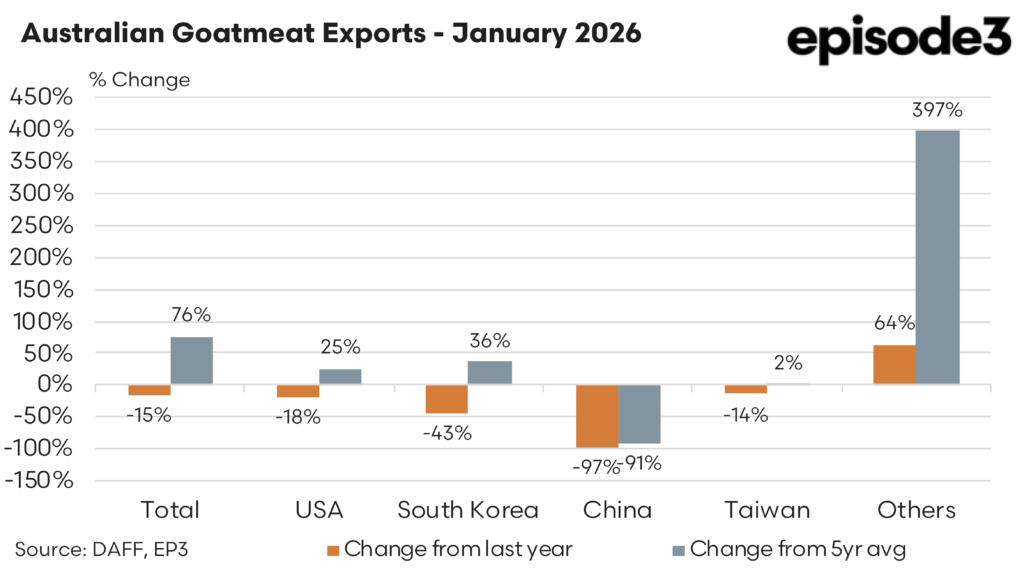
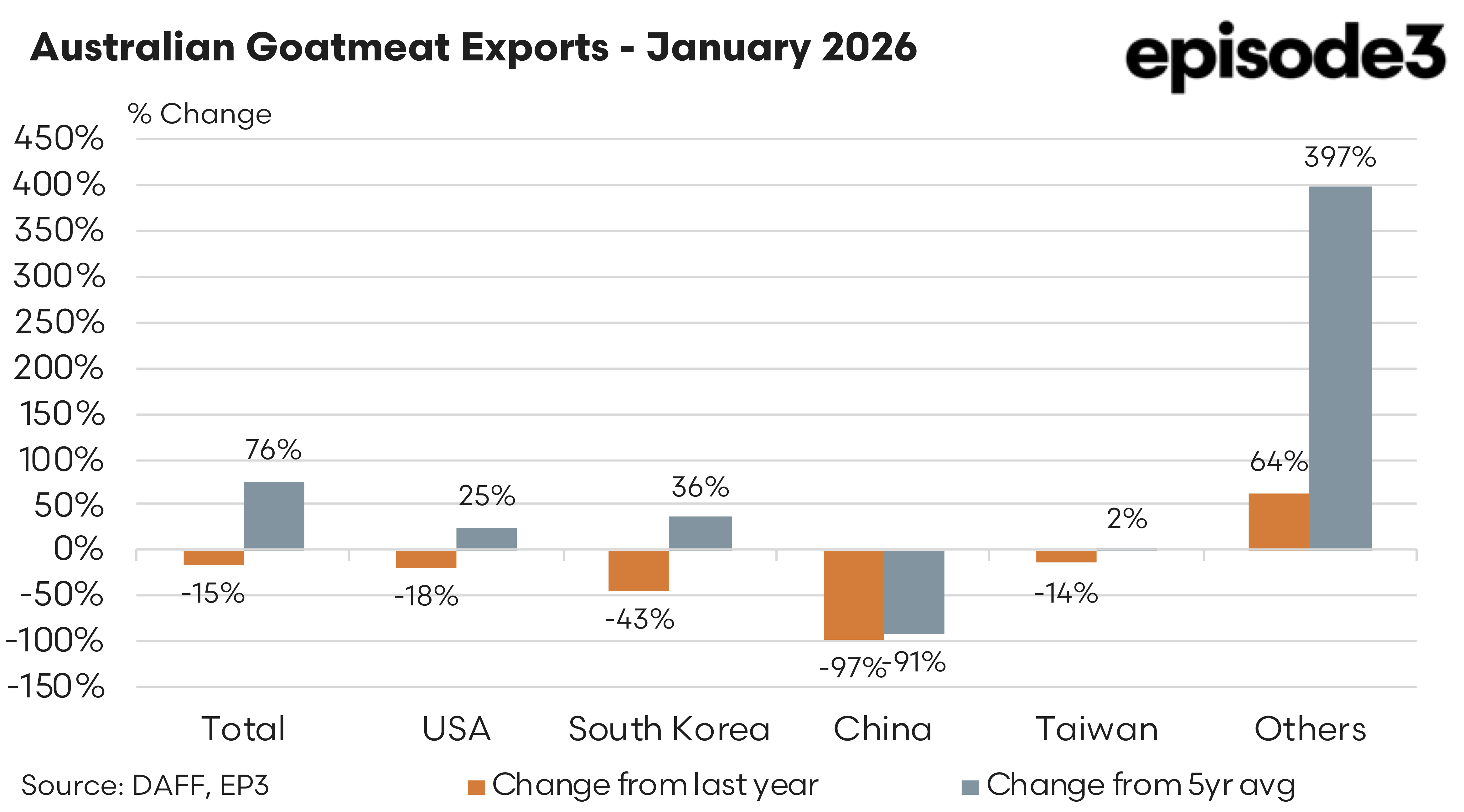
South Korea accounted for 351 tonnes in January. Volumes to Korea were down 43 percent compared with January 2025, highlighting a significant pullback on a year earlier. However, shipments were still 36 percent above the five year average for the month, suggesting that while flows have moderated, they remain elevated relative to longer term trade patterns. Korea has emerged as a more consistent secondary market in recent years, and although January’s year on year result was weaker, the broader structural trend remains positive.
China presented the most dramatic shift in the January data. Exports totalled just 21 tonnes, effectively a collapse in trade compared with last year, with volumes down 97 percent year on year and 91 percent below the five year January average. This near absence of shipments underscores the volatility that can characterise smaller or opportunistic markets in the goat meat trade.
Taiwan received 118 tonnes in January. Volumes were 14 percent lower than January last year but marginally above the five year average, up 2 percent. This suggests relative stability in trade to Taiwan, with modest year on year softening but overall alignment with historical seasonal levels.
Exports to all other destinations combined totalled 1,702 tonnes in January. While these markets collectively were 64 percent higher than January last year and an extraordinary 397 percent above the five year average, they now account for the largest share of total shipments. This sharp rise points to significant diversification across a broad range of smaller markets, helping to offset the collapse in trade to China and cushioning the impact of softer flows into the US and Korea.
The January 2026 goat meat exports show a sector that is adjusting in composition rather than contracting structurally. Total volumes were lower than a year earlier but remain well above historical averages, and the distribution of trade has shifted decisively toward a wider group of secondary destinations. The volatility evident in markets such as China highlights the importance of diversification, while the continued strength relative to the five year average suggests that Australia’s goat meat export industry remains on a higher long term trajectory despite short term fluctuations.