How exposed is the Australian sheepmeat trade to the conflict in Iran?

The escalating tensions across the Middle East and North Africa (MENA) have placed renewed focus on Australia’s exposure to the region through the sheepmeat trade.
With Iranian missile and drone attacks disrupting airspace and creating uncertainty for air freight and shipping routes into parts of the region, exporters are now watching closely to see how long these disruptions might persist and what they could mean for trade flows.
The MENA region is one of the most important destinations for Australian sheepmeat.
Based on average trade values since 2024, the region accounts for roughly $4.3 billion in annual exports, representing about 23 percent of Australia’s total sheepmeat export value.
That makes it one of the largest regional markets for Australian lamb and mutton, sitting alongside China and the United States as a major pillar of demand.
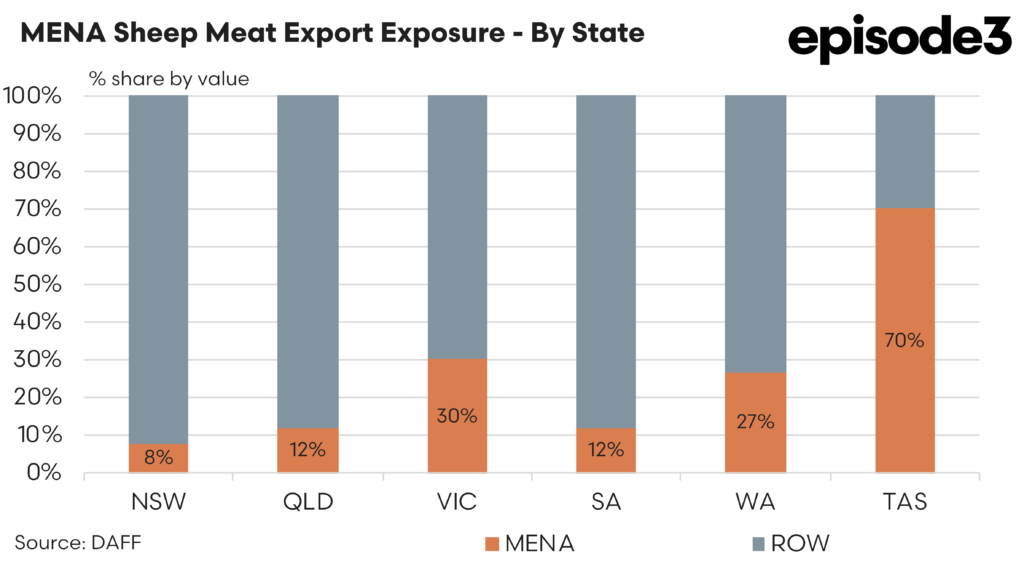
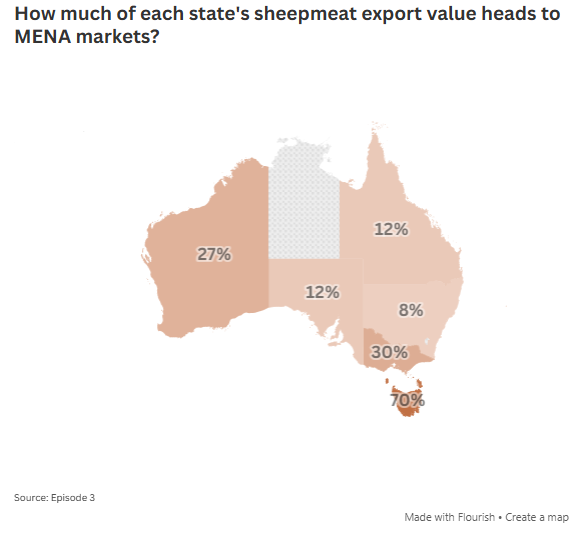
While the national exposure is significant, the reliance on the MENA region varies markedly by state.
The data shows that some states have far greater exposure to the region than others, meaning any disruption to trade flows will not be felt evenly across the country.
Tasmania stands out as the most exposed state, with around 70pc of its sheepmeat export value heading to MENA markets.
That level of reliance means any sustained disruption to shipping or logistics into the region would have a disproportionate impact on Tasmanian processors and exporters.
If access to the region became constrained for an extended period, Tasmanian product would need to find alternative markets quickly.
Victoria also shows a relatively high level of exposure, with around 30pc of sheepmeat export value flowing into the MENA region.
As one of the largest sheepmeat processing states in Australia, Victoria has built strong and longstanding trade links into Middle Eastern markets.
Those markets are particularly important for a wide range of lamb and mutton cuts that may not have the same level of demand elsewhere.
Western Australia follows with about 27pc exposure, reflecting its geographic proximity and established supply chains into the Middle East.
Western Australian exporters have historically maintained strong trade relationships across the Gulf region and North Africa, making it a key destination for product originating from the state. The exposure is lower but still notable in several other states.
Queensland and South Australia each send roughly 12 per cent of their sheepmeat export value into the region, while New South Wales has the lowest exposure at around 8 per cent.
For these states the Middle East remains an important market but represents a smaller share of overall trade compared with Asia and North America.
At this stage the key variable is not demand but logistics.
The Middle East remains a large and structurally important consumer of sheepmeat and there is little indication that underlying demand has weakened.
The issue instead revolves around whether exporters can move product reliably into the region while security risks to shipping and aviation remain elevated. Many market participants, including me, expect the disruption to be relatively short lived.
Iran’s capacity to sustain missile and drone attacks that materially affect regional transport corridors may prove limited and the prevailing view in some quarters is that the situation could stabilise within a matter of weeks.
History however offers a useful reminder that conflicts do not always resolve as quickly as initially expected.
When Russia invaded Ukraine in early 2022 there was a widely held assumption that the conflict would be brief. Instead the war has continued for years and reshaped global commodity markets in the process.
For the Australian sheepmeat industry the hope is that the current tensions in the Middle East prove temporary and that shipping and air access return to normal conditions relatively quickly.
If the disruption is brief the trade impact will likely be manageable.
If the situation drags on for longer however exporters may be forced to redirect product into alternative markets which could place downward pressure on prices and alter trade flows across the global sheepmeat market.