
Goatmeat export update March 2026
March 2026 - Goat Meat Export Update
Australia’s goat meat export performance in March 2026 points to a market that continues to operate at an elevated structural level, despite ongoing volatility in individual destination flows.
Total exports for the month reached 4,408 tonnes, representing a 13 percent decline compared with March last year. While this year on year contraction suggests some softening in demand or supply availability, the broader context remains firmly positive. March volumes were still 41pc above the five year average, reinforcing the notion that the goat meat sector has expanded significantly over recent years and is now trading at a higher baseline than in previous cycles.
The United States further cemented its position as the dominant destination for Australian goat meat in March. Shipments totalled 2,179 tonnes, accounting for close to half of total export volume. While exports to the US were down 10pc compared with March last year, they remained 37pc above the five year average. This highlights the structural importance of the US market, which continues to underpin the export program through consistent demand, particularly across ethnic and food service segments. Even with some moderation at the margin, the US remains the central pillar of Australia’s goat meat trade.
South Korea recorded 295 tonnes of imports in March, continuing a pattern of volatility across secondary markets. Export volumes were 44pc lower than a year earlier and 26pc below the five year average, indicating a more pronounced period of weakness compared with previous months. This result suggests that Korean demand has softened materially, with the market currently playing a less significant role in absorbing Australian goat meat supply than it has at times in recent years.
China remained a marginal participant in the goat meat export program during March. Shipments totalled just 265 tonnes, down 67pc compared with the same month last year and 30pc below the five year average. While this represents a modest increase on the near negligible volumes seen earlier in the year, China continues to operate well below historical participation levels. The ongoing weakness in this market underscores its opportunistic nature within the goat meat trade and highlights the limited reliance Australian exporters can place on Chinese demand in the current environment.
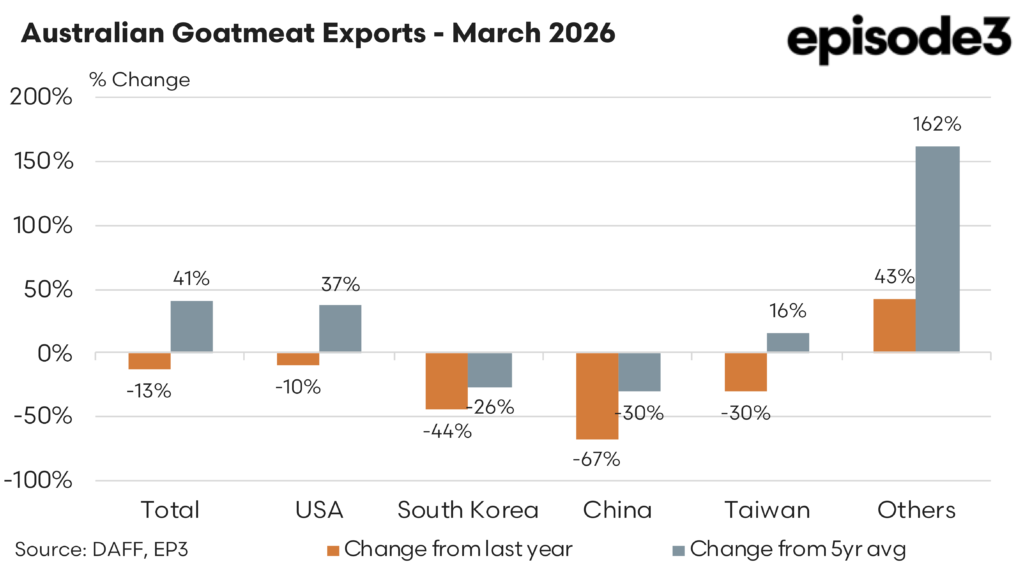
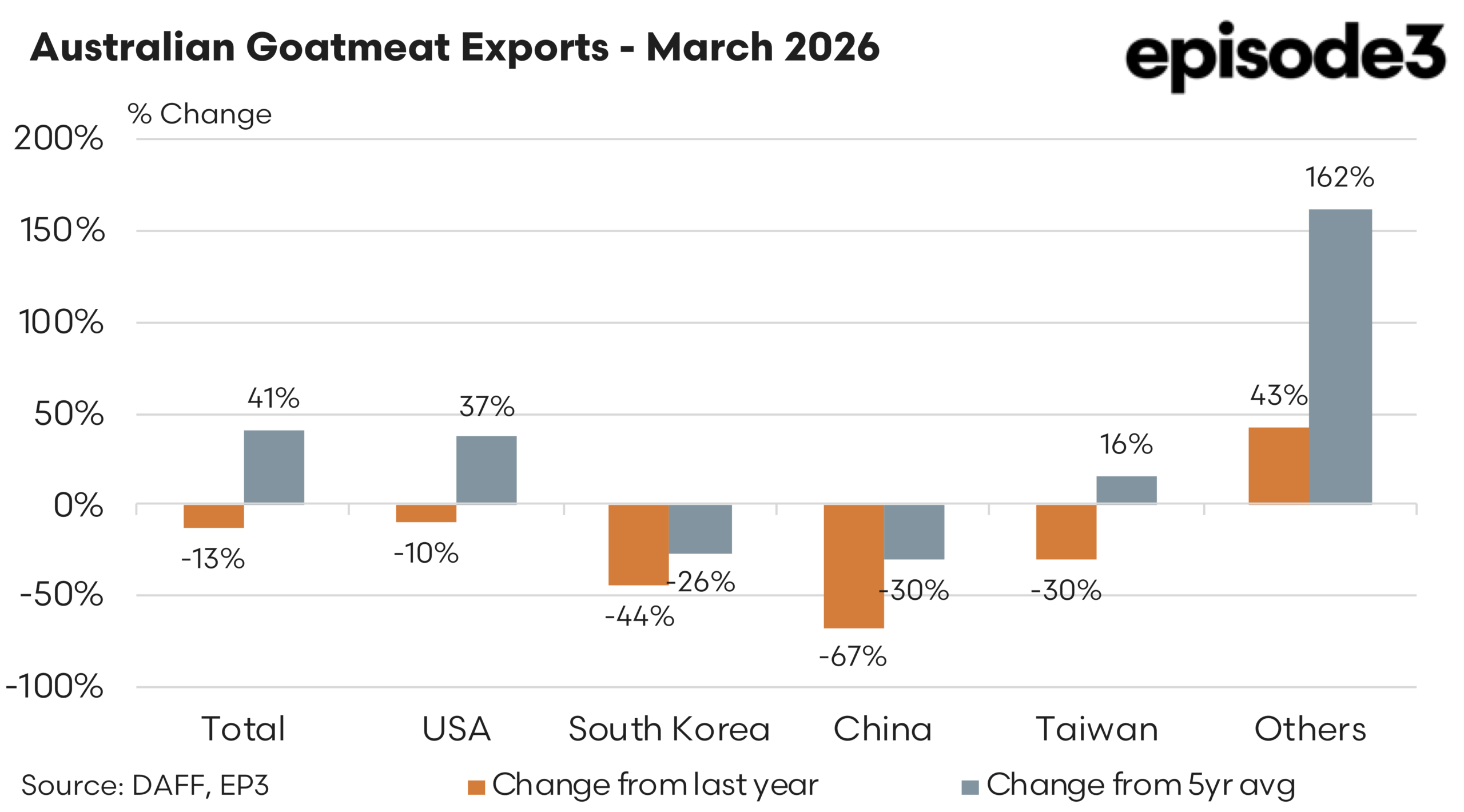
Taiwan provided a more stable outlet in March, with exports reaching 237 tonnes. Volumes were 30pc lower than March last year but remained 16pc above the five year average. This suggests that while demand has softened in the short term, Taiwan continues to perform relatively well compared with longer term norms and maintains its role as a consistent, if smaller, destination within the export mix.
The most notable feature of the March data once again lies in the performance of the “other markets” category. Exports to these destinations totalled 1,431 tonnes, up 43pc compared with March last year and an impressive 162pc above the five year average. This continued strength highlights the growing importance of diversification across a wide range of smaller or emerging markets. The ability of these markets to absorb increased volumes has been critical in offsetting the decline seen in destinations such as China and Korea, and points to a more distributed and resilient export structure.
March 2026 reinforces the key themes evident in earlier months. While headline export volumes have softened relative to last year, the goat meat sector remains structurally stronger than in the past, as evidenced by the consistent outperformance against five year averages. The export profile continues to evolve, with the United States anchoring demand and a broadening base of secondary markets providing additional support. However, the volatility seen across several Asian destinations highlights the importance of maintaining market diversification, as shifts in demand can occur quickly and materially impact overall trade flows.