Growing the Family Farm
Independent Contributor
Expanding a family farming business is interesting, to say the least, especially with the dynamics of parents, kids, and siblings all trying to make decisions together. Throw in how fast the business world is changing, new technology, and the usual intergenerational challenges, and often it all just gets too hard.
So, instead of banging on about idealistic fundamentals, I’ll just tell you the real story of how I’ve grown our family farming business while trying to teach a bit of business sense and risk appetite to my slightly scattered offspring.
A 26-Year Journey in a Nutshell
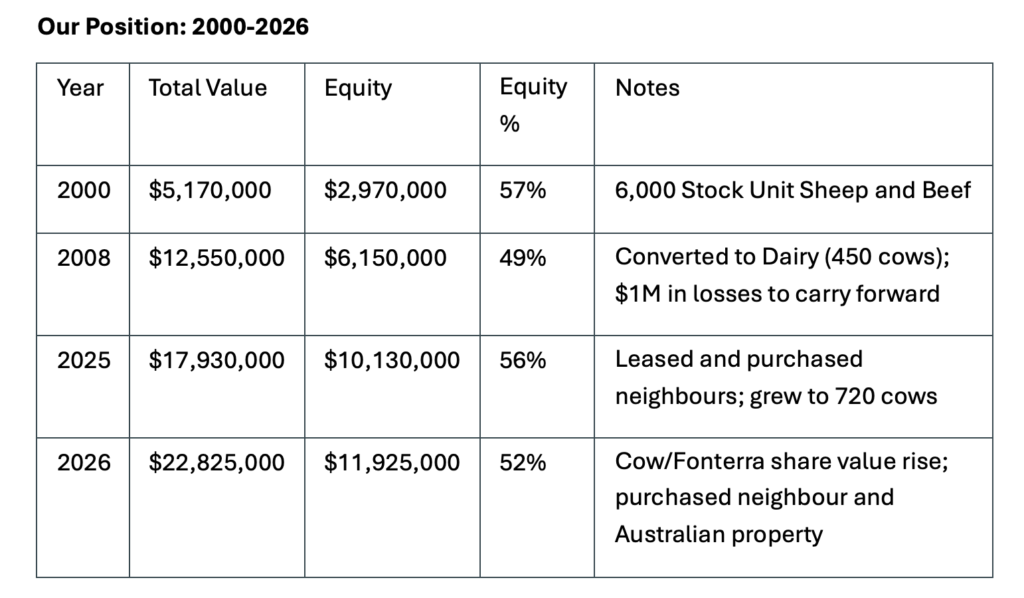
Now, I’m not going to claim to be in the top 10% of farmers; we realistically sit about ‘average’. Over 26 years, we grew our equity by $8,955,000, representing a Compound Annual Growth Rate (CAGR) of 5.7%. The interesting part is we did this without paying any company tax, as a few years were up, a few were down, and most broke even, with capital improvements coded as repairs or depreciated.
The Story Behind the Numbers
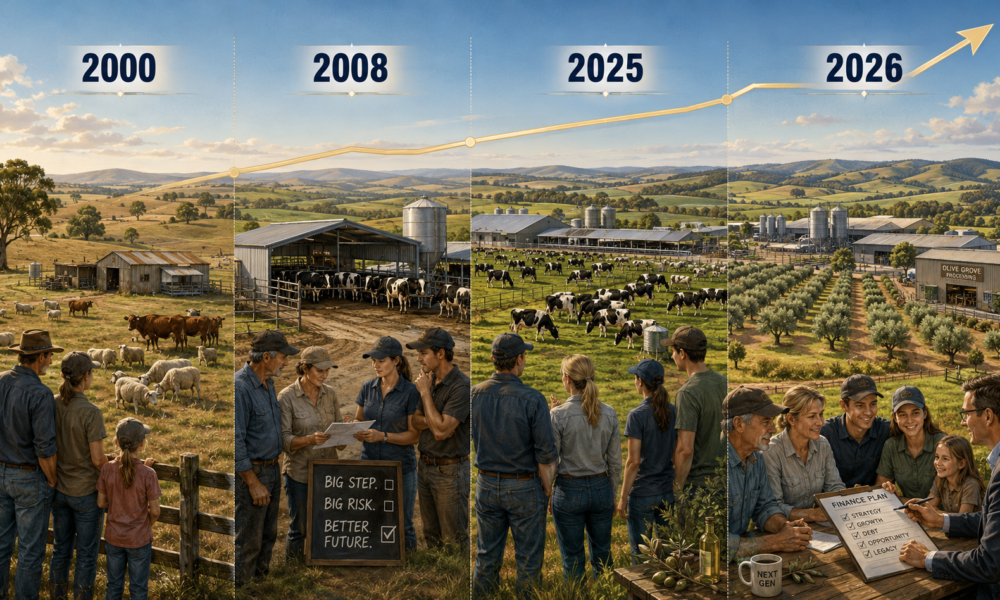
This growth wasn’t a straight line. For a long stretch—16 years, from 2008 until 2024—our growth effectively flatlined. Every expansion, whether it was extra cows, lease blocks, or houses, was a difficult grind.
- The Big Pivot (2008): Shifting from sheep and beef to a dairy operation was a massive move. It gave us a short-term dip in equity and some losses to carry forward, but it set the stage for everything that came later.
- Steady Growth (2025): We grew the business by leasing and purchasing neighbouring land, which let us increase our herd to 720 cows and build our equity back up to a healthy 56%.
- Hitting the Accelerator (2026): Good market conditions, with a high milk price and a jump in cow values, gave us some ‘Lazy equity’. We bought a neighbouring 130-acre block in New Zealand and took a punt on a 25-acre olive grove in Australia.
Getting Comfortable with Debt
I’ve always used debt as a tool for growth, which often leaves you in that classic ‘asset rich/cash poor’ scenario. Some boomers had the attitude ‘Pay interest or Tax?’.
My thinking is simple: there’s no big money in the day-to-day of farming, but there are great returns in the real estate, with literally no tax implications in NZ, and manageable with a long-term plan here.
Our 2026 expansion came after a hard search. We looked at a model dairy farm partnership in Gippsland and a trendy berry business near Melbourne, but both deals fell through. It took our third and fourth opportunities to finally get a deal done.
We landed on a 25-acre olive grove with its own processing facility. The books showed it just breaking even, but I could see the equity growth potential, and my wife thought its luxury home value in a tourist area was amazing. At $1.9 million, we could get into it without a mountain of debt.
Just as that was happening, a 130-acre block with a house popped up near our main dairy farm for $900,000. With farm cashflow looking good, I went back to the banker. He had wanted us to pay down principal, but what the hell—we asked to borrow another $600,000 instead. He saw it our way, and we bought both the small block and the olive grove.
The Real Takeaway: Debt, Growth, and the Next Generation
The key takeaway here is the link between maximising debt and growth, and how that fits with your own risk appetite and succession planning.
I see it everywhere—an aversion to debt often stops succession planning dead in its tracks and forces good farming families to exit the industry unnecessarily. My kids think I’m mad for owing the bank so much, but I see it as a mix of interest and trepidation on their part, which is about where I want them.
If I don’t show them the obvious benefits of diluted debt over time, they’ll just look for a cushy town job instead. And if they do that, who the hell will take over?
The result of all this is that there’s now about $2-3 million in equity for each of my four kids to put into or partner in a business someday. That’s the real goal: giving them the confidence and the foundation to stay in this industry and build something for themselves.