
Global lamb pricing update July 2026

Lamb pricing update - July 2026
Global lamb markets have become considerably more balanced since the last update in May, with Oceania continuing to strengthen while the exceptional premiums enjoyed by the Northern Hemisphere have begun to unwind. The latest price movements suggest the gap between the world’s major lamb producing regions is narrowing, although Australia still sits in a unique position as a relatively high-priced producer that remains highly competitive in global export markets.
Since May, New Zealand has recorded the strongest percentage price increase among the major exporting nations. NZ lamb prices have lifted from 863 A¢/kg to 920 A¢/kg, an increase of almost 7 percent. The recovery follows a prolonged period where New Zealand values lagged well behind other exporting regions and has likely been assisted by improving export demand and firmer processor schedules as seasonal supplies tighten.
Australia has also continued its steady upward trajectory. Australian lamb prices have increased from 1,165 A¢/kg to 1,224 A¢/kg since the previous update, representing a rise of around 5pc. The move reinforces the underlying strength that has been evident in the Australian market throughout 2026, with tighter domestic supply, robust export demand and ongoing processor competition continuing to underpin values. Local supply fundamentals have become the dominant driver as the winter supply shortage sets in, allowing Australian prices to continue appreciating even as several overseas markets have begun to soften.
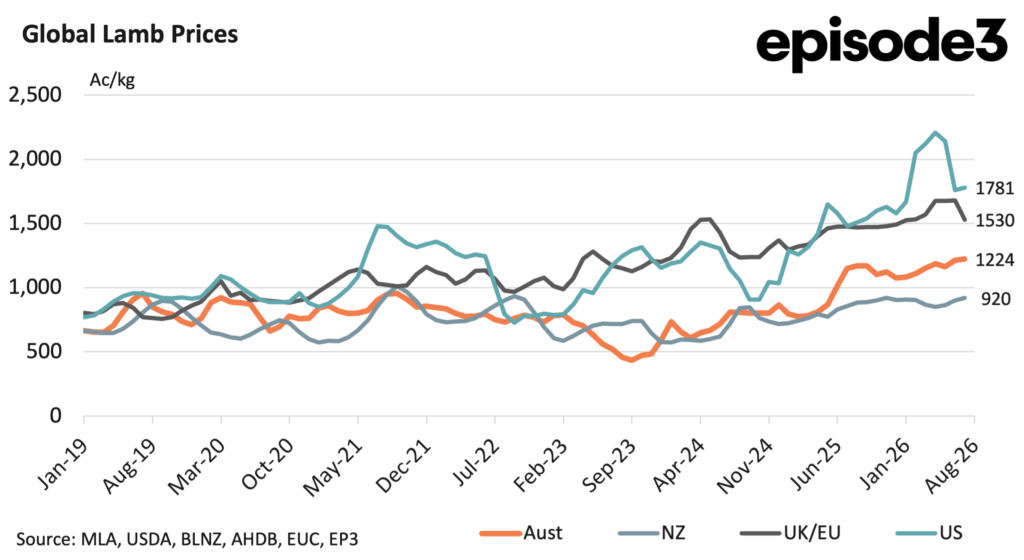
The biggest change over recent months has occurred in the Northern Hemisphere. After reaching historically elevated levels during April and May, both the UK/EU and US markets have eased. Combined UK and EU lamb prices have declined from around 1,678 A¢/kg to 1,530 A¢/kg. While that represents a fall of almost 9pc, European values remain well above long-term averages and continue to reflect relatively tight regional supplies. The correction appears more like a moderation following an exceptional rally than the beginning of a sustained downturn.
The United States has experienced the largest absolute price correction. US lamb values have eased from approximately 2,140 A¢/kg to 1,781 A¢/kg, a decline of around 17pc. Despite that retreat, the US remains comfortably the highest-priced lamb market globally. Strong consumer demand, structurally tight domestic sheep numbers and continued reliance on imported product continue to support US values well above those seen elsewhere. Although the US premium has narrowed, it has by no means disappeared.
The latest pricing relationships paint an interesting picture of the global market. Australian lamb is now trading at a 33pc premium to New Zealand. That spread has narrowed slightly compared with earlier in the year as New Zealand prices have recovered, although it still highlights the stronger pricing environment currently enjoyed by Australian producers. Australia also continues to trade at a sizeable discount to Europe. Australian values sit around 20pc below the combined UK and EU market, preserving Australia’s competitive position into many export destinations.
The gap to the United States has narrowed more noticeably. Australian lamb is now trading approximately 31pc below US values compared with a 46pc discount earlier in the year. That reduction has been driven by both stronger Australian prices and softer US prices, bringing the two markets closer together than they have been for several months.
From a global perspective, the pricing structure is becoming less extreme. Earlier in the year, the world lamb market effectively consisted of three distinct pricing tiers. New Zealand occupied the lowest tier, Australia sat comfortably in the middle, while Europe and particularly the United States traded at exceptionally high premiums. Those gaps have begun to compress. New Zealand is catching up, while Australia continues to edge higher. European prices have moderated and the United States has retreated from record highs.
Importantly, Australia remains in perhaps the strongest strategic position of all the major exporters. Local producers are benefiting from prices that continue to improve, while Australian exporters still maintain a meaningful pricing advantage over many competing Northern Hemisphere suppliers. That combination provides ongoing support for export demand while allowing producer returns to strengthen.
Looking ahead, the key question will be whether Northern Hemisphere prices continue easing or whether tighter seasonal supplies reassert themselves later in the year. Likewise, New Zealand’s recent recovery will need to be sustained if it is to continue narrowing the gap with Australia. For now, the global lamb market appears to be transitioning from one characterised by extreme regional divergence towards a more balanced pricing structure. Even so, the pricing hierarchy remains unchanged from earlier in the season. The United States continues to command the highest prices globally, Europe occupies the next tier, Australia sits comfortably in the middle as the world’s most competitive major exporter, and New Zealand remains the lowest-priced supplier despite its recent recovery.