
More NSW stock, but supply squeeze lingers
Market Morsel
The latest Sheep and Lamb Yarding Index shows that livestock availability remains tight across much of the country, despite another improvement in the number of sheep and lambs being offered in New South Wales. The August to September period has continued a pattern that has been developing over recent months, with NSW providing more livestock while several of the other major sheep producing states remain constrained.
For sheep, NSW yardings increased from 36pc in the July to August period to 42pc during August to September.South Australia also recorded a modest improvement, rising from 19pc to 21pc, while Victoria edged higher from 8pc to 10pc. Western Australian sheep yardings moved in the opposite direction, easing slightly from 27pc to 25pc.
While the individual movements were generally modest, the underlying index levels remain important. Victoria continues to record exceptionally low sheep yardings, while South Australia and Western Australia are also sitting towards the lower end of their historical ranges. NSW is therefore providing some additional sheep supply, but there is little evidence of a substantial increase in availability across the major southern producing states.
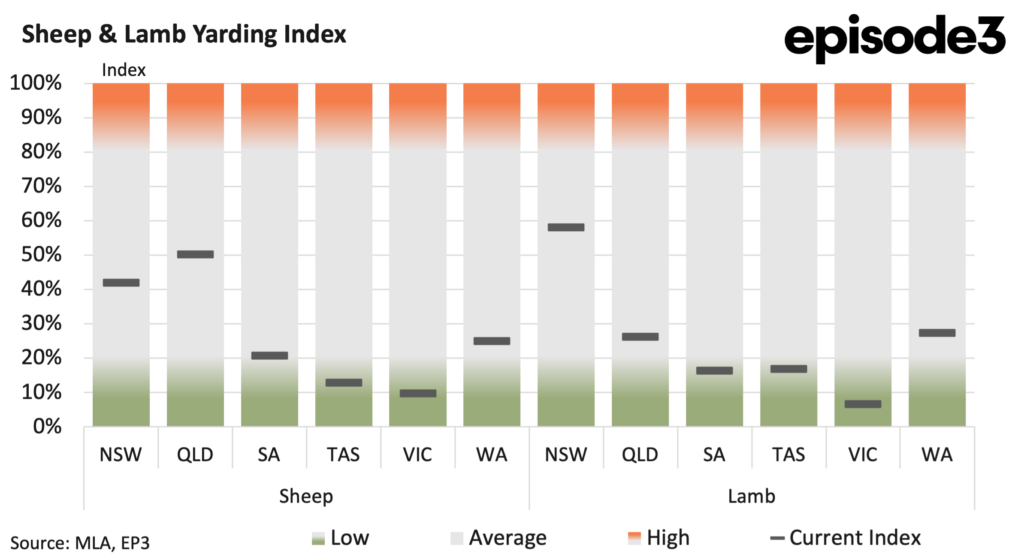
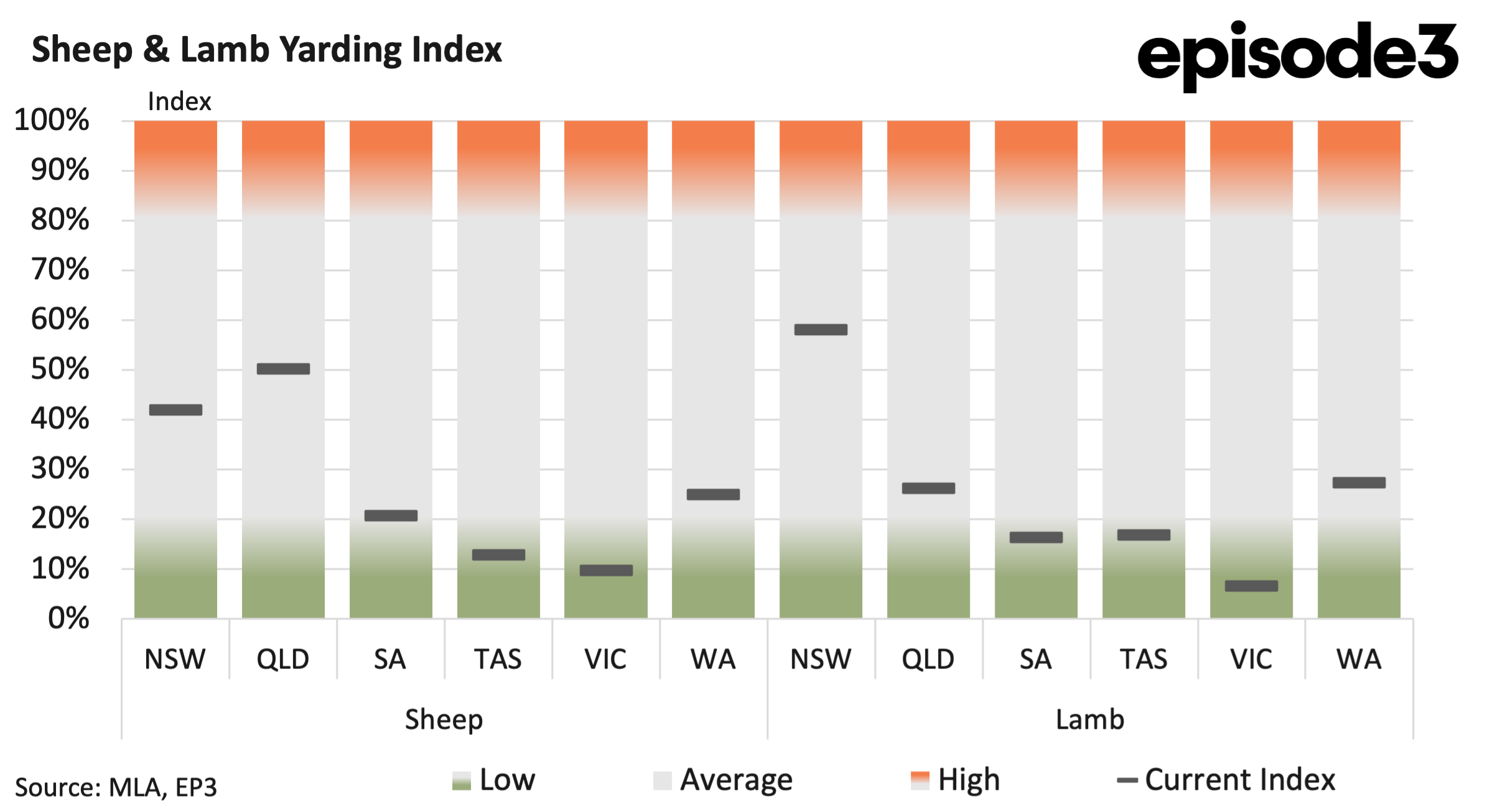
The lamb numbers provide an even clearer picture of this regional divide. NSW lamb yardings increased from 45pc to 58pc, continuing the improvement in supply that has been evident since the depths of the winter tightening. The latest increase follows the earlier lift in NSW lamb yardings from 19pc to 43pc and then 45pc, suggesting that the flow of lambs into saleyards has progressively improved. That additional NSW supply has been important in taking some of the extreme scarcity out of the national lamb market.
However, the other major producing states are telling a very different story. Western Australian lamb yardings fell sharply from 65pc to 27pc during the latest four week period. WA had previously been one of the stronger sources of lamb supply nationally, so the size of the latest decline is particularly noteworthy. South Australian lamb yardings also declined from 22pc to 16pc, while Victoria remained exceptionally tight, edging from just 5pc to 6pc. The relatively stronger NSW numbers therefore need to be considered alongside continued tightness across Victoria, South Australia and now a substantial contraction in Western Australian offerings.
The price movements over the same period suggest the market has been able to absorb the additional NSW supply without coming under renewed downward pressure. Heavy lamb prices increased by around 34c over the past four weeks to approximately 1,155c/kg cwt. Merino lamb strengthened by around 29c to 1,112c/kg cwt, while trade lamb was effectively unchanged at approximately 1,192c/kg cwt. Light lamb was also broadly steady, easing by less than 2c over the four week period. Mutton recorded a stronger recovery, increasing by around 54c to approximately 883c/kg cwt. Restocker lamb also rebounded strongly, gaining around 70c over four weeks to sit near 1,170c/kg cwt.
The price performance represents an interesting change from the previous yarding update. During July and August, an increase in livestock availability coincided with a broad correction in sheep and lamb prices. Heavy, trade, light and Merino lamb prices all declined, while mutton and restocker lamb experienced particularly large falls. At that point, more livestock was becoming available at the same time as processors were dealing with relatively subdued export demand, reducing the need to compete aggressively for stock.
The latest figures suggest that correction has lost momentum. NSW continues to provide more lambs, but there has not been a corresponding improvement in supply across the other major producing states. Instead, WA has tightened considerably, while Victoria and South Australia remain at relatively low yarding levels. That helps explain why prices have stabilised and, in several categories, begun to recover.
The mutton market is particularly noteworthy. A 54c increase over four weeks has occurred despite NSW sheep yardings improving, suggesting the additional supply from NSW has not been sufficient to materially loosen the national sheep market. Persistently low yardings across the southern states continue to provide underlying support. The recovery in restocker lamb prices is also significant after the sharp falls recorded previously. A gain of around 70c suggests producer buying interest has returned following the winter price correction, adding another source of competition for available lambs.
Overall, the latest Sheep and Lamb Yarding Index does not point towards a national spring surge in livestock availability just yet. Instead, it shows a market increasingly divided between improving NSW supply and continued tightness across several of the other major producing regions.