
Cattle market enters a more cautious phase
Cattle slaughter and yarding update July 2026
The latest Cattle Slaughter and Yarding Index suggests the Australian cattle market has entered a more cautious phase as winter conditions, softer processing margins and changing regional supply patterns reshape processor behaviour. Unlike recent months, the July update is not defined by a simple increase or decrease in cattle availability. Instead, it highlights a growing disconnect between where cattle are coming forward and where processors are prepared to lift throughput.
Queensland again dominated the supply side during July with their yarding levels increasing from 78 percent in June to 88pc in July, reinforcing the state’s position as the country’s primary source of cattle availability. New South Wales was largely unchanged, edging from 60pc to 61pc, and Victoria also remained relatively stable, easing only marginally from 59pc to 58pc. The tightening was more evident elsewhere with South Australian yarding levels almost halved, falling from 53pc to 27pc. Tasmania eased from 43pc to 39pc, while Western Australia recorded a modest improvement from 30pc to 34pc.
Although cattle availability remained relatively stable at a national level, the processing picture changed considerably. Queensland slaughter activity fell sharply from 92pc to 54pc, despite the increase in yardings. New South Wales also recorded a significant decline, slipping from 43pc to 24pc. Tasmania fell from 57pc to 37pc, while Victoria eased slightly from 54pc to 51pc. South Australia was the notable exception, despite much tighter yardings, slaughter activity increased from 70pc to 87pc. Western Australia also lifted modestly from 77pc to 79pc. The July figures suggest processors have become increasingly selective in their operating decisions.
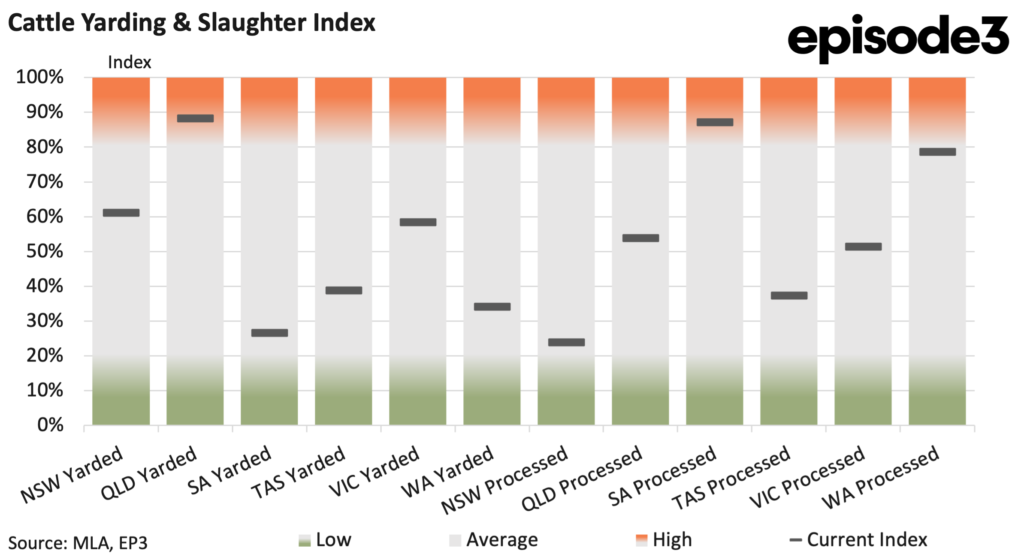
Higher cattle availability has not automatically translated into higher slaughter activity. Instead, processors appear to be adjusting throughput according to both regional cattle supply and the profitability of processing those cattle into export markets. Seasonal factors have also become more influential. Mid-winter typically brings a tightening in cattle availability across southern Australia as producers hold stock where feed conditions allow. At the same time, processors continue to face a more difficult export environment, with pressure on manufacturing beef values limiting their willingness to chase additional numbers. This combination has created a market where operating rates are being managed more carefully than earlier in the year. Rather than maximising throughput, processors appear focused on maintaining margins while securing sufficient cattle to meet existing commitments.
The latest MLA cattle indicators support that interpretation. Over the past four weeks, processor cow prices have eased by 5c/kg liveweight. Heavy steer prices have declined by 19c/kg liveweight, representing the largest fall among the processor categories. Dairy cow prices have also softened, easing 13c/kg liveweight. These movements indicate that finished cattle remain under pressure as processors manage procurement against softer export returns. The decline is not dramatic, but it reflects a market where buyer competition has become more measured than it was during the strong recovery seen through late autumn.
The weakness has not been confined to slaughter cattle with feeder steer prices declining by 16c/kg liveweight over the past four weeks. Meanwhile feeder heifers have eased by just 3c/kg liveweight. Restocker yearling steers are down 22c/kg liveweight, while restocker yearling heifers have slipped 8c/kg liveweight. This represents a notable change from the previous month, when younger cattle continued to outperform processor categories.
The latest figures suggest that buyer caution has spread further back through the production chain. Feedlots and restockers remain active, but they are becoming more disciplined in the prices they are prepared to pay. The CSYI data and MLA price indicators present a consistent picture.
Processor activity has softened across much of the eastern seaboard despite cattle availability remaining relatively stable in several key regions. At the same time, prices have eased across almost every major cattle category.
Queensland continues to stand apart, with the state recorded the strongest yarding index nationally, yet slaughter activity declined substantially.
This suggests the increase in cattle availability has not been matched by a corresponding increase in processor demand, reflecting a more disciplined approach to procurement and throughput. Meanwhile in South Australia processors lifted slaughter activity despite significantly lower yardings, indicating competition for available cattle remained relatively strong or that processors relied more heavily on cattle sourced from interstate saleyards or from outside the saleyard system. The regional differences have become one of the defining characteristics of the current cattle market.
National averages increasingly disguise the variation that now exists between individual states. Supply conditions, processor confidence and procurement strategies are no longer moving together across the country. Seasonal conditions will continue to influence producer selling decisions through the remainder of winter.
Export market performance will also remain critical, particularly given the recent triggering of safeguard tariffs in China and South Korea. For processors, the challenge is no longer simply finding cattle. It is finding cattle that can be processed profitably into an increasingly competitive international market.