
Global cattle pricing update August 2026

Get short video updates on your phone
For quicker updates as markets move, follow @themeatwatcher on Instagram. I regularly post short summaries and charts breaking down what’s happening in meat proteins and broader ag markets so you can stay across the key moves without having to read through pages of analysis. If markets are moving quickly, that’s usually where the updates will land first.
Global cattle price update - August 2026
Global cattle prices softened through July, although the correction was relatively modest across most major exporting nations. The easing reflects a market that is beginning to adjust after an extended period of strong price gains, particularly in Australia and the United States. While global beef demand remains broadly supportive, changes to trade flows and export market access have started to influence domestic cattle markets.
Australian cattle prices declined by 4.2 percent during July to sit at 438c/kg liveweight, representing the largest monthly correction among the four major cattle exporting nations. The move follows several months of firm pricing and reflects a market that has become more balanced after a strong first half of the year. The activation of safeguard quotas into both China and South Korea has reduced the competitiveness of Australian beef into two key premium markets, forcing exporters to redirect product into alternative destinations. That shift has eased some of the competition for slaughter cattle and taken some of the heat out of the domestic market.
The United States also recorded a softer month, with cattle prices converted into Australian dollar terms easing by 3.7pc to 777c/kg lwt. Despite the decline, American cattle continue to trade at historically elevated levels. Tight herd numbers remain the dominant driver, with years of liquidation continuing to restrict supplies of finished cattle, low beef production and reduced cold storages. The July correction appears more reflective of normal market volatility than any meaningful change in the underlying supply outlook.
Argentina experienced only a modest adjustment, with prices easing 1.4pc during the month to 452c/kg lwt. The country’s cattle market has enjoyed a remarkable recovery over the past two years, supported by economic reforms, currency adjustments and stronger export demand. While prices have paused during July, they remain near record levels and continue to close the gap on Australia’s market.
Brazil moved against the broader trend, recording a 1.6pc increase during July and lifted to 350c/kg lwt when adjusted into Australian dollar terms. The lift was modest, but it reinforces Brazil’s position as the lowest priced of the four major exporters.
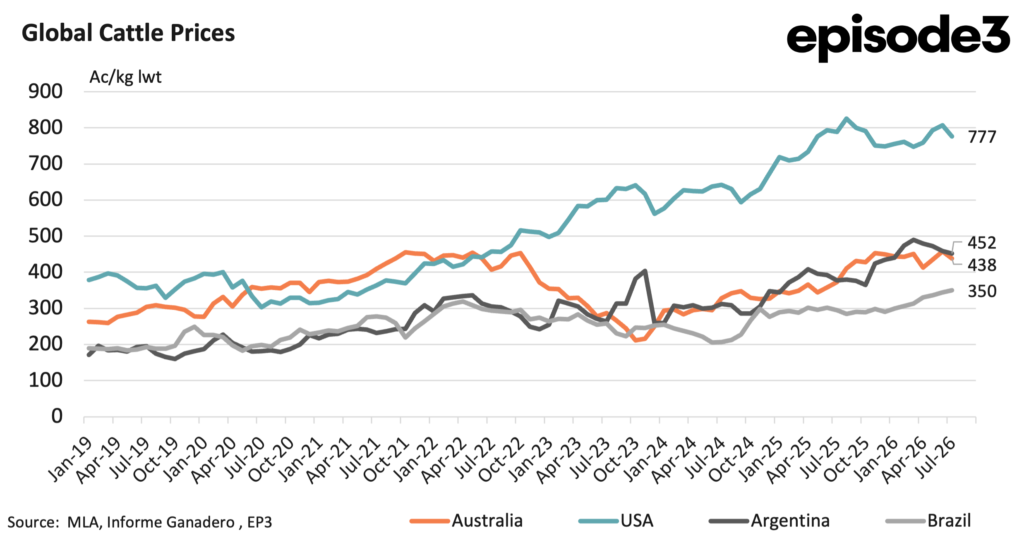
The relative pricing between the major exporters remains an important indicator of international competitiveness. Australian cattle are now trading at a 3pc discount to Argentina, highlighting just how far the two markets have converged over the past two years. Only a short time ago, during the last domestic herd rebuild here, Australia commanded a substantial premium over Argentina. That relationship has now effectively disappeared.
Australia continues to trade at a significant premium to Brazil. Current prices sit around 25pc above Brazilian cattle values, reflecting Australia’s higher supply chain costs and greater emphasis on the targeting of premium export markets.
The United States remains in a league of its own. American cattle prices continue to trade around 44pc above Australia, underlining the extent of the ongoing herd shortage. Although US prices eased during July, they remain historically high and continue to provide strong support for imported beef demand. For Australian exporters, the substantial discount to US cattle remains a competitive advantage in North American beef markets.
The July movements also demonstrate how quickly trade policy can influence domestic livestock markets. The introduction of safeguard tariffs into China and South Korea has not fundamentally altered Australia’s export outlook, but it has changed the economics of where beef is sold.
As product is redirected into alternative markets, competition for cattle has become slightly less intense than it was during the first half of the year. That has contributed to the modest easing in Australian cattle prices. Despite the softer month, Australia’s cattle market remains in a fundamentally healthy position.
Seasonal conditions across much of the country continue to support producer confidence, while export demand remains diverse even as access into some destinations becomes more constrained. The recent price correction should therefore be viewed as a normal adjustment rather than the beginning of a sustained downturn.
Looking ahead, much will depend on how global trade flows adapt to the new tariff settings and whether demand from alternative export markets can absorb product previously destined for China and South Korea. The United States is also likely to remain a key influence, with ongoing herd rebuilding expected to be slow and imported beef demand remaining historically strong. July represents a month of consolidation rather than reversal with prices easing across most major exporters, but the broader global cattle market remains well supported. Australia has lost a little momentum as export pathways adjust, yet it continues to sit comfortably above Brazil, almost level with Argentina and at a substantial discount to the exceptionally expensive US market.