
The real value of mutton and lamb
Market Morsel
Australian sheep prices have pushed into territory rarely seen when measured in today’s dollars, with mutton setting a new inflation-adjusted record during July 2026 and trade lamb prices returning to levels that sit close to the most expensive points in the historical series.
Comparing livestock prices across decades can be misleading when the effect of inflation is ignored. A price of 100c/kg in the 1960s bought considerably more than the same nominal price would today. Converting historical prices into 2026 dollar values allows a more meaningful comparison and helps answer whether current prices are genuinely exceptional, or simply appear high because the value of money has changed.
For trade lamb, the long-term inflation-adjusted average sits at 723c/kg cwt. The central 70pc range extends from 490c/kg to 956c/kg, representing the band in which prices have spent most of their time. The broader 95pc range runs from 257c/kg to 1,189c/kg, placing anything above that upper level among the most expensive real trade lamb prices recorded.
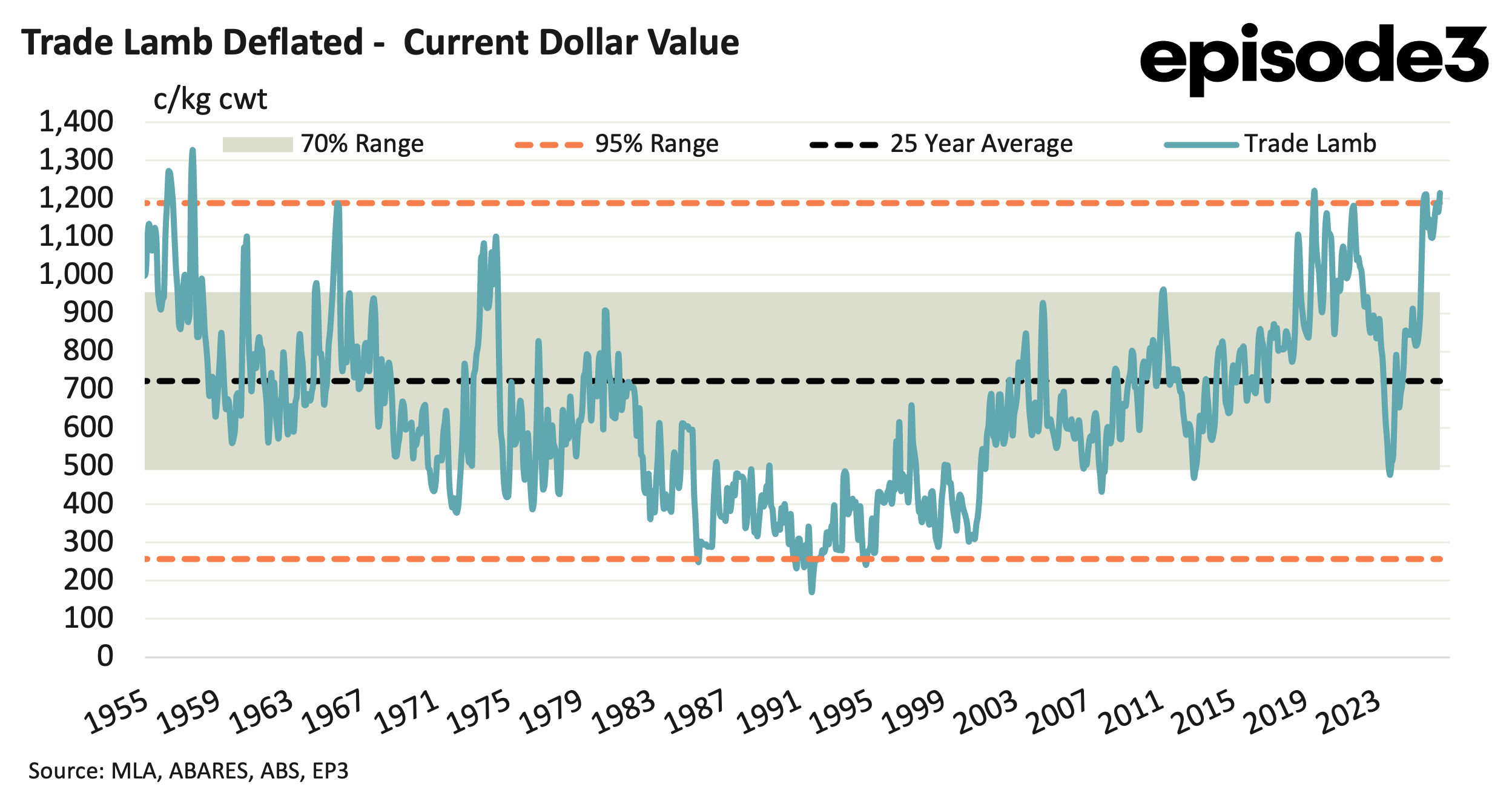
The trade lamb market moved beyond that 95pc threshold during the recent rally. Prices reached approximately 1,250c/kg cwt in early July 2026, putting the market around 73pc above its long-term inflation-adjusted average. It was an exceptional price, but not quite a record once the full historical series is converted into current dollars.
The highest equivalent trade lamb values occurred in August 1957, when prices were close to 1,330c/kg cwt in 2026 dollar terms. This means the early July 2026 peak was around 80c/kg below the real price record, or approximately 6pc lower. Current trade lamb values have therefore moved into genuinely rare territory, although they remain just short of the extreme levels reached almost seven decades ago.
The mutton story is even more striking. Its long-term inflation-adjusted average is 419c/kg cwt, with a 70pc range of 239c/kg to 598c/kg. The 95pc historical range stretches from just 60c/kg at the lower end to 777c/kg at the upper end.
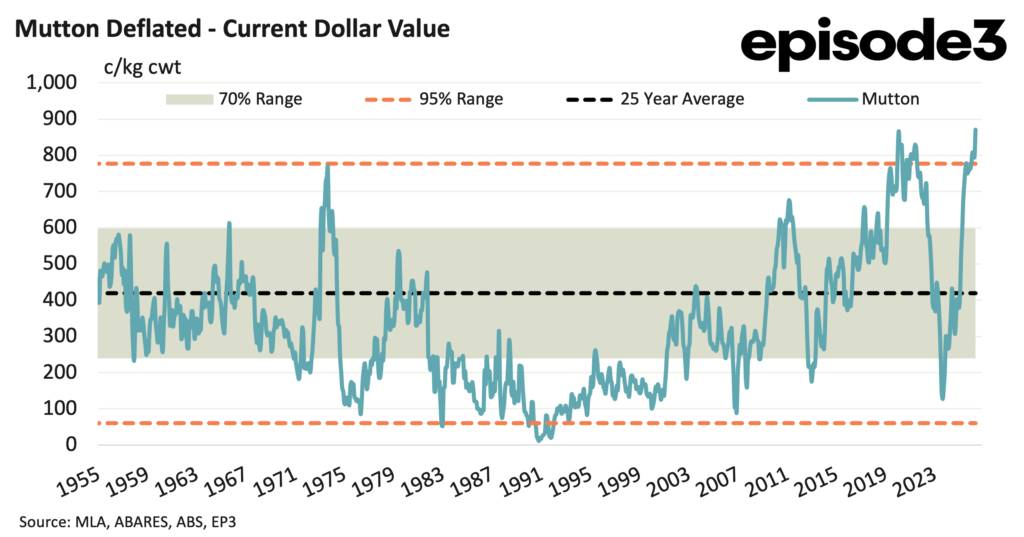
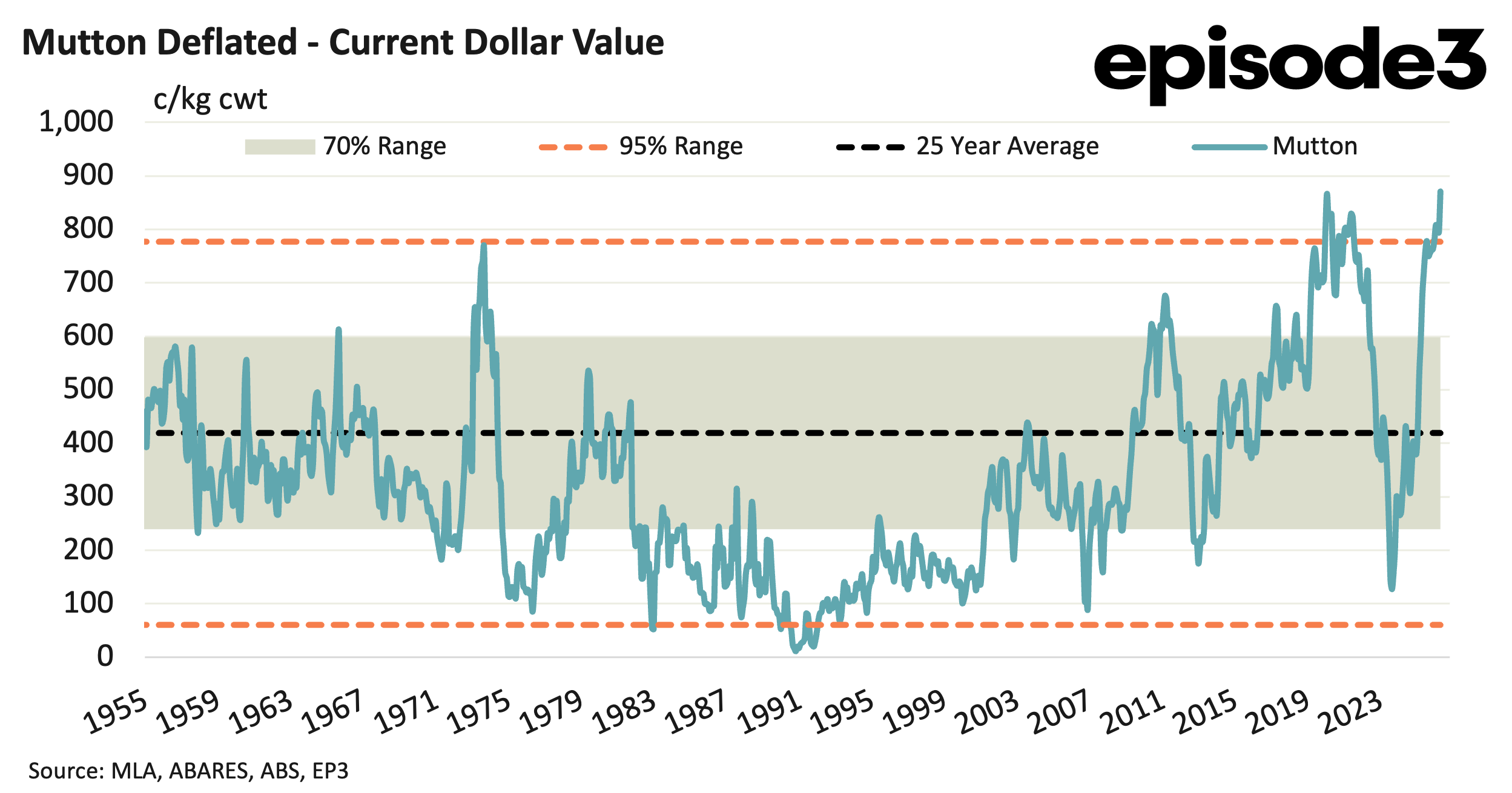
Mutton prices nearly reached 930c/kg cwt in early July 2026. This placed the market more than 120pc above its long-term real average and around 153c/kg above the upper boundary of the 95pc range. In practical terms, mutton was trading at more than twice its normal inflation-adjusted value.
Unlike trade lamb, this represented a new real price record. Mutton had previously reached a significant peak in March 2020, but the recent rally moved decisively beyond that level. Although nominal mutton prices have risen sharply at different points in the past, none matched the levels represented by the early July 2026 peak after adjusting the entire series for inflation.
That result marks a major reversal from periods when mutton traded at deep discounts to lamb and frequently sat below its long-term real average. The mutton market spent large parts of the 1980s, 1990s and early 2000s near the lower end of its historical range. At times, inflation-adjusted prices fell close to the bottom of the 95pc band.
More recently, mutton has moved through several distinct phases. Prices strengthened through the latter half of the 2010s and reached their previous real peak around March 2020. The market then weakened sharply, with inflation-adjusted values falling back toward 120c/kg during 2023 before staging an extraordinary recovery.
The scale of that turnaround is important. From the 2023 low to the July 2026 high, real mutton prices increased by more than seven times. That movement reflects a major change in the balance between available sheep supply and processor and export demand, rather than inflation simply pushing all prices higher.
The relative position of lamb and mutton also tells a useful story. At the July peaks, trade lamb was approximately 527c/kg above its long-term real average, while mutton was around 511c/kg above its own average. The absolute deviations were therefore similar, but because mutton begins from a much lower long-term base, its percentage departure from normal was far more extreme.
For producers, the figures confirm that recent sheep prices were not merely high in nominal terms. Trade lamb values reached levels seen only during a handful of periods in almost 70 years, while mutton moved into completely new territory.
Markets rarely remain at statistical extremes indefinitely, and prices above the 95pc historical range should not automatically be treated as a new normal. Even so, the early July rally has reset the benchmarks. Trade lamb came close to challenging its inflation-adjusted record, while mutton established one outright.