
A$7.5m owed
The Snapshot
- Marina Commodities (Australia) has around A$7.5m owed to unsecured creditors.
- The top 10 Australian creditors account for about 74pc of the Australian unsecured exposure.
- The receivership is a reminder that counterparty risk matters just as much as price risk.
- In volatile markets, war, tariffs, freight disruption and currency moves can increase pressure on commodity traders.
- Growers should spread sales between buyers, check counterparties and think carefully about how much unsecured credit they are effectively extending.
The Detail
Farmers spend a lot of time worrying about price risk. Should I sell today, wait another week or hold out for another $10/t? That is understandable, especially now, when agricultural markets are being pushed around by war, geopolitics, tariffs, and an increasingly unpredictable global trading environment.
Another risk probably gets much less attention. You can make a great sale, pick the top of the market and still end up with a terrible result if the buyer does not pay.
The receivership of Marina Commodities is a timely reminder of that risk. KPMG was appointed receiver of Marina Commodities Inc., Ausican Commodities Ltd and Marina Commodities (Australia) Pty Ltd on 14 August. Marina’s Australian operation sourced crops locally, supplied the Canadian business and sold crops into the Australian market.
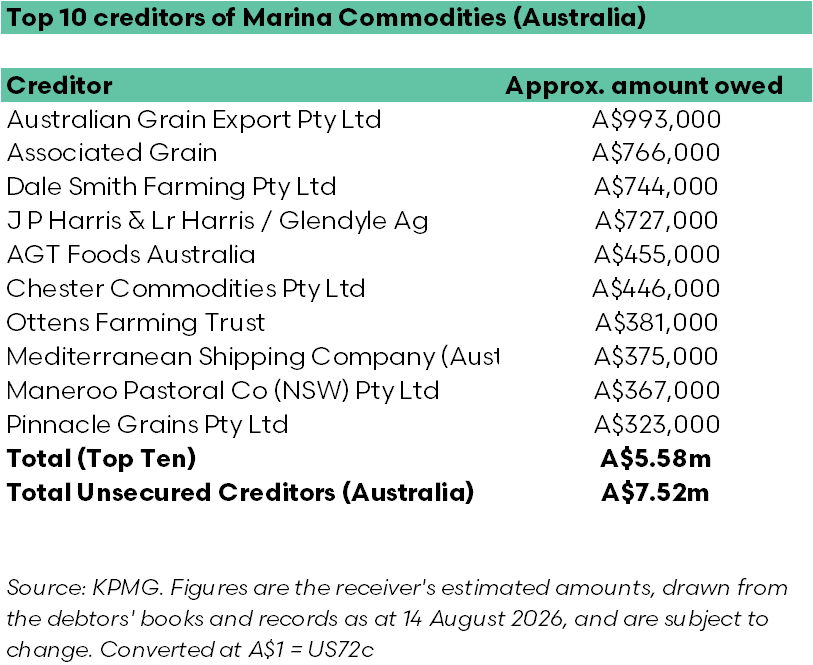
The Australian creditor list makes for uncomfortable reading. By my calculation, around US$5.41m, equivalent to approximately A$7.5m at an exchange rate of US72¢, is owed to unsecured creditors specifically listed against Marina Commodities (Australia). There are 75 creditor entries covering grain companies, farming businesses and trusts, freight and shipping companies and other service providers.
The top ten account for around 74pc of the Australian unsecured exposure, and four creditors are owed more than A$700,000 each. We cannot assume that every farming-related name represents grain delivered and unpaid, because the receiver’s document does not tell us what each debt relates to. Still, some substantial agricultural businesses are clearly caught up in the failure.
A fairly large, secured creditor also sits ahead of the unsecured list. CIBC is listed in the receiver’s notice as being owed about US$47.6m, or roughly A$66m, and holds security over the debtor companies’ assets. Across the group, the most recent unaudited accounts showed book assets of only US$45.3m, around A$63m, with the vast majority of that made up of accounts receivable rather than physical inventory. KPMG warns that the eventual realisable value of those assets could differ materially from book value.
The lead-up to the receivership is also interesting. CIBC alleges that Marina had developed a borrowing-base shortfall of at least US$36m, or around A$50m, by the end of July, according to reports in Canadian media. The lender also raised concerns about the treatment of inventory and receivables used to support its lending, although the debtors have reserved the right to contest some of those allegations. They remain allegations, not proven findings.
None of this means we can say Marina collapsed because someone made a bad grain trade, got a hedge wrong or was caught on the wrong side of the market. Not enough information is available to make that claim, and the issues raised by CIBC appear broader than simply getting the market wrong.
It does, however, come at a time when the general trading environment is unusually uncertain. The war in Ukraine continues, conflict in the Middle East has increased uncertainty around freight and energy, while tariffs, sanctions and geopolitical sabre-rattling have become an almost normal part of international trade.
That sort of environment does not automatically make grain traders insolvent, but it can increase the risks involved in running a physical commodity business. Prices move quickly, currencies move, freight costs change, shipments get delayed, and money can be tied up for longer than expected. The amount of working capital required to keep trading can therefore change very quickly.
For farmers, there is not much point trying to become an expert on the internal finances of every grain buyer. Most growers will never know what a trader’s bank knows about its funding arrangements, debtors, hedging book, or cash position. Even financial institutions lending tens of millions of dollars can find themselves surprised by what is happening inside a business.
That is why one of the simplest pieces of advice remains one of the best: spread your counterparty risk.
I wrote about grain-trade insolvencies back in 2020, and the lessons haven’t changed much. Do some research on the businesses you sell to, use the bush telegraph to find out whether buyers are paying on time, consider a credit check and be cautious if someone is consistently offering considerably more than the rest of the market without an obvious reason. Most importantly, do not put all your eggs in one basket.
There are also ways to reduce payment risk within the transaction itself. Clear Grain Exchange is probably the best-known Australian example, with its settlement system structured so the seller retains the grain until payment, while an independent custodian facilitates the settlement. It is one option growers can consider where they want additional protection around payment.
Perhaps the easiest way to think about all of this is to forget about grain for a moment. If you deliver A$300,000 worth of grain to a buyer and have not yet been paid, you have effectively extended A$300,000 of credit to that business. If the same grain trader walked onto your farm and asked you to lend it A$300,000 unsecured, would you do it?
The answer may still be yes, but let’s be honest, you likely wouldn’t.
Farmers insure their tractors, headers, sheds and crops. They diversify production, worry about weather, manage fertiliser, fuel costs, and spend countless hours deciding whether to sell grain today or tomorrow. Yet it is possible to hand another business several hundred thousand dollars worth of grain and end up with a hole in your bank balance.
That doesn’t mean growers should stop dealing with smaller traders or assume that the biggest company is automatically the safest. Competition between grain buyers is important, and insolvencies will happen from time to time. It simply means that counterparty risk deserves to sit alongside production risk and price risk when growers decide how and where they sell their grain.
A $10/t premium is nice. Picking the top of the market is even better. But the best grain price is only the best price if you get paid.
NB: Figures are drawn from the receiver’s notice dated 24 August 2026 and reflect the debtors’ books and records as at 14 August 2026. They are estimates and are subject to change. Any business listed that believes it has been included in error should contact the receiver, KPMG, at marina@kpmg.ca.