Another big one: Australia heads for a 61 million tonne winter crop

The Snapshot
- Australia is heading for a 60.9Mt winter crop, the fourth largest on record and 16pc above the ten-year average.
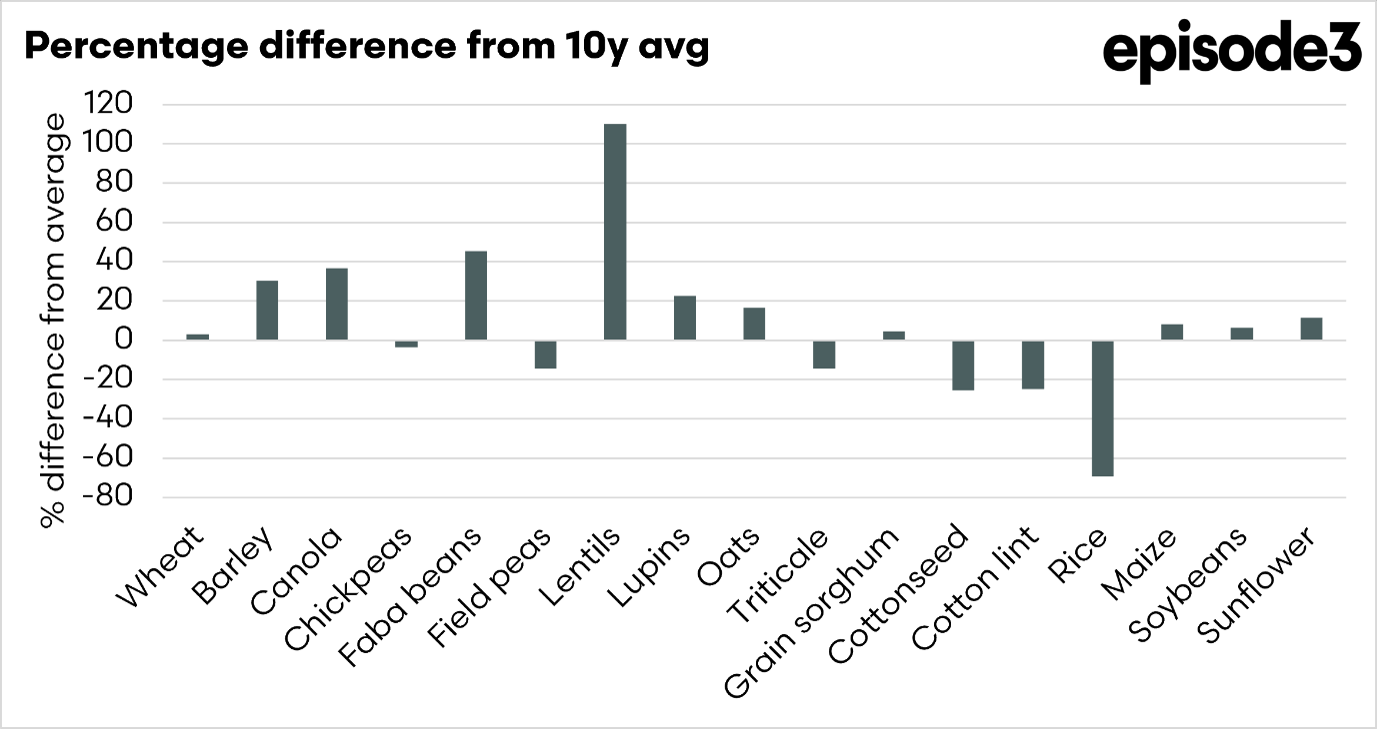
- Barley and canola are standouts, with production tracking 30pc and 37pc above their ten-year averages respectively.
- South Australia and Victoria are driving the strength, while northern NSW and Queensland remain much weaker.
- Western Australia is down sharply from last year’s record but is still forecast to produce 18pc more than its ten-year average.
- Frost, timely rainfall in parts of WA and a much softer summer crop outlook remain the main risks.
The Detail
Australia is heading towards another seriously large harvest, with ABARES forecasting winter crop production of 60.9 million tonnes in 2026-27, enough to make it the fourth largest crop on record.
Production is forecast to be 12pc lower than last season, but that comparison needs some perspective. The 2025-26 harvest was exceptional, driven particularly by a record Western Australian crop. Against the ten-year average, the current forecast is actually 16pc higher, putting this season comfortably among Australia’s better production years.
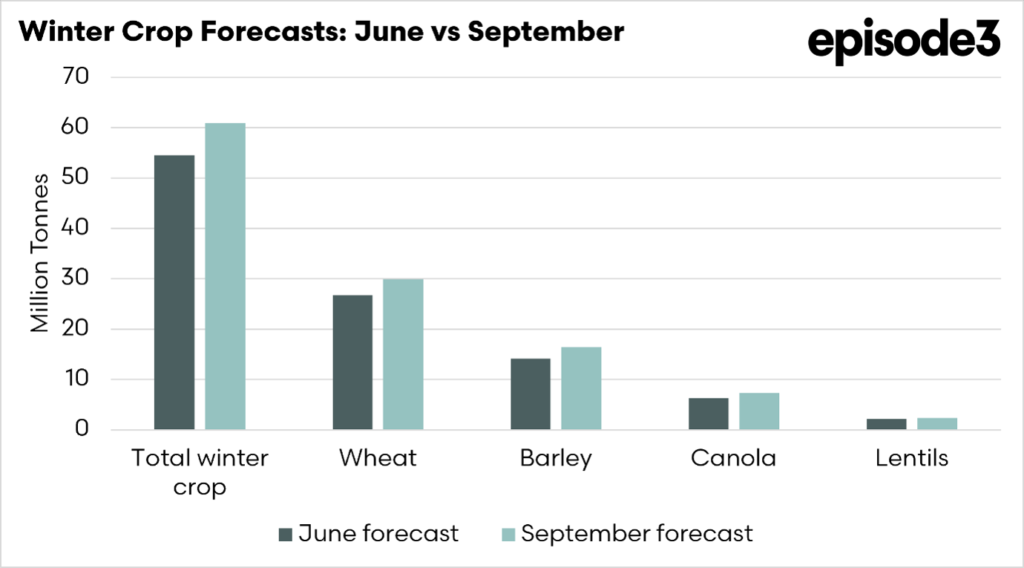
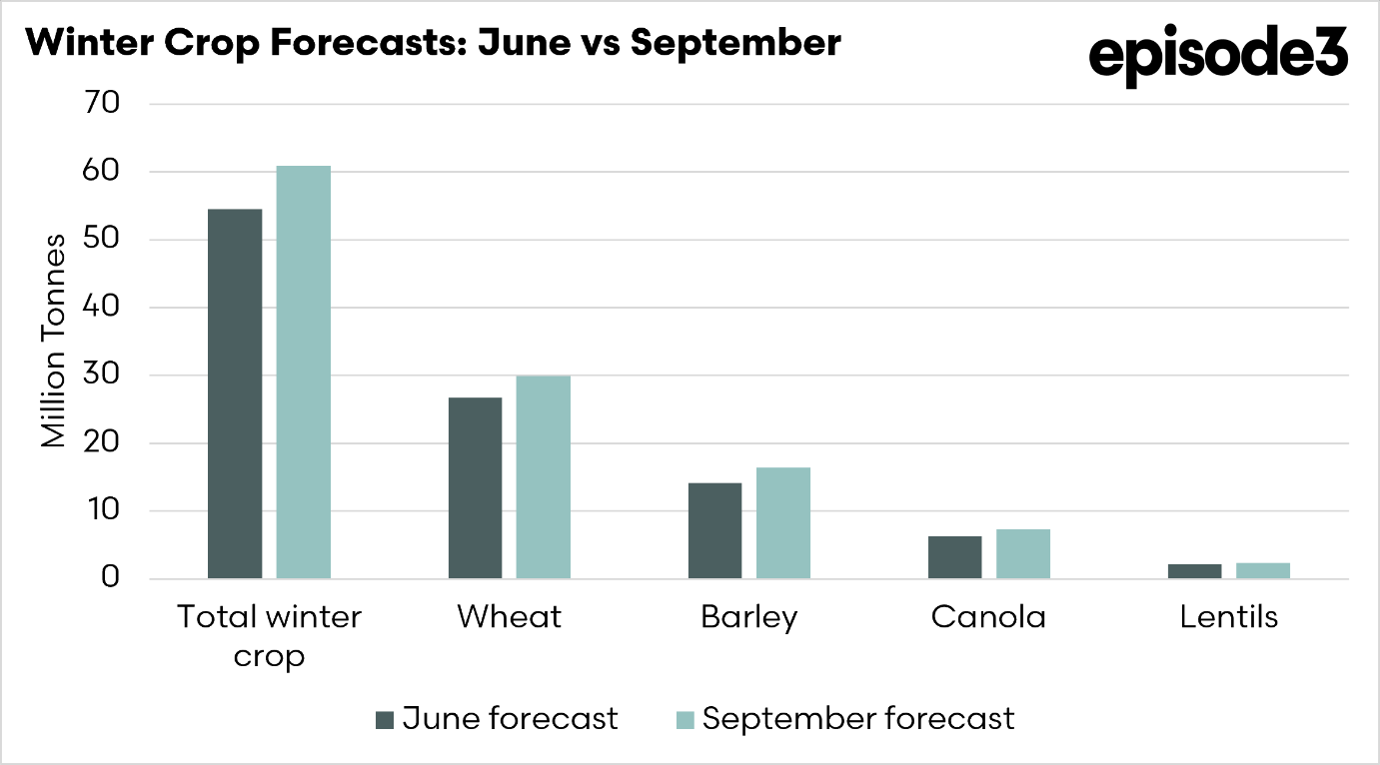
The other interesting part of the September report is how the crop has developed through winter. ABARES’ first forecast in June put national winter production at 54.5 million tonnes. Three months later, after favourable conditions across much of southern Australia, that estimate has increased by 6.4 million tonnes, or around 12pc.
The improvement is spread across most of the major crops. Wheat has moved from 26.7 million tonnes in June to 29.9 million tonnes, barley from 14.1 million to 16.4 million tonnes, and canola from 6.2 million to 7.3 million tonnes.
This is not merely a big crop. In several commodities, Australia is heading towards production levels near the top of the historical range.
Barley leads the cereals.
Barley is one of the standouts. Production is forecast at 16.4 million tonnes, making it the second-largest barley crop on record and putting output 30pc above the ten-year average. Area planted is estimated to have increased 6pc from last year, with barley favoured in several regions because of relative margins, lower fertiliser requirements and its suitability under drier conditions.
Canola is also shaping up for another enormous crop. Production of 7.3 million tonnes would be the third largest on record and around 37pc above the ten-year average, despite being forecast 5pc lower than last year’s very strong result.
Wheat is comparatively less spectacular, but hardly weak. Production is forecast at 29.9 million tonnes, down 17pc from last year, largely reflecting an 11pc reduction in planted area. Even with that decline, wheat production remains around 3pc above its ten-year average.
Lentils are another number worth watching. Production is forecast at a record 2.25 million tonnes, around 110pc above the ten-year average. That deserves a separate discussion because lentils trade in a much thinner global market than wheat or barley, meaning the rapid growth in Australian production could have important price and marketing implications.
When a crop of almost 30 million tonnes of wheat is the relatively ordinary part of the national grain story, Australia is not having a small year.
The south is carrying the crop.
South Australia and Victoria have enjoyed excellent conditions, southern New South Wales has also performed strongly, while northern NSW and Queensland have had a much tougher season. Western Australia remains comfortably above average, although production is coming back from last year’s exceptional result.
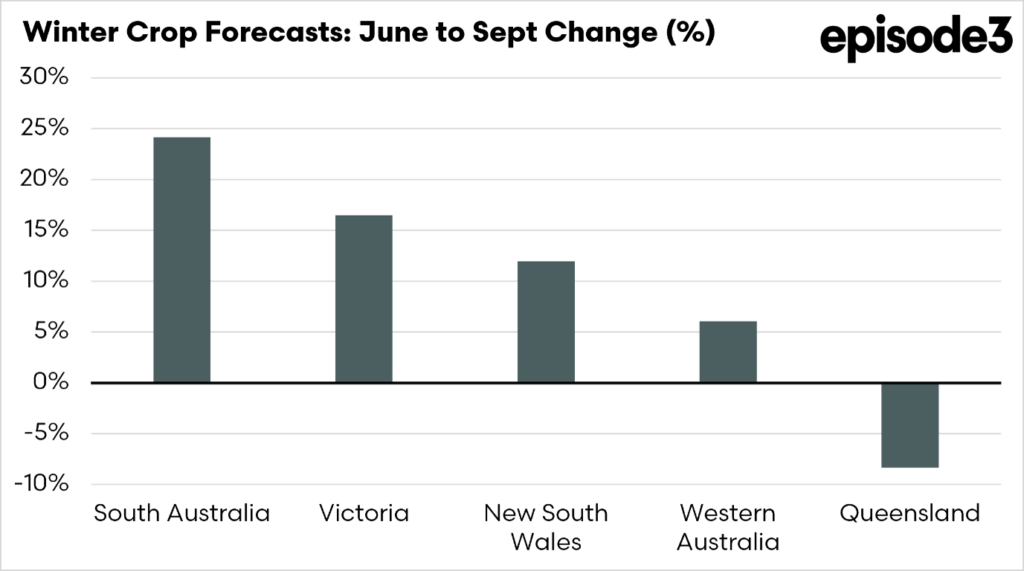
South Australia has seen the largest increase since the June report, with production now forecast at 11.3 million tonnes, up from 9.1 million tonnes three months ago. That would make it the state’s second-largest winter crop on record, behind 2022-23.
Average South Australian yields are forecast at 2.7 tonnes per hectare, 29pc above the ten-year average and the second highest on record. Wheat, barley and canola yields are also all expected to be the second highest recorded. Good early soil moisture, followed by average to above-average rainfall through June and July and mild temperatures, has crops running as much as four weeks ahead of normal.
Victoria has followed a similar path. Its forecast has increased from 9.7 million tonnes in June to 11.3 million tonnes in September, an 18pc rise. If realised, that would marginally exceed the state’s previous production record set in 2022-23.
The Victorian cropping area has also reached a record 3.8 million hectares, with ABARES noting continued expansion of cropping into country previously used for livestock. Wheat yields are forecast at 3.4 tonnes per hectare, 20pc above the ten-year average, while barley yields are expected to be 25pc above average.
NSW is really two seasons
New South Wales production has increased from 11.7 million tonnes in the June forecast to 13.1 million tonnes in September, but the state-wide figure hides a substantial regional divide.
Conditions through central and southern NSW have generally been favourable, with sufficient soil moisture around planting and adequate winter rainfall supporting stronger yield potential. The north has had a very different experience, with low soil moisture and limited follow-up rainfall restricting both crop area and yields.
That weakness continues into Queensland, where winter production is forecast at just 2.2 million tonnes, down 44pc from last year. Queensland is the only major state where the September forecast is below the June estimate, falling from 2.4 million tonnes as seasonal conditions remained difficult.
Chickpeas provide a good example of those northern conditions. National production is forecast at about 1.05 million tonnes, down more than 50pc from last year.
That sounds catastrophic until you compare with the past decade. The crop is only around 3pc below the ten-year average and would still rank as Australia’s fifth-largest chickpea crop. Last year’s crop was simply enormous.
WA comes back to merely very big.
Western Australia is forecast to produce 22.8 million tonnes, down 16pc from last year’s extraordinary 27.2 million tonne harvest.
Again, the long-term comparison is more revealing. Even after that year-on-year decline, the current WA forecast remains 18pc above the ten-year average.
The September estimate is also higher than the 21.5 million tonnes forecast in June, helped by favourable conditions in areas including Esperance and Geraldton. Albany and southern Kwinana have been drier, and current yield expectations there remain reliant on timely in-crop rainfall.
A longer-term structural story is also developing in WA. Winter cropping area has edged above 9.2 million hectares, with some sheep-grazing land continuing to move into cropping as producers change enterprises.
If that shift proves permanent, it may continue to increase WA’s cropping capacity even when seasonal yields return towards average, something Episode 3 has been discussing since before the live export ban was announced.
Summer is the weak spot.
The outlook becomes considerably softer once attention turns to summer crops.
ABARES forecasts summer crop production at 3.4 million tonnes in 2026-27, down 25pc from last season and 11pc below the ten-year average.
Sorghum production is forecast at just over 1.9 million tonnes, while cotton lint production is expected to decline to around 679,000 tonnes. Rice is the real outlier, with production of just 139,000 tonnes sitting almost 70pc below its ten-year average.
For cotton and rice, reduced irrigation water availability is a major constraint, with higher water prices across the Murray-Darling Basin also weighing on planting. Sorghum still has some upside if spring rainfall improves, as substantial areas remain fallow in regions where winter crops were not planted.
It is not in the bin yet.
Plenty can still happen between a forecast crop and grain safely stored in the silo.
The advanced development of crops through Victoria and South Australia increases exposure to frost, while parts of Western Australia still require timely rainfall. On the flip side, many southern crops entered spring with good stored soil moisture and are already well advanced, making them less reliant on spring rainfall than they might otherwise be.
The headline number says Australian winter production is falling 12pc from last year. Technically, that is true, but last year was exceptional.
Against history, Australia is currently heading towards its fourth-largest winter crop on record. Barley is on track for the second largest crop, canola the third largest, and several other commodities are running well above their long-term averages.
We are becoming accustomed to 60 million tonne winter crops. They are still very big crops.