Groundhog Day: Black Sea risk drives wheat higher again

The Snapshot
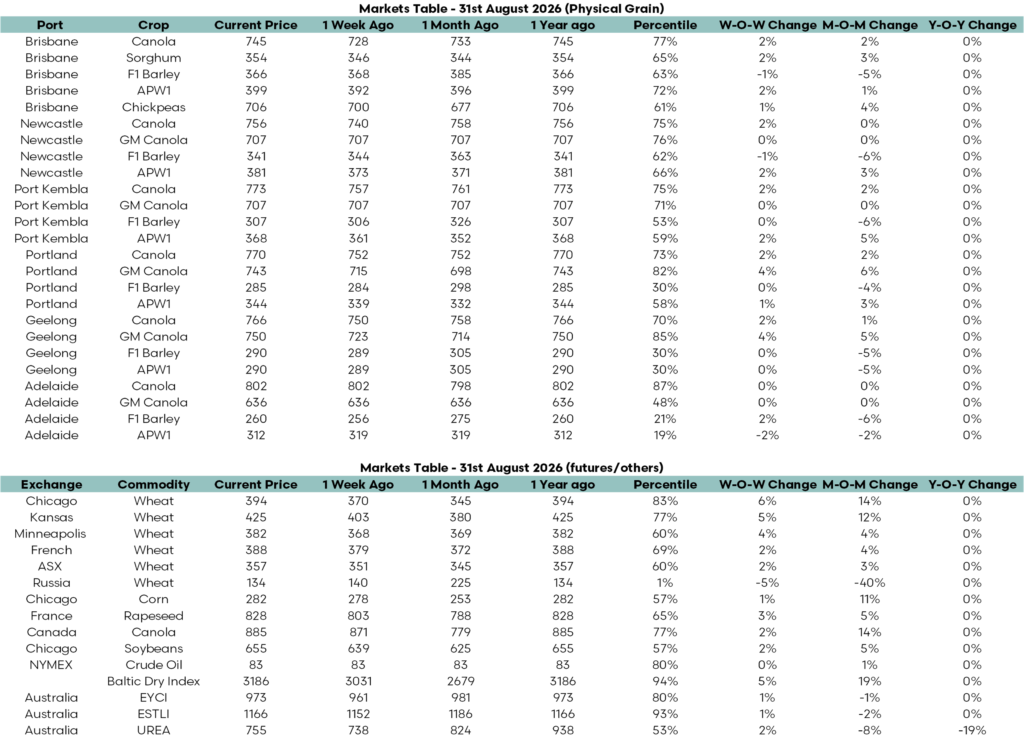
- Black Sea disruption pushed Chicago wheat 6pc higher for the week and 14pc for the month.
- Russia and Ukraine are increasingly relying on alternative export routes that cannot replace normal Black Sea capacity.
- Australian wheat participated in the rally, although gains varied substantially between ports.
- Australia is still heading for a very large winter crop, with ABARES forecasting 60.9Mt.
- Urea bounced while DAP softened, giving Australian growers mixed signals on input costs.
The Detail
Writing the grain market update is starting to feel a little like Groundhog Day. I open the computer, look at what moved wheat and, once again, we are back in the Black Sea. Russia and Ukraine are attacking ports, ships are struggling to move, exporters are searching for alternative routes and wheat prices are rallying. The names and numbers change, but the underlying story stubbornly refuses to go away.
This time, however, the disruption is becoming harder for the market to ignore. Chicago wheat rose 6pc over the week and is now 14pc higher than a month ago, while Kansas wheat gained 5pc and French wheat 2pc. Russian and Ukrainian exporters are both trying to work around disruption to their normal routes, but the numbers show why that is difficult. Russia moved 46.3Mt of grain through the Azov and Black Sea last season, around 90pc of its seaborne exports. Rail requests towards Baltic ports have surged, but Russian Baltic terminals have capacity of only around 7Mt annually. Even with other ports and land routes included, industry estimates suggest alternatives could replace only around half of normal Black Sea movements.
Ukraine has the same problem from the other side of the conflict. Weekly exports did improve 28pc to around 241,000t as more grain moved towards the Danube, but that remains a fraction of the roughly 760,000t per week being exported in early July when the major seaports were functioning normally. Ukraine had been moving at least 4Mt of food exports each month before the latest blockade, compared with expectations of around 1.7Mt during August. Alternative routes exist, but they are slower, more expensive and simply do not have the same capacity.
At the same time, buyers looking elsewhere are finding that Europe has its own problems. French corn conditions have deteriorated to just 28pc good-to-excellent, compared with 62pc a year ago and the lowest level on record since 2011. The European Commission has cut EU maize production to 50.1Mt, a 19-year low. That matters for wheat because less corn means more wheat may need to stay within Europe for livestock feeding, just as importers are looking towards France, Romania and Poland to replace disrupted Black Sea grain.
Australian prices have participated in the rally, although certainly not evenly. APW1 rose 2pc for the week in Brisbane, Newcastle and Port Kembla, while Portland gained 1pc. Adelaide went the other way, falling 2pc to $312/t. That difference is important because a global futures rally does not automatically translate dollar-for-dollar into every Australian port. Basis, local crop expectations and regional supply still matter.
On that supply front, ABARES now expects Australia to produce a 60.9Mt winter crop, the fourth largest on record and around 16pc above the ten-year average. Wheat is forecast at 29.9Mt, barley at 16.4Mt and canola at 7.3Mt, with South Australia and Victoria among the strongest contributors. I have written separately about the broader ABARES report, and separately again about the extraordinary lentil number, so I will spare regular readers another full lap of those numbers here.
Canola was also stronger this week. Most eastern non-GM values gained around 2pc, while GM canola at Portland and Geelong rose 4pc. Offshore markets provided support, with French rapeseed up 3pc and Canadian canola up 2pc. Corn and soybeans were firmer as well, although their weekly moves were more modest.
Fertiliser continues to send mixed signals. Australian urea rose 2pc to A$755/t this week, although it remains 8pc below a month ago and 19pc below last year. Global urea markets have recently firmed, and Australian spot indications increased to around US$480–500/t CFR. DAP moved the opposite way, with Australian spot values easing from around US$930–935/t to US$910–920/t. Phosphate availability remains tight, however, so the current expectation is for gradual easing rather than a dramatic collapse.
The Black Sea has therefore handed wheat growers another opportunity, but it is worth remembering how quickly these markets can change. I wrote about this separately last week because geopolitical rallies are particularly dangerous to become greedy around. Wheat can rise quickly when traders fear exports will disappear, but if peace negotiations suddenly progress, ports reopen or commercial shipping becomes safer, that risk premium can disappear just as quickly.
Nobody knows whether the next Black Sea headline adds another $30/t or removes $30/t. That uncertainty is precisely the point. You do not need to sell everything because the market has rallied, but when war hands you a better price, it is worth considering whether taking some of that opportunity is preferable to waiting for the perfect one.