
Global lamb pricing update Aug 2026

Lamb pricing update - August 2026
Global lamb prices continued to converge during August, with the most significant moves coming from a sharp correction in the UK, further strength in New Zealand and a softer Australian market. The latest movements have changed several of the pricing relationships between the world’s major lamb producing regions, although Australia remains positioned between lower-priced New Zealand and the higher-priced Northern Hemisphere markets.
Australian lamb prices have eased from 1,215 A¢/kg in July to 1,173 A¢/kg during August, a decline of around 3.5pc for the month. The fall comes after the strong rally in Australian lamb prices through the first half of 2026 and represents a relatively modest correction compared with the movements occurring in some international markets.
New Zealand has continued to move in the opposite direction. NZ lamb prices increased from 920 A¢/kg in July to around 960 A¢/kg during August, representing a monthly increase of approximately 4.3pc. That combination of softer Australian prices and stronger New Zealand prices has substantially narrowed the price gap across the Tasman. Australia was trading at a 32pc premium to New Zealand during July, but that premium has fallen to just 22pc in August. It is a significant compression in only one month and continues the convergence that has been evident between the two markets as New Zealand prices recover from the comparatively weak levels seen earlier in the cycle.
The largest international movement, however, has occurred in the UK. UK lamb prices have fallen from around 1,565 A¢/kg in July to approximately 1,400 A¢/kg during August, a decline of 10.5pc. This follows an extraordinary run in British lamb prices during the first half of the year and means the UK has now undergone a substantial correction from the highs reached during autumn and early summer. Importantly for Australia, that correction has rapidly reduced the premium commanded by UK lamb. Australian lamb was priced around 21pc below the UK market in July and that discount has narrowed to approximately 17pc in August. In other words, Australian lamb has become relatively more expensive against UK product even though Australian prices themselves have fallen. That is because the UK correction has been considerably larger than the decline experienced locally.
The European market has also weakened, although the movement has been much less dramatic. EU lamb prices have declined from approximately 1,495 A¢/kg to 1,440 A¢/kg, representing a fall of around 3.7pc. Interestingly, this has left Australia’s relative position against the EU almost unchanged.
Australian lamb was around 19pc below EU prices in July and remains approximately 19pc below them during August. Both markets have declined by similar proportions, maintaining the existing price relationship despite lower absolute values.
Combining the UK and EU markets provides an even clearer picture of the broader Northern Hemisphere correction. The combined UK/EU benchmark has fallen from 1,530 A¢/kg in July to around 1,420 A¢/kg during August. That represents a decline of approximately 7.2pc in a single month.
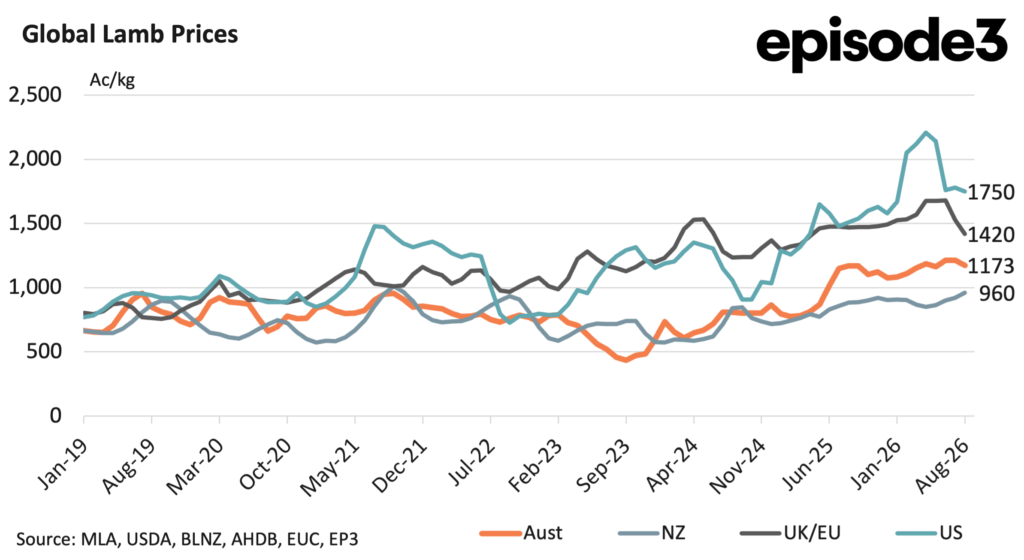
The United States has been considerably more stable. US lamb prices have eased from 1,781 A¢/kg to approximately 1,750 A¢/kg, a comparatively modest decline of 1.7pc. This follows the much larger correction that had already occurred from the US market’s earlier 2026 highs. Despite those previous falls, the United States remains the highest-priced market within the global comparison. The interesting development is that Australia’s discount to the US has widened slightly during August. nAustralian lamb was approximately 32pc below US values in July and is now around 33pc below. That reflects Australian prices falling more quickly than US values over the latest month and is the opposite of what has occurred against the UK.
The global price structure is therefore changing in several directions simultaneously. New Zealand is moving closer to Australia from below, while the UK is moving rapidly towards Australia from above. The EU remains at a relatively stable premium to Australia, while the US has stabilised sufficiently for its premium over Australian lamb to widen marginally. For Australian exporters, that produces an interesting competitive environment.
Australian prices sit at substantial discounts into some of the world’s highest-value lamb markets. At the same time, Australia’s premium over New Zealand has fallen by ten percentage points in just one month, increasing the relative competitiveness of Australian product against its most important export competitor. The question heading into spring is how much increasing seasonal supply as we move toward the spring flush creates further downward pressure and further narrows the gap between Australian and New Zealand pricing.