
China safeguard trigger hurts beef processor conditions
Get short video updates on your phone
For quicker updates as markets move, follow @themeatwatcher on Instagram. I regularly post short summaries and charts breaking down what’s happening in meat proteins and broader ag markets so you can stay across the key moves without having to read through pages of analysis. If markets are moving quickly, that’s usually where the updates will land first.
Beef Processor Trading Conditions Update June 2026
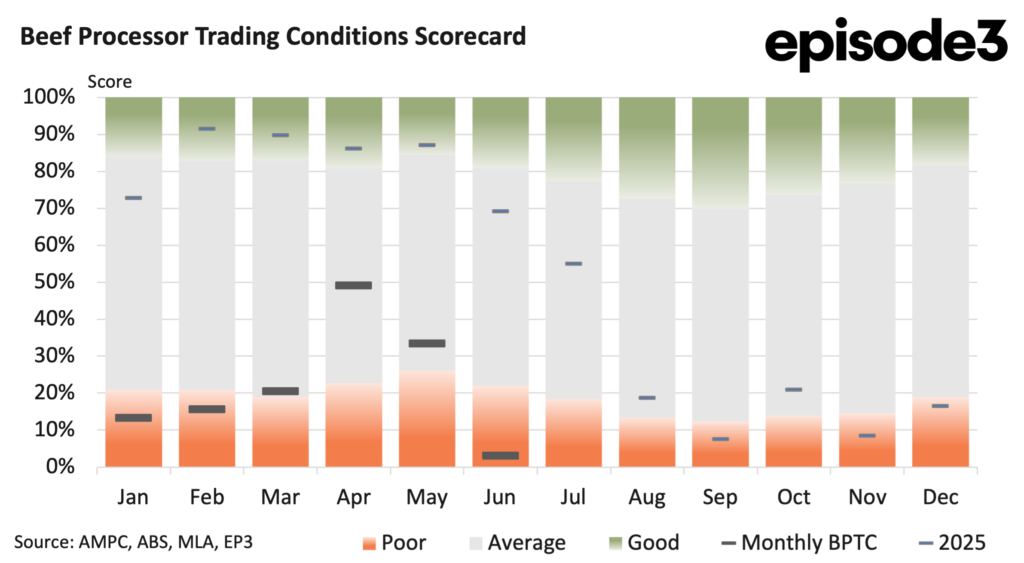
Beef processor trading conditions deteriorated sharply during June, with the Beef Processor Trading Conditions index falling to just 3pc as rising cattle procurement costs collided with weakening export returns. The June result was a significant reversal from May and dragged the average BPTC score for the first half of 2026 down from 26pc to 23pc. That compares with an extraordinary average of 83pc over the first six months of 2025, highlighting just how dramatically the processing environment has changed over the past twelve months. The difference between the two periods is particularly striking given Australian beef production and exports remain historically strong. Processors are moving plenty of beef, but the margins available for doing so have become considerably tighter.
June delivered pressure from both sides of the processor equation, with cattle becoming more expensive at the same time as average export values weakened. Procurement costs increased across all three of the major cattle categories monitored within the BPTC. Heavy steer prices lifted by 4.9pc during June, reversing some of the relief processors had experienced earlier in the year. Young cattle recorded an even stronger increase, rising by 16.6pc over the month. Processor cow values were also substantially higher, increasing by 13.1pc.
These are significant movements for an industry where livestock procurement represents the largest individual cost of turning cattle into beef. The increase in cow values is particularly important given the role manufacturing beef plays in Australia’s export trade. Higher cow procurement costs become considerably harder to absorb when returns for the resulting beef are simultaneously moving in the opposite direction. That was exactly the situation processors faced during June.
Average export values across Australia’s four largest beef destinations declined by 2.3pc over the month. While that headline movement appears relatively modest, the individual market performances reveal a much more significant shift in the trading environment.
China was the standout source of weakness, with average export values falling by 11pc during June. The decline coincided with Australia’s safeguard quota being filled and the higher tariff subsequently applying to Australian beef entering the Chinese market. That fundamentally changed the economics of trade into what has been one of Australia’s fourth largest beef destinations. Product that might otherwise have been directed towards China increasingly needed to compete for a home elsewhere, placing additional pressure on returns across the export complex.
The United States also eased slightly, with average Australian beef export values declining by 0.7pc during June. This was a relatively minor movement, and the US remains an extremely valuable destination for Australian beef, particularly given ongoing tightness in American cattle supplies. Japan provided some support, with export values increasing by 1.5pc.South Korea was also firmer, recording a 2.1pc increase over the month. However, improvements into Japan and South Korea were nowhere near enough to offset the deterioration in Chinese values. The result was the 2.3pc decline across the top four markets at precisely the same time processors were facing substantially higher cattle costs.
Domestic conditions offered no relief either with Australian retail beef prices easing by 0.4pc during June. The movement itself was small, but its direction added to the margin pressure evident elsewhere. Processors were paying more for cattle while receiving slightly less from the domestic market and, on average, less from their major export destinations. It is difficult to design a less favourable combination for processing margins.
That helps explain why the BPTC collapsed to just 3pc despite the Australian beef industry continuing to operate at high production levels. The result also demonstrates how quickly conditions can change. During April, falling cattle prices provided processors with a substantial improvement in margins and pushed the BPTC sharply higher.
June, that advantage had effectively disappeared. Cattle prices had rebounded while the export environment had become considerably more difficult.
The comparison with 2025 remains particularly stark. An average BPTC of 83pc during the first half of last year represented an exceptionally favourable period for processors. The equivalent 23pc reading for 2026 shows that those conditions are now firmly in the rear-view mirror. The outlook from here will depend heavily on how export flows adjust to the changing trade environment.