Market lessons: The value of averaging up

Market Lessons
Sharp rallies are exciting, but they also create one of the harder decisions in grain marketing. When prices are moving higher, there is always a temptation to wait for a little more. The problem is that nobody knows in advance where the rally will finish, how long it will last or whether a sharp fall is the end of the move or simply a correction before another leg higher.
The concern in the current rally has been that it is based on the actions of Ukraine and Russia, and if peace looks on the cards, markets will crash.
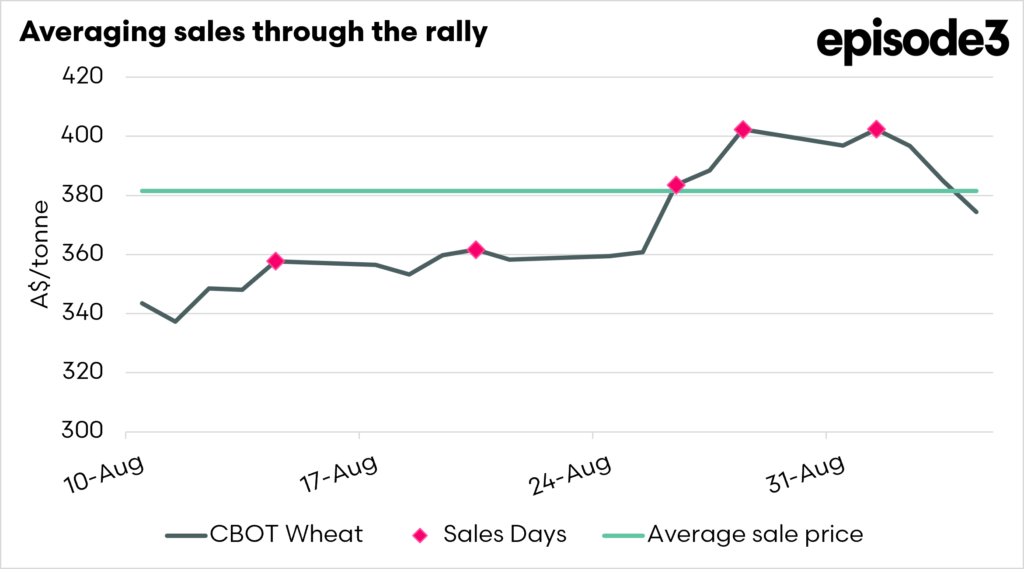
The recent move in CBOT wheat is a good example. During August, the December 2026 contract moved from the mid-A$340s to above A$400/mt before falling back to around A$374/mt by 4 September. That does not mean the rally is necessarily over. Prices could recover and move higher again. The point is that growers do not need to know the eventual high to make sensible marketing decisions while a rally is occurring.
For the chart, we used a simple rules-based example. Five equal parcels, each representing 20pc of the grain being marketed, were sold as the market moved through progressively higher price levels. The sale dates were not picked afterwards because they happened to look good. They were based on the first trading day the market moved through a series of approximate price thresholds around A$350, A$360, A$375, A$390 and A$400/mt.
That produced an average sale price of about A$381.55/mt across the five tranches. By 4 September, the market had fallen back to A$374.44/mt. The important point is not that the average happened to be around A$7/mt above the market at that point. If wheat rallies again next week, that comparison could quickly change.
The value of averaging is that some grain is progressively priced as the market improves, without requiring the grower to decide where the top will be. If prices continue higher, there are still tonnes available to participate. If the market reverses, some of the opportunity has already been captured.
There is also nothing special about the 20pc increments or the price levels used in this example. Growers can create their own rules. Some may sell every A$10/mt rise, others at fixed time intervals, when local basis reaches a target, when a gross-margin goal is met, or by combining several of those signals. The exact method matters less than having a process you understand before the market starts moving quickly.
Good grain marketing is not about making one perfect call. It is about spreading decisions, managing risk and responding to opportunities as they appear. Averaging up is one way of doing that without relying on knowing what tomorrow’s price will be.