
Cattle tighten as buyers fight for numbers
Market Morsel
The latest Cattle Yarding and Slaughter Index shows the Australian cattle market has tightened noticeably through August, with yardings falling sharply across several key eastern states while processor activity remains comparatively resilient.
The most important development is the shift in cattle availability. New South Wales yardings fell from 64pc in July to 43pc in August. Queensland dropped even more sharply, sliding from 97pc to 61pc. Tasmania fell from 45pc to 22pc, while Victoria declined from 53pc to 22pc. South Australia was slightly firmer, moving from 30pc to 33pc, and Western Australia improved from 31pc to 39pc.
That is a very different picture to the one seen earlier in winter. Through June and July, Queensland had been providing strong cattle flow, helping keep northern slaughter activity elevated. By August, that supply pulse had eased considerably. The reduction in yardings across NSW, Queensland, Victoria and Tasmania points to a genuine tightening in cattle availability rather than simply a change in processor behaviour.
The slaughter side of the index is more mixed. New South Wales processing activity increased from 21pc to 38pc despite the drop in yardings. Queensland eased from 59pc to 52pc. South Australia declined from 91pc to 80pc. Tasmania was broadly steady at 26pc. Victoria fell from 53pc to 44pc. Western Australia edged higher from 69pc to 71pc.
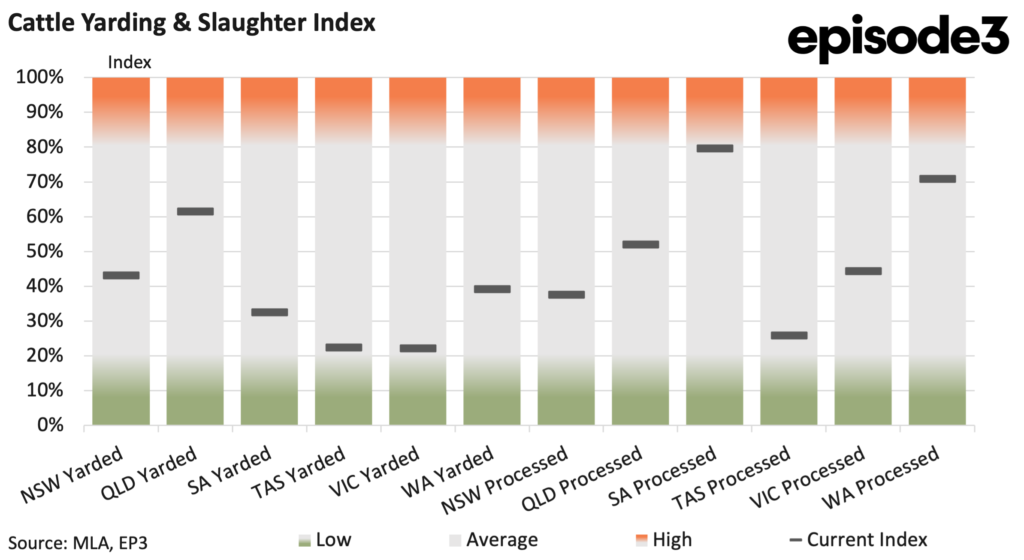
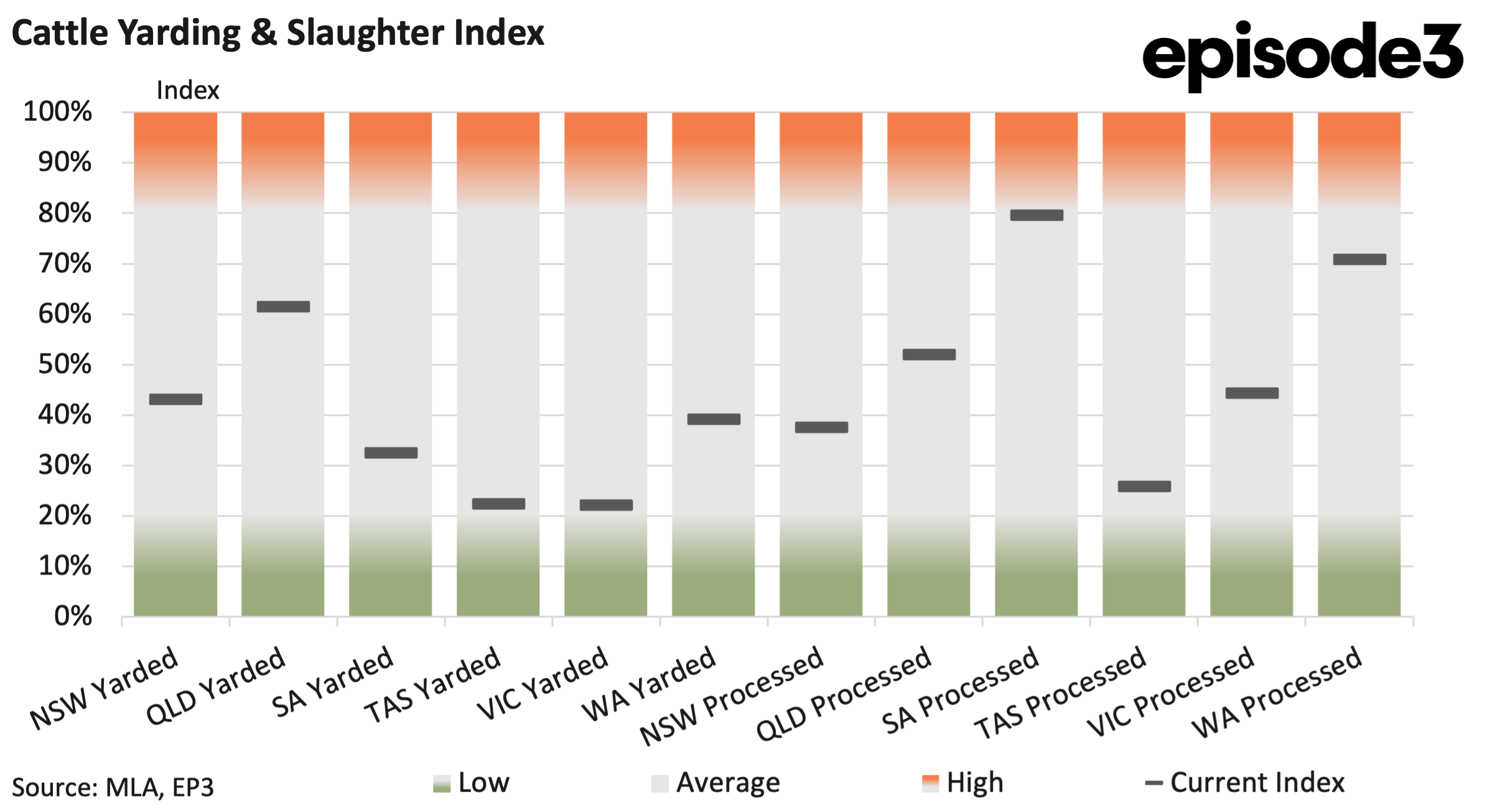
The August figures suggest processors are still trying to maintain throughput even as fewer cattle come forward. That is particularly obvious in New South Wales, where yardings dropped sharply but slaughter activity increased. This type of divergence usually indicates processors are drawing more heavily on direct consignments, previously booked cattle or stock sourced from outside the immediate saleyard system. It can also indicate greater competition for available cattle as plants try to keep chains moving.
That interpretation is supported by the recent price trends. Heavy steer values have risen by 38c/kg liveweight over the past four weeks. Processor cow prices are up by 22c/kg liveweight. Feeder steers and feeder heifers have both gained over 20c/kg liveweight. The strongest moves have been in restocker categories, with yearling heifers up 77c/kg and yearling steers rising 49c/kg over the same period.
Those are not the price movements of a market experiencing abundant cattle supply. They point instead to stronger competition across several buyer categories, with processors, feedlots and restockers all having to work harder to secure stock. The processor cow market is particularly interesting. Export manufacturing beef values have weakened over recent months, reducing the value processors can extract from cow beef. Ordinarily, that would place downward pressure on cow grids Instead, cow prices have strengthened. That tells us the supply side is currently exerting more influence than the export side.
Processors may be receiving less for the beef, but they are still being forced to pay more for cattle because the available numbers have tightened. That is an uncomfortable position for processing margins. The same dynamic applies to heavy steers. Heavy steer prices have moved higher despite a softer export trading environment, reinforcing the idea that physical cattle availability is now the dominant short term driver.
The CSYI helps explain why. When yardings fall sharply across several major states while slaughter remains relatively elevated, the procurement task becomes more difficult. Processors cannot simply reduce bids without risking further losses in supply. This is particularly true where plants need to maintain labour, meet customer commitments and avoid inefficient stop start operations. The result is a market where cattle prices can rise even when the value of the finished product is under pressure.
That is the clearest feature of the August update. Earlier in winter, processor caution and softer export returns were enough to keep a lid on prices. Now, tighter cattle availability has changed the equation. The balance of power has moved back towards producers. The strongest evidence of that is not only the lift in heavy steer and cow values, but the sharp rebound in restocker categories. Restocker demand appears to have strengthened considerably as seasonal conditions improve and confidence returns to parts of the production sector. This adds another source of competition for cattle that might otherwise have moved more quickly towards processors. The market is no longer simply about how much beef can be sold. It is increasingly about whether enough cattle can be secured at a price that leaves a workable margin. For now, the supply side is winning that battle.