
Feedlot update Q2, 2026
June 2026 cattle on feed update
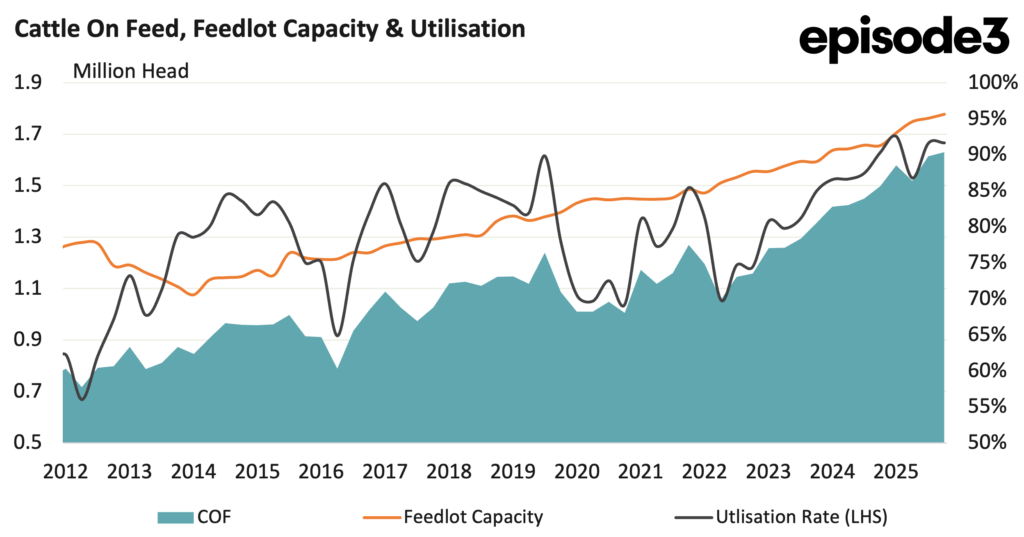
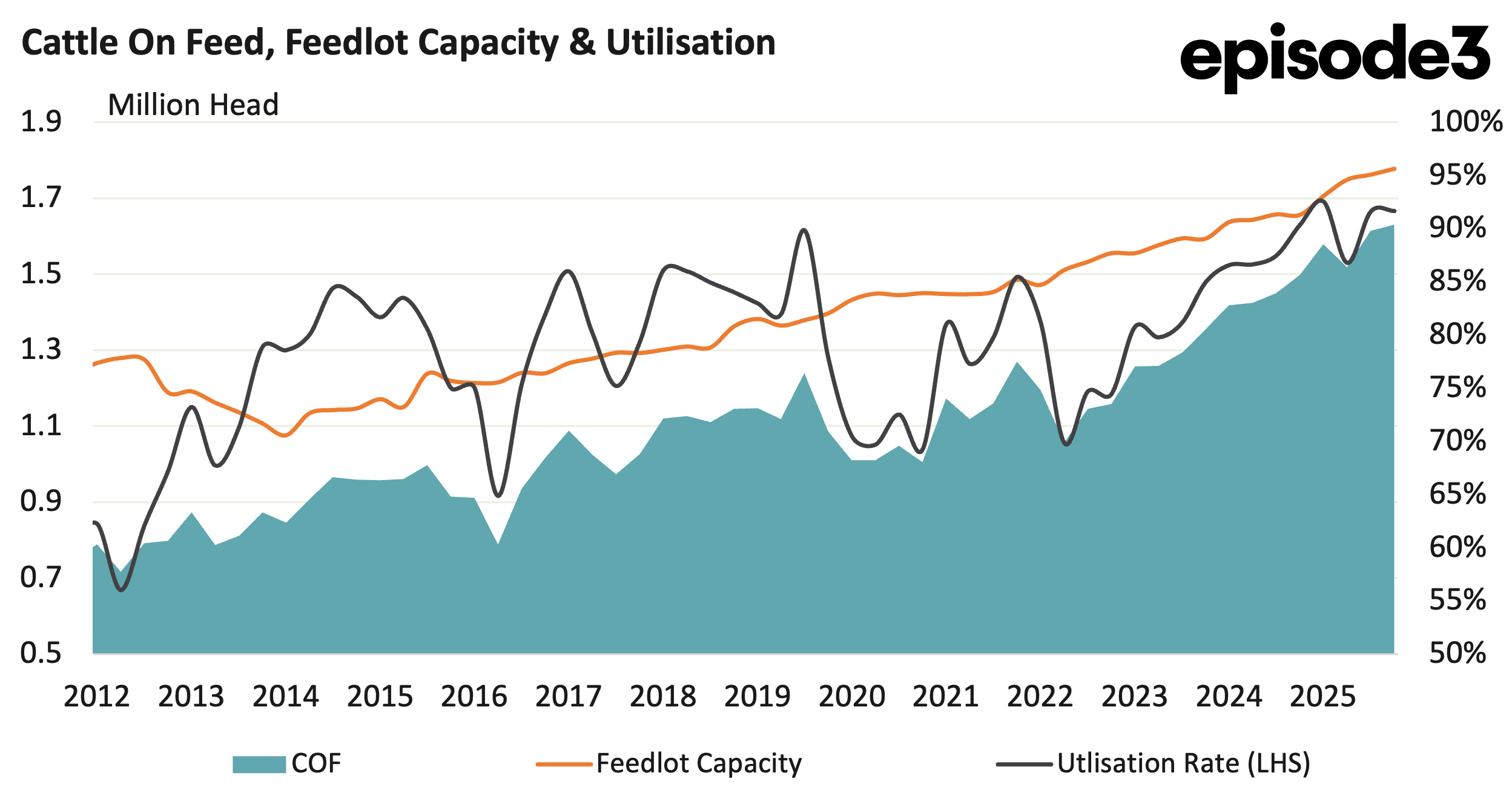
Australian feedlots pushed further into record territory during the June quarter, with numbers on feed, capacity and turnoff all setting new highs. National feedlot capacity increased to 1.795 million head, up 1pc from March and 5.2pc higher than a year earlier. Cattle on feed lifted another 1.9pc to 1.661 million head, while national utilisation increased from 92pc to 93pc.
The story is becoming increasingly familiar. New feedlot capacity continues to be added, but cattle are filling that space almost as quickly as it becomes available. Compared with June 2025, cattle on feed have increased by more than 81,000 head, or 5.2pc. The Australian beef supply chain is becoming increasingly reliant on the feedlot sector, and the June quarter numbers reinforce just how large that part of the production system has become.
Turnoff remained above the one million head mark for the second consecutive quarter. Feedlots sent 1.051 million cattle to slaughter during Q2, marginally above the March quarter record of 1.047 million head but 17.5pc higher than June 2025. Across the first half of 2026, feedlot turnoff has therefore reached almost 2.1 million head.
Queensland continues to be the powerhouse of the system. Numbers on feed lifted 4.5pc during the quarter to 973,049 head, while capacity was unchanged at 988,599 head. That pushed Queensland utilisation from 94pc to an extraordinary 98pc. Turnoff also increased 3.2pc to 653,734 head, meaning Queensland alone accounted for more than 62pc of national grainfed turnoff during the quarter.
NSW went down a slightly different path. Capacity increased 3pc to 558,601 head, accounting for almost all of the additional feedlot capacity added nationally during Q2, but cattle on feed were broadly steady at 503,502 head. Turnoff eased 3.9pc to 268,112 head. Victoria and Western Australia also recorded lower numbers on feed, so much of the national increase during the quarter was effectively a Queensland story.
The more interesting longer term shift remains the balance between grain finished and grass finished cattle.
ABS slaughter data shows around 4.8 million adult cattle were processed during the first six months of 2026. Of those, approximately 2.1 million were grain finished and 2.7 million were grass finished. That puts the grainfed share of slaughter at 43.5pc, compared with 39.4pc during 2025.
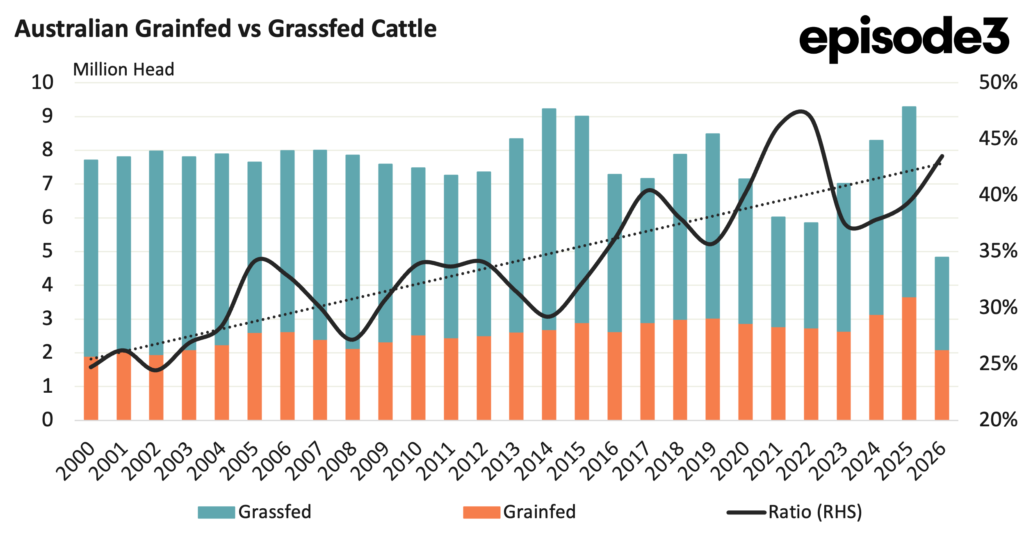
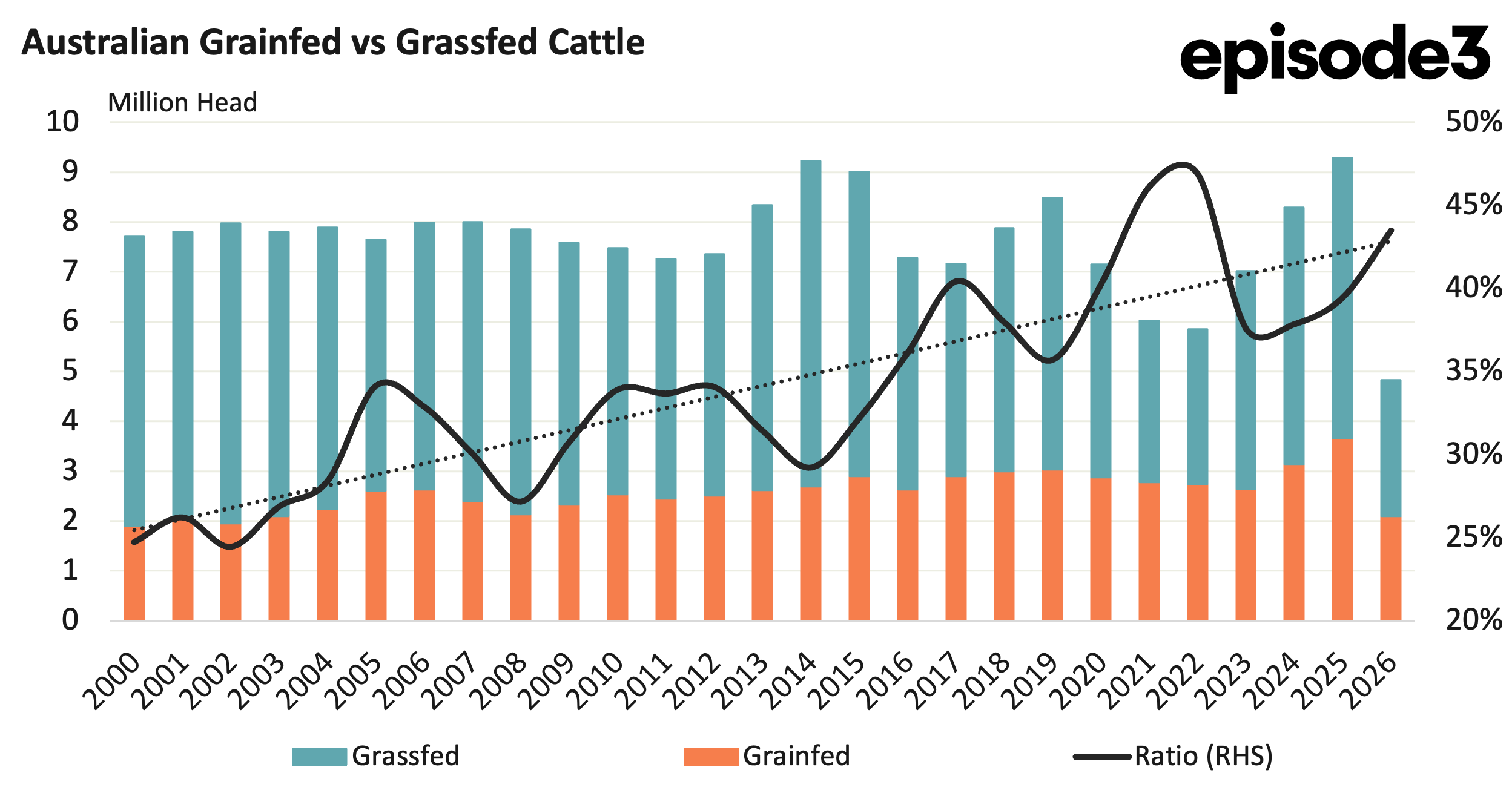
The 2026 figure only covers the first half of the year, so it is not yet a completed annual observation, but the direction is difficult to ignore. Around the turn of the century, grainfed cattle represented roughly one quarter of Australian adult cattle slaughter. The underlying trend has been steadily higher since then and, based on the first six months of 2026, more than four in every ten cattle processed in Australia are now coming through the feedlot system.
What makes this particularly interesting is that the rising grainfed share is occurring without the normal herd rebuild signal sitting behind it.
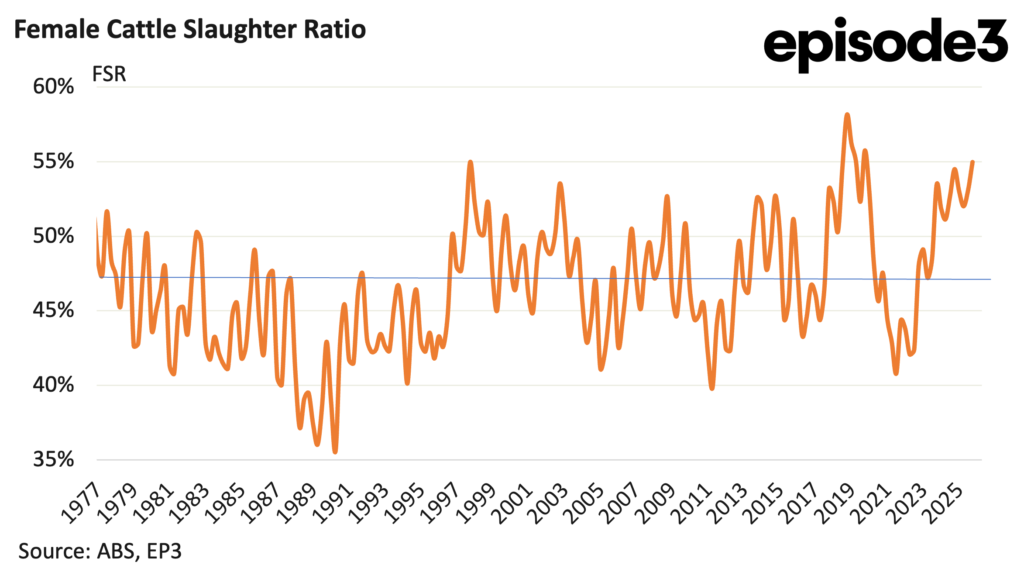
In Q1, the grainfed share of slaughter jumped to 45.5pc, which could have been interpreted as an early rebuild signal. Normally, producers begin retaining females as seasonal conditions improve, grassfed slaughter contracts and the relatively consistent feedlot pipeline consequently represents a greater proportion of the kill. But the female slaughter ratio was sitting at 53.1pc, suggesting the herd was still in liquidation territory rather than rebuilding.
That disconnect became even clearer during Q2. The national female slaughter ratio increased to 55pc, with a record 1.387 million female cattle processed during the quarter. The annual FSR is now running around 54pc, comfortably above the 47pc level we use as the broad dividing line between herd liquidation and rebuild. Total cattle slaughter during the first half of 2026 was also 6.9pc higher than the same period last year.
In other words, grainfed cattle are increasing their share of Australian slaughter even while grassfed cattle remain available in very large numbers and female retention remains weak. That points increasingly towards structural growth in lotfeeding rather than the grainfed ratio simply being pushed higher by a cyclical contraction in grassfed supply.
Demand is helping underpin that growth. Grainfed beef exports reached a record 121,750 tonnes during the June quarter, 7.7pc above the same period last year. Japan and South Korea were particularly strong, while shipments to China eased as market access issues disrupted trade. At the same time, feeder cattle availability tightened, with feeder steer throughput down 11pc and feeder heifer throughput falling 13pc during the quarter. Prices moved the other way, with the feeder steer indicator up 2.5pc and feeder heifers lifting 4.7pc.
That leaves the feedlot sector balancing some competing pressures. International demand for grainfed beef remains strong and utilisation is sitting close to maximum levels, particularly in Queensland, but feeder cattle are becoming more expensive and grain prices have also increased feed costs.
The Q2 feedlot numbers therefore reinforce the two themes evident earlier in the year. Australian lotfeeding continues to expand in scale and importance, with record cattle numbers, capacity and turnoff. But the increasing grainfed share of slaughter should not be mistaken for evidence that the cattle herd has begun rebuilding.
Almost 44pc of cattle slaughtered during the first half of 2026 were grain finished, despite female slaughter remaining firmly in liquidation territory. That suggests something more structural is underway. Feedlots are not simply filling a temporary gap created by the cattle cycle. The long-term trend suggests they are taking an increasingly important role in Australia’s beef production system.