Market lessons: Forward contract or swap?

Market Lessons
There is more than one way to reduce grain price risk before harvest. Two common tools available to Australian growers are forward contracts and swaps. Both can provide price protection, but in quite different ways.
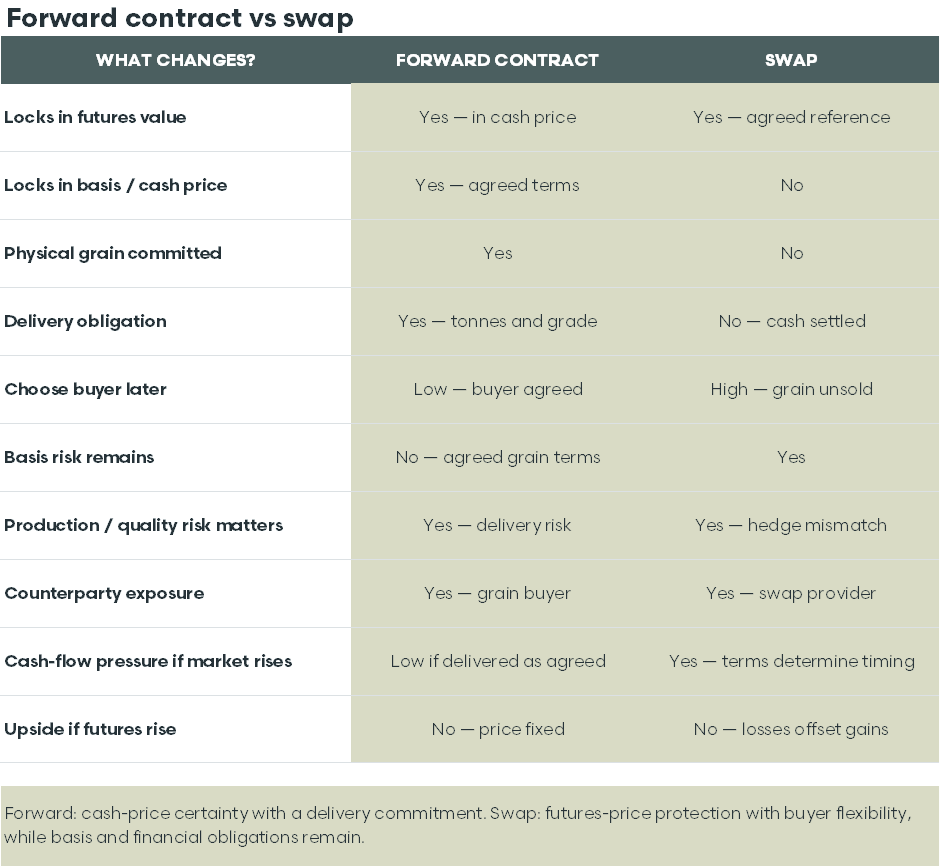
A forward contract is the simpler and more common of the two. The grower agrees to sell a set quantity and quality of grain to a buyer, usually for a nominated delivery period, at an agreed cash price. That price effectively combines the futures market, basis, and other local pricing factors into one number.
The advantage is certainty. If a grower forwards 500 tonnes of wheat at A$350/mt, they know the price they will receive on those tonnes provided they meet the contract requirements.
The trade-off is that the grower has committed the physical grain. If production is lower than expected, quality does not meet specification or circumstances change before delivery, the grower still has a contract to manage. The certainty around price therefore comes with reduced flexibility.
A swap works differently. Rather than physically selling grain, the grower fixes the futures component of the price through a financial contract. The physical grain remains unsold.
This can be useful when a grower considers the futures component attractive but wants to retain flexibility over where and when the grain is eventually sold. They can still choose the physical buyer later and potentially take advantage of changes in local basis.
That flexibility creates a different set of risks. A swap does not lock in the final cash price because basis remains open. If the futures component has been fixed but local basis subsequently weakens, the final physical grain price may still be lower than expected.
The grower also still carries a hedge commitment. If futures rise after the swap is established, the swap moves against the grower while the physical grain generally increases in value. Australian swap products often incorporate futures margining mechanics within the product rather than requiring the grower to manage exchange margin calls directly, but the financial exposure has not disappeared. The swap terms cover it.
Production risk also looks different. A forward contract creates a physical delivery obligation. A swap does not require physical delivery, but if a grower hedges more tonnes than they eventually produce, they may be left with a financial position that is no longer matched by grain.
Neither approach is automatically better. A forward contract provides greater certainty over the complete physical sale. A swap provides greater flexibility by separating the futures decision from the physical grain sale.
The important question is therefore not simply which price looks better. It is which risks the grower wants to remove, and which risks they are comfortable leaving open.