
Rain puts the brakes on cattle supply as prices surge
Market Morsel
The October Cattle Yarding and Slaughter Index (CYSI) highlights a significant shift in Australian cattle market conditions, with widespread rainfall restricting livestock availability across northern Australia while cattle prices have strengthened sharply. The combination of disrupted cattle movements, improved seasonal confidence and stronger competition from restockers and feedlots has created a market where buyers are paying considerably more for cattle, despite mixed processor throughput across the country.
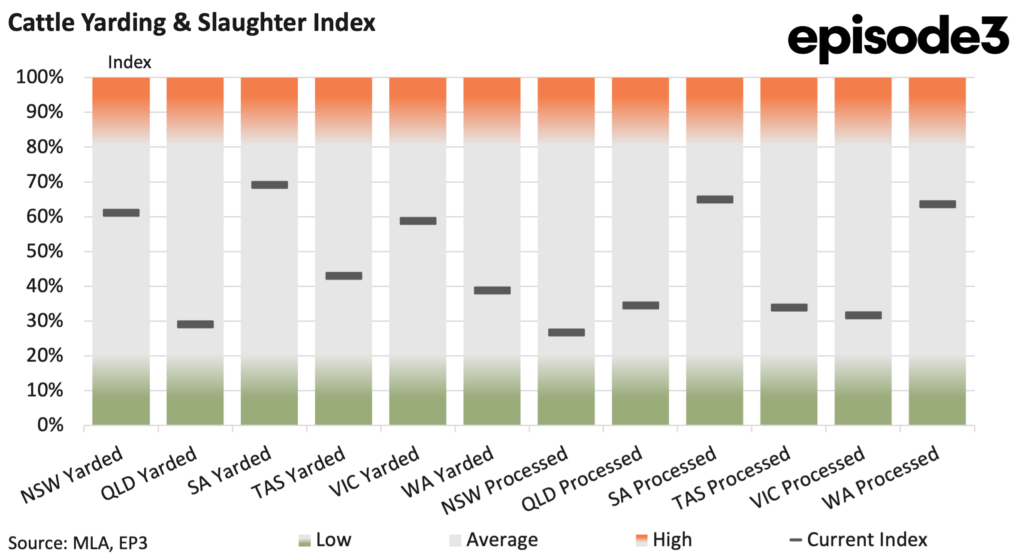
Queensland recorded the most dramatic change in saleyard activity, with its Cattle Yarding Index falling from 85pc in September to just 29pc in October. NSW also recorded a substantial decline, easing from 76pc to 61pc, while Tasmania slipped from 50pc to 43pc. Southern markets moved in the opposite direction, with South Australia increasing from 56pc to 69pc and Victoria rising from 50pc to 59pc. Western Australia remained unchanged at 39pc.
These movements demonstrate how uneven cattle availability has become, with southern saleyards recording increased activity while northern offerings have contracted sharply. The slaughter figures reinforce this regional divergence. Queensland’s Cattle Slaughter Index declined from 46pc to 34pc, while Western Australia fell from 85pc to 64pc and South Australia eased from 69pc to 65pc. NSW increased from 22pc to 27pc, Victoria strengthened from 23pc to 32pc and Tasmania recorded a substantial increase from 13pc to 34pc.
Importantly, these indices measure relative activity rather than actual head counts, meaning individual state movements cannot be combined to determine changes in national throughput. Nevertheless, the decline in Queensland is particularly significant given its importance to Australian beef processing. Widespread rainfall during October has been an important influence on livestock availability, particularly across Queensland and northern NSW. Wet paddocks and difficult road conditions have interrupted livestock movements, restricting deliveries to saleyards and processing facilities.
National weekly slaughter fell by approximately 7,800 head to 140,062 head during the final full week reported in October, with Queensland accounting for most of that reduction. The disruption is not entirely logistical. Improved seasonal conditions are also giving producers greater confidence to retain cattle, add additional weight and potentially delay marketing until early 2027. This change in selling intentions could extend the supply contraction beyond the immediate rainfall disruption, particularly if pasture conditions remain favourable.
The impact on livestock prices has been substantial. Restocker yearling heifers recorded the strongest increase over the past four weeks, gaining approximately 89c/kg liveweight to reach 493c/kg, an increase of more than 22pc. Restocker yearling steers strengthened by almost 75c/kg to 580c/kg, representing a gain of nearly 15pc. Feeder cattle also recorded significant improvements, with feeder steers increasing by 67c/kg to 552c/kg and feeder heifers gaining 61c/kg to 495c/kg. Both feeder categories have strengthened by approximately 14pc over the four-week period.
The substantial gains across restocker and feeder cattle suggest competition for livestock destined for future production has been particularly strong. Improved seasonal confidence is likely encouraging producers to retain or purchase cattle, while feedlot operators continue competing for suitable animals. Processor cattle prices have also increased, although their gains have been more moderate. Heavy steers strengthened by approximately 33c/kg to 487c/kg liveweight, while processor cows increased by 30c/kg to 405c/kg. These movements represent gains of approximately 7pc and 8pc respectively, considerably below the increases recorded across restocker and feeder categories.
The difference highlights the commercial pressures facing processors. While reduced livestock availability is increasing competition for slaughter cattle, weaker export trading conditions are limiting the capacity of processors to continually increase procurement prices. Some processing businesses may respond by reducing operating days or bringing forward seasonal shutdowns rather than pursuing increasingly expensive livestock. Grainfed cattle are providing some protection against the disruption, with feedlot supply generally less exposed to the difficulties associated with moving cattle from wet paddocks. However, this does not eliminate the broader challenge of securing sufficient livestock to maintain processing schedules.
The October CYSI therefore points towards a market where rainfall has altered both immediate livestock availability and producer selling intentions.
Southern cattle movements have been relatively mixed, but the sharp contraction in Queensland supply has coincided with substantial increases across all major cattle price indicators. The strongest gains among restocker and feeder categories suggest producers and feedlots are responding more aggressively than processors. For the remainder of 2026, the critical question is whether improved seasonal conditions continue encouraging cattle retention, or whether livestock availability recovers as access improves. For now, rainfall has strengthened producer selling power, increased competition for available cattle and placed additional pressure on processors already facing challenging trading conditions.