
Cheaper cattle offer little relief to processors as export returns slide

Beef Processor Trading Conditions - August 2026 update
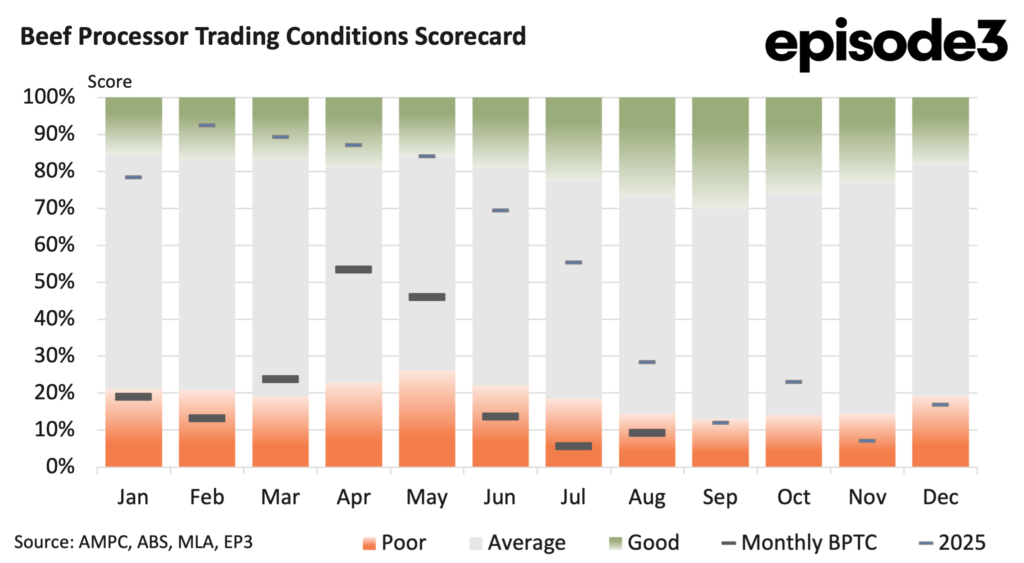
Australian beef processor trading conditions improved marginally during August, although weaker export returns continued to limit the benefits of falling cattle procurement costs. The Episode 3 Beef Processor Trading Conditions (BPTC) index rose from 7pc in July to 9pc in August, offering some relief after the sharp deterioration recorded over the previous three months. Despite the modest improvement, the index remains at historically low levels, highlighting the difficult commercial environment for Australian beef processors. The average BPTC reading for the first eight months of 2026 now stands at just 23pc, compared with 73pc for the corresponding period in 2025. That represents a deterioration of 50 index points, demonstrating how dramatically processor trading conditions have changed over the past twelve months.
The main positive development in August was a reduction in cattle procurement costs across all major categories. Heavy steer prices fell 3.1pc over the month, while processor cow values eased by 1.4pc. Young cattle recorded the largest adjustment, with prices down 7pc in August. These movements followed a period of elevated cattle prices, which had placed considerable pressure on processor margins, particularly as international beef returns began to weaken. For processors, cheaper cattle offer an opportunity to improve the relationship between livestock purchasing costs and the revenue generated from processed beef.
However, the benefit depends heavily on what is happening to meat prices in Australia’s major export destinations. Unfortunately for processors, August delivered another disappointing result on that front. Average beef export values across Australia’s four largest international markets fell by 4.2pc during the month, offsetting much of the improvement achieved through lower cattle prices.
The United States recorded an 8.2pc decline in average export values, representing a substantial reduction in returns from Australia’s largest beef export destination. Japan experienced an even sharper correction, with average export values falling by 8.9pc during August. South Korea also weakened, although the decline was more modest at 3pc. China was the only major destination to record an improvement, with average export values increasing by 5.7pc.
The Chinese result was a welcome positive development following the significant deterioration in export values recorded in July, when returns from that market declined by 18pc. Nevertheless, the improvement in China was insufficient to offset weaker returns across the other three major destinations. The contrasting movements demonstrate the challenges facing processors when international markets move in different directions. While stronger values in one destination can offer some support, widespread declines elsewhere can quickly erode those benefits.
The comparison of cattle procurement costs with export values is particularly important when assessing the August BPTC result. Heavy steer prices fell by 3.1pc, but the average export value across the four major destinations declined by a larger 4.2pc. This suggests that, for processors purchasing finished cattle, softer livestock prices were not necessarily translating into an equivalent improvement in meat trading returns. The larger decline in young cattle prices offered greater potential relief, although the benefits depend on the types of cattle being processed and the markets that supply the resulting beef.
Domestic retail beef prices also weakened during August, declining by 1.1pc. This added another layer of pressure on processor revenues, with the domestic market offering little help in offsetting weaker international returns. The August result therefore reflects competing influences rather than a broad improvement in trading conditions. Lower livestock procurement costs provided some breathing room, but falling export and retail beef values continued to constrain the recovery.
The BPTC index has now declined substantially from its April peak of 53pc, falling to 45pc in May, 13pc in June and 7pc in July, before recovering slightly to 9pc in August. The latest reading suggests the deterioration may have temporarily stabilised, but there is little evidence yet of a sustained recovery. For processors, the challenge heading into spring will be to maintain the benefits of cheaper cattle while securing stronger returns from international beef markets. Unless export values stabilise, any further improvement in processor trading conditions may increasingly depend on further reductions in livestock procurement costs. That would offer little comfort to cattle producers, particularly after the substantial price correction already seen across several categories in August.