
Grand Theft Agriculture: Crime doesn’t pay, unless you’re stealing from farmers
After 13 years of waiting, Grand Theft Auto VI is finally being released this week. Millions of gamers will presumably abandon their families, call in sick to work and spend an unhealthy number of hours stealing cars, robbing businesses and generally being a menace to society.
For anyone unfamiliar with the franchise, GTA is essentially a crime simulator without the inconvenience of court appearances, prison sentences or lengthy discussions with an insurance company. Unfortunately, some people appear to have been getting in some early practice.
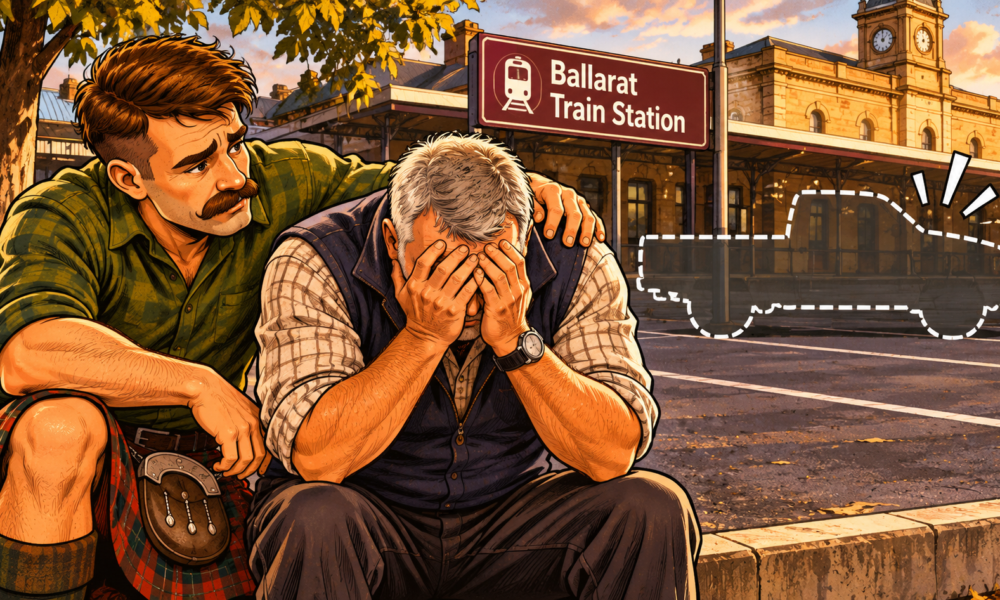
My fellow Episode 3 analyst Matt Dalgleish recently had his car stolen in Ballarat, while members of my family suffered a similar experience on a rural property in Scotland. Neither incident is believed to have been part of an elaborate GTA marketing campaign.
The incidents also provide a useful excuse to look at something considerably less amusing: rural crime and what it actually costs agriculture.
Grand Theft Livestock
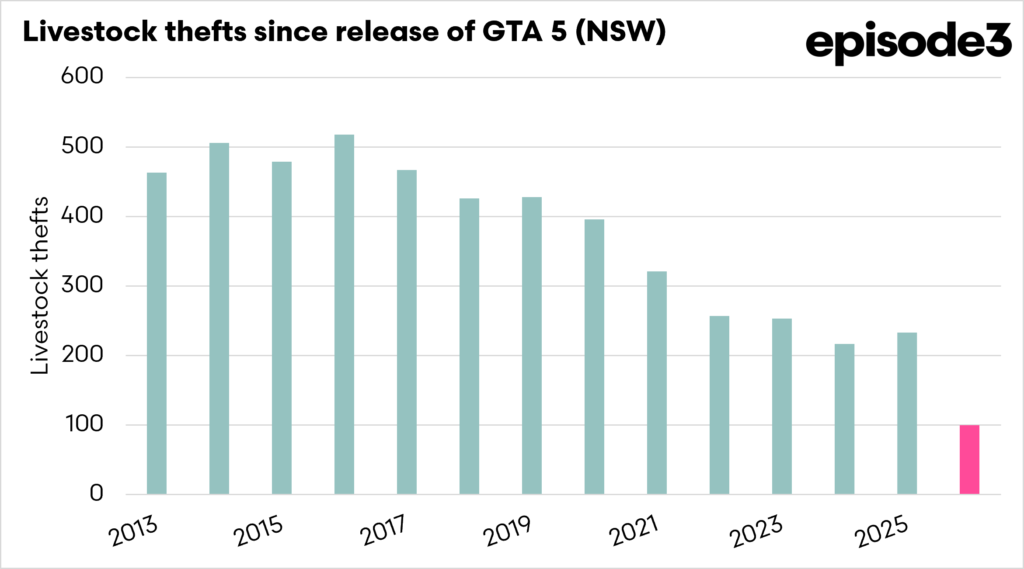
Using data from the NSW Bureau of Crime Statistics and Research, we looked at reported livestock theft since GTA V was released in September 2013.
NSW was recording roughly 460 livestock theft incidents a year around that time. By 2025, the number had fallen to around 230, a decline of about 50pc. The peak came in 2016 at more than 500 incidents, while recent years have generally sat between 200 and 260.
On the surface, that is encouraging. Australia’s cattle rustlers appear to have suffered a fairly severe downturn; maybe they are too busy playing video games?
The problem is that recorded crime only measures what gets reported.
Research from the University of New England found that around 90pc of NSW respondents to a national farm crime survey had experienced crime on their properties, with roughly 30pc reporting seven or more incidents. Trespassing, illegal hunting and livestock theft were among the most common offences.
More importantly, only around 30pc of surveyed farmers who experienced livestock theft reported it to police.
That makes the official decline much harder to interpret. Recorded livestock theft may have halved since 2013, but is that what’s actually happening on farms?
There are obvious reasons for under-reporting. A missing mob may not be noticed immediately, particularly on large properties, and by the time animals are discovered missing, there may be little evidence of when they disappeared or who took them.
In GTA, stealing a vehicle brings police cars and helicopters within seconds. On a farm, you might not notice the stock is missing for weeks or months.
Grand Theft Tractor
Livestock are only one part of the problem. Modern farming businesses hold enormous amounts of valuable machinery, vehicles, fuel, chemicals and electronic equipment, often spread across properties covering thousands of hectares.
A tractor or header can cost hundreds of thousands of dollars. GPS guidance equipment can be worth tens of thousands. A full bulk diesel tank can represent another sizeable asset sitting exposed.
This is where rural crime becomes more than an insurance problem. What is being stolen is often productive capital.
Lose a GPS unit during seeding, and the damage isn’t simply the replacement cost. Lose diesel during harvest and expensive machinery can sit idle. Lose breeding livestock, and the value may include genetics and years of future production, not just what the animals were worth the day they disappeared.
The economics also become more attractive to thieves as asset and input values rise.
At $1.50/litre, stealing 1,000 litres of diesel gives someone $1,500 worth of fuel. At $2.50/litre, the same effort produces $2,500 worth of stolen product.
A 67pc increase in revenue without any productivity improvement. Impressive business growth, apart from the minor detail that it is completely illegal.
Higher fuel prices earlier this year were accompanied by reports of increasing diesel theft, suggesting criminals are following commodity markets.
For farmers, the costs can extend well beyond whatever disappears through the gate. Harvest delays, machinery downtime, insurance excesses, replacement costs and lost production can turn what looks like a relatively small theft into a much larger commercial problem.
Protecting productive capital
Farm security is difficult because farms are not suburban houses. You cannot put a six-foot fence around several thousand hectares, and expensive machinery often has to operate far from sheds, houses, and other people.
That does not mean security should be treated as an afterthought.
Removing keys, locking vehicles, securing fuel tanks and using GPS trackers on high-value machinery are obvious starting points. Cameras and motion-activated lighting around sheds and fuel storage are relatively inexpensive compared with what they protect.
Accurate records matter as well. Machinery serial numbers, photographs and inventories make life considerably easier if something disappears. Livestock records and regular checks of remote paddocks can also help you spot problems sooner.
Neighbouring farmers may still be one of the best security systems available. Rural communities tend to notice unfamiliar vehicles, unusual movements, and people who probably shouldn’t be where they are.
Australian farms can have millions of dollars invested in machinery, livestock, and inputs, yet security spending can be quite minimal.
If a business wouldn’t leave a $500,000 tractor uninsured, leaving the keys in it beside an unlocked diesel tank may take the open-door policy too far.
Grand Theft Auto VI will undoubtedly make billions of dollars from people pretending to steal cars, machinery and just about everything else that moves.
Livestock theft in NSW has roughly halved since GTA V was released. The less comforting part is that substantial under-reporting means we don’t really know how much crime goes unrecorded.
As for Matt and my family, hopefully their recent experiences with Grand Theft Auto will be their last outside the virtual world.
Perhaps the most unrealistic part of GTA is not the ability to steal almost anything, the extraordinary number of crimes one person can commit, or the complete lack of concern about the price of fuel.
It is that when you report a crime, the police arrive almost immediately.