
Producing the most does not mean supplying the world
The Snapshot
- The biggest producer is not always the biggest exporter.
- Exportable surplus often matters more to global prices.
- China produces heavily but consumes most of it domestically.
- Brazil dominates both production and exports across several commodities.
- Australia punches above its weight in global agricultural trade.
The Detail
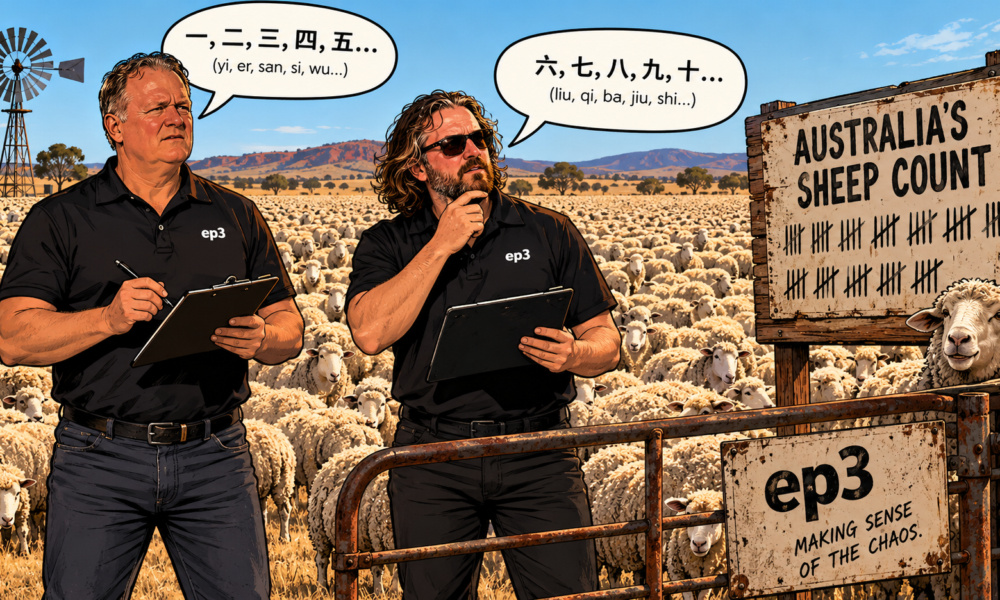
China has the world’s largest sheep flock, at somewhere between 170 million and 190 million head. Australia has about 69 million, but it is Australia that is the world’s largest sheepmeat exporter.
That distinction recently caused some embarrassment when an $800,000 government-funded industry project claimed Australia had the world’s largest flock (see here), a simple error, but one of many.
Putting that error aside, it raises an interesting question. How often is the country producing the most also the country exporting the most? The answer is only a little more than half the time.
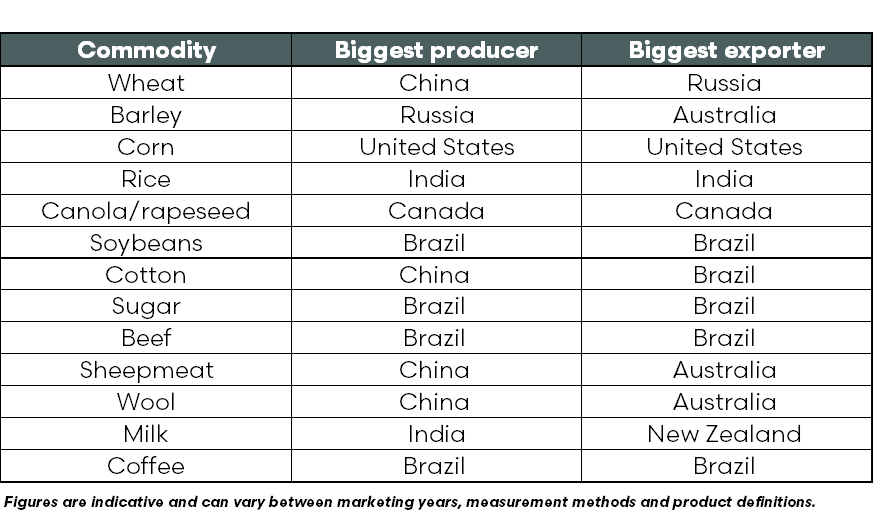
Across these 13 commodities, the biggest producer and exporter are different countries in six cases. That matters because production tells us where a commodity is grown, while exports tell us who the rest of the world relies upon.
China is the clearest example. It is the largest producer of wheat, cotton, sheepmeat and wool in this comparison, but it is not the largest exporter of any of them. China produces enormous volumes, but it also has an enormous domestic market waiting to consume them.
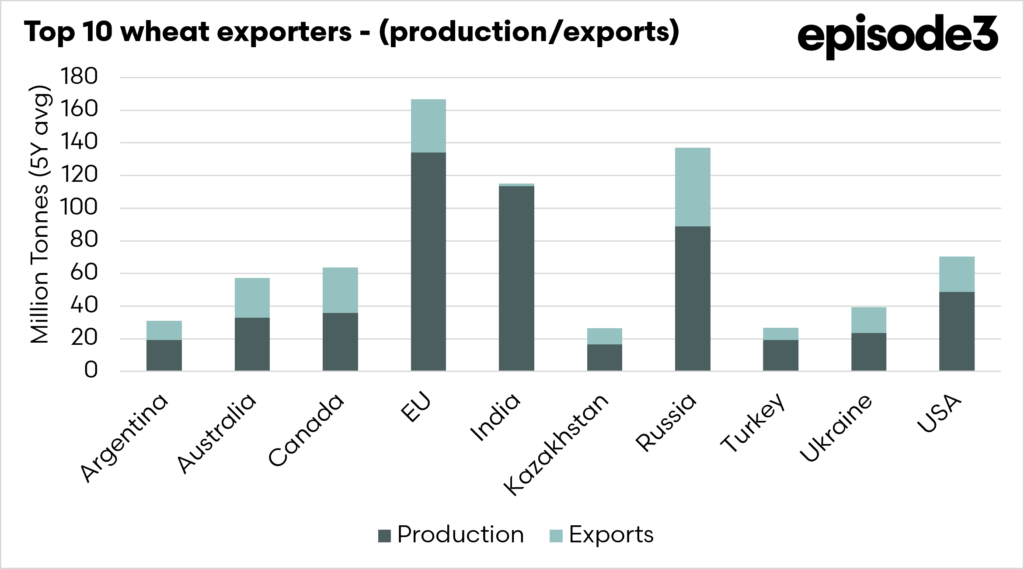
China grows about 141 million tonnes of wheat, while Russia produces considerably less. Russia still exports more wheat because China consumes most of its crop domestically.
That is why events in Russia can have such an immediate effect on international wheat prices. If Russian exports are disrupted by poor weather, government intervention or problems around Black Sea ports, importing countries must find replacement tonnes elsewhere.
A change to China’s crop matters, but it can initially be absorbed through domestic stocks, consumption or imports. A change to Russia’s export program lands directly in the market where international buyers are competing.
India and New Zealand provide another good comparison. India produces more than 220 million tonnes of milk, making it easily the world’s largest producer. New Zealand produces only a fraction of that volume.
However, India also has more than 1.4 billion people, while New Zealand has barely more people than Melbourne. New Zealand can export a large share of its dairy production, giving it far more influence over international dairy trade than its production ranking suggests.
Brazil is the exception
Brazil is the genuine agricultural heavyweight because it often manages to do both. It is the largest producer and exporter of soybeans, sugar, beef and coffee, while also leading cotton exports despite China producing more.
Brazil has the scale to produce enormous volumes and a domestic market that still leaves a huge surplus available for export. This means Brazilian weather, currency movements, infrastructure and government policy can quickly influence global markets.
A smaller Brazilian soybean crop shifts demand towards the United States. Problems with the sugarcane crop affect global sugar availability, while changes to Brazilian beef access can redirect large volumes into competing markets.
Brazil’s influence comes from having plenty of production and plenty left over to sell. Not many countries can claim both.
Australia punches above its weight
Australia sits at the other end of the spectrum. It is not the biggest producer of any commodity in the table, but it is the largest exporter of barley, sheepmeat and wool.
This is not a weakness. It is one of the defining strengths of Australian agriculture.
Australia has a relatively small population and produces far more grain, meat and fibre than its domestic market can consume. That leaves a substantial exportable surplus and makes the country far more important to global buyers than the size of its population or agricultural production might suggest.
Sheepmeat is a perfect example. China has more than twice as many sheep and produces substantially more sheepmeat, but most of it stays in China. Australia exports a large proportion of its lamb and mutton, making it the country overseas buyers are more likely to rely upon.
The same broad story applies to wool. China produces more wool across all categories, while Australia remains the dominant exporter of the high-quality apparel wool for which it is known.
The biggest producer tells us where most of a commodity comes from. The biggest exporter tells us whose supply is available to the world.
For farmers and market analysts, that second question is often the more important one. Global prices are heavily influenced by the tonnes crossing borders, not simply by the tonnes produced.
Australia does not have the world’s largest sheep flock, and it does not need to pretend that it does. Being the world’s largest sheepmeat exporter is a considerably more useful claim, and thankfully it has the added advantage of being true.