
Regenerative Agriculture Gets a MAGA Hat

Regenerative agriculture has found some unlikely friends in the United States. President Donald Trump has signed an executive order advancing regenerative agriculture and farm resilience, with the stated aim of improving soil health, lowering input costs, improving chemical efficiency, supporting profitability, maintaining yields and strengthening rural economies. The order also falls within the broader Make America Healthy Again agenda, driven by Health and Human Services Secretary Robert F. Kennedy Jr.
For Australian farmers and policy people, the interesting part is not simply that the US is talking about regenerative agriculture. It is who is now talking about it. Regenerative agriculture has not always sat comfortably with the right side of agricultural politics, nor with many commercial-scale farmers. That does not mean farmers are opposed to better soils, improved ground cover, stronger water retention, or more efficient use of inputs. Most farmers would argue that good farming has always involved improving the land’s productive capacity.
The issue is the baggage that comes with the term. For many mainstream producers, regenerative agriculture has often sounded like something pushed by green groups, food activists, organic advocates, carbon consultants, large food brands and people a long way removed from the practical realities of running a commercial farm. It can be viewed as anti-chemical, anti-GM, anti-scale and a bit too close to the “farming would be better if farmers just stopped doing modern farming” school of thought.
That is why US development is worth watching: the language has changed. The Trump administration is not selling regenerative agriculture primarily as a climate policy. It is not being wrapped in the usual language of emissions, decarbonisation or net zero. Instead, it is being sold through health, food security, farm resilience, lower input costs, chemical exposure, rural prosperity, national self-reliance and new markets.
The biggest example of these strange bedfellows is RFK Jr. Kennedy has long been one of the more prominent critics of pesticide use in agriculture. In an earlier Episode3 article, we flagged him as the “joker in the deck” for agriculture because many of his positions looked much closer to policies farmers would normally associate with the Australian Greens than with conservative farm politics. His involvement in legal action against Monsanto over alleged health concerns related to glyphosate makes his current role especially interesting.
That is what makes the current US position so unusual. On one hand, the Trump administration has recognised glyphosate-based herbicides and elemental phosphorus as critical agricultural inputs, important to food production, national security and defence. On the other hand, the regenerative agriculture order directs US agencies to examine cumulative chemical exposures in the food supply and encourages research into technologies that reduce reliance on chemical crop protection tools.
That looks contradictory at first glance, but it is probably better understood as a recognition of where the US farming system actually sits. The US cannot simply walk away from glyphosate, synthetic chemistry or modern crop protection overnight. RFK Jr. himself has acknowledged that the current system is heavily dependent on these tools, and that removing them suddenly would risk lower yields, higher food prices and further pressure on farm businesses.
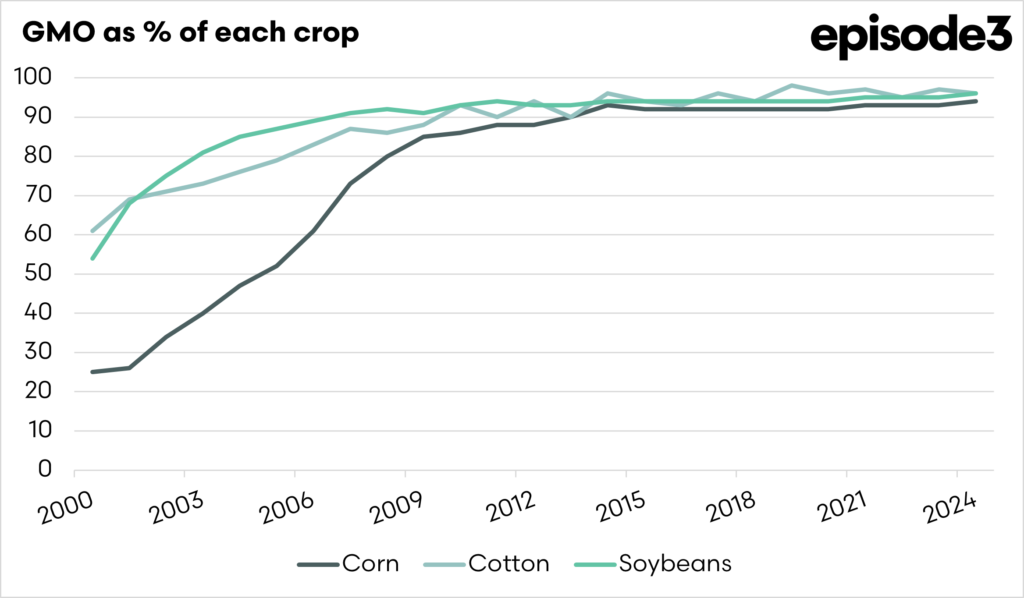
The accompanying chart on GM crop adoption helps explain why. Since 2000, genetically modified crops have moved from a rapidly expanding technology to the dominant production system for major US row crops. By 2024, more than 90% of US corn, cotton and soybean acres were planted with genetically engineered seeds. Herbicide-tolerant soybeans, cotton and corn are no longer niche technologies. They are the backbone of the modern US row crop system.
That chart is not anti-GM. It is a structural chart. It shows that the US system has been built around GM seed, herbicide tolerance, chemical weed control, large machinery, scale, yield, logistics and commodity markets. Farmers adopted these systems because they worked, fitted the economics of commercial production and aligned with the incentives of the time.
That is why the regenerative agriculture push is more significant than a simple press release. If a farming system has been built around GM crops and chemical weed control for more than two decades, then any political objective to reduce reliance on chemicals is not a small adjustment at the margins. It is a challenge to the system’s structure itself.
The Trump and RFK Jr. positions appear to be trying to hold two ideas together. First, glyphosate and phosphorus are critical to the existing food production system. Second, the long-term direction should be to encourage farming systems that are less dependent on synthetic chemicals. For farmers, that is not necessarily hypocrisy. It may simply be realism.
The executive order also links regenerative agriculture to health. The US debate is no longer just about soil health or environmental outcomes. It is being linked to nutrition, chemical exposure, chronic disease prevention, food quality and broader public health. That health framing matters because it is harder for farmers to dismiss than climate framing.
Many farmers are used to arguing against poorly designed climate policy. They can point out where carbon schemes are impractical, where targets are unrealistic, where costs are pushed back onto producers, or where policy ignores seasonal variability and commercial risk. Health is different, because it speaks directly to families, children, food labels and trust.
Once farming systems are drawn into a public health debate, an approved and widely used chemical can become part of a broader argument about residues, childhood health, chronic disease and the food system. That is why the issue is particularly relevant to Australia. The US debate shows how quickly regenerative agriculture can be repackaged.
It does not have to be sold as a green idea. It can be sold as a health idea, a food security idea, an input efficiency idea, a biofuel idea or even a national resilience idea. The substance might not be dramatically different, but the framing changes who is willing to listen.
That does not make regenerative agriculture good or bad. It means the debate needs to be more practical. Improving soil structure, maintaining groundcover, managing grazing pressure, reducing erosion, increasing water infiltration, improving rotations, and cutting unnecessary inputs can all make sense where they fit the system. Plenty of farmers already do things that could sit under a regenerative banner, even if they would never describe themselves as regenerative farmers.
But there are also real risks. Who defines regenerative agriculture? Which practices count? Who measures them? Who pays for the transition? Does the farmer get a premium, or just extra paperwork? What happens if synthetic chemicals are still the most reliable tool in a given system, or if a broad soil-health idea becomes a narrow certification standard?
These are the questions Australian agriculture should be asking now. The US example is not a template. It is a reminder that agricultural policy can attract strange bedfellows. In this case, a Republican administration, RFK Jr., regenerative farmers, biofuel interests, health campaigners, retailers and food companies are all circling around the same idea.
The final question for Australian farmers and policy people is a simple one. If an Australian government went hard on regenerative agriculture, how would you feel about it? Not just in theory, and not just if it came from the side of politics, you normally support. Would you be comfortable if an ALP government heavily funded regenerative agriculture? What if it were the Coalition? What if it was Pauline Hanson’s One Nation?