
Wool Market Update – Oct 2026

Wool Market Update October 2026
Why Your Neighbour Says The Market’s Down And You Had A Good Month
When someone tells you the wool market fell, ask them which market. They almost certainly mean the EMI, and the EMI is one number covering every micron from 16 to 30, weighted by how much of each gets sold. It is an extremely broad indicator and it is good for exactly one thing: telling you what the whole Australian clip did on average. It cannot tell you what your wool did, because your wool is one micron and the EMI is all of them.
This September the EMI finished within three cents of where it started. On that number, nothing happened.
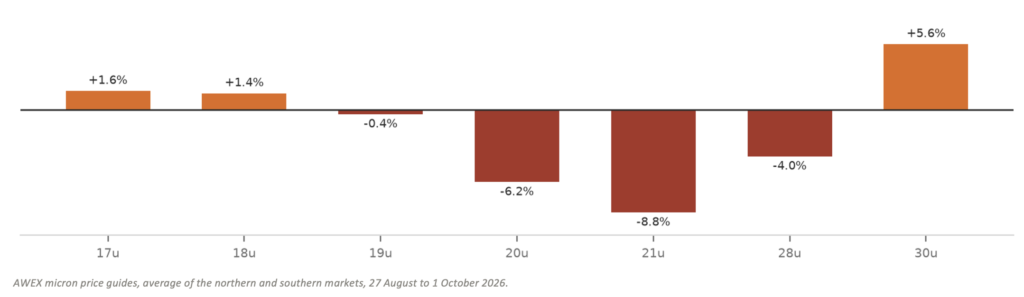
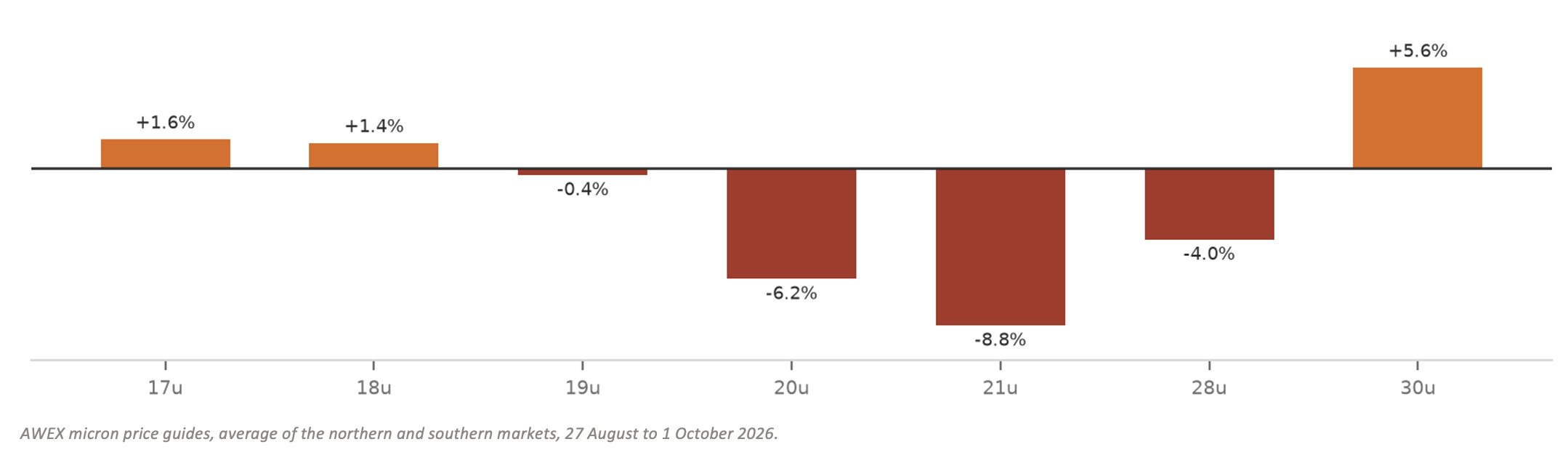
Underneath it, 17 micron put on 1.6 percent and 18 micron 1.4 percent. Nineteen sat still. Twenty lost 6.2 percent and 21 lost 8.8 percent. Down the broad end, 30 micron gained 5.6 percent.
That is not one market having a quiet month. That is five markets going different ways inside one average, same country, same week, same buyers in the room. If you grow 17 micron you had a good September. If you grow 21 you lost nearly nine percent of your clip’s value in five weeks. So there is no such thing as the wool market. There is your market, and your micron decides which one you are in. Everything else in this report follows from that.
Why It Happened: The Season Put Diameter On Sheep
Micron is not fixed. A sheep that is eating well grows a heavier, broader fibre, and a sheep that is short of feed grows a finer one. Two dry years followed by a good one does exactly what you would expect: the same ewes, in the same paddocks, cut wool a micron or so broader than they did. Nobody changed their flock. The season changed the wool.
That shows up in the national test data, and this year it is dramatic.
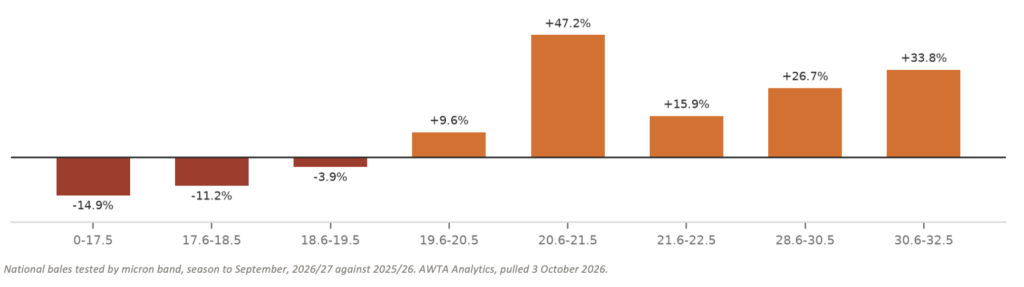
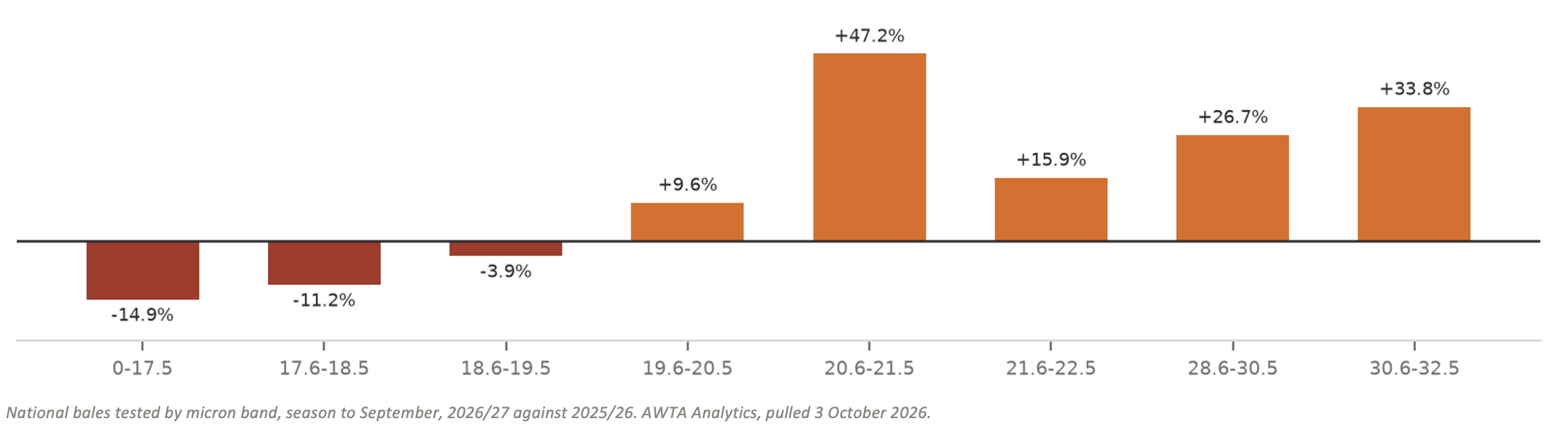
Wool under 17.5 micron is down 14.9 percent on the same point last season and the 17.6 to 18.5 micron band is down 11.2 percent. At the same time the 20.6 to 21.5 micron band is up 47 percent. South Australia has grown its 21 micron band by 156 percent and Victoria by 96 percent. The whole clip is down only 0.8 percent, which is nothing, so this is not less wool. It is the same wool, broader.
Now put the two sides together, because this is the whole of it. The buyers who want sub-18.5 for next-to-skin garments have 13 percent less of it to bid on, so they have to bid harder. The buyers who use 21 micron have nearly half as much again arriving into a market that was already covered. One season has made fine wool scarce and medium wool abundant at the same time, and that is why your neighbour’s cheque and yours went different ways.
If You Grow 21 Micron, Read This Part
This has been the hardest month of the year for you, and the shape of it matters more than the last sale does.
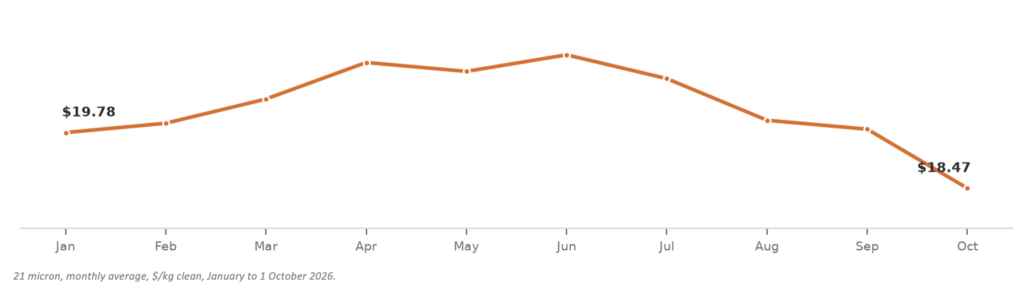
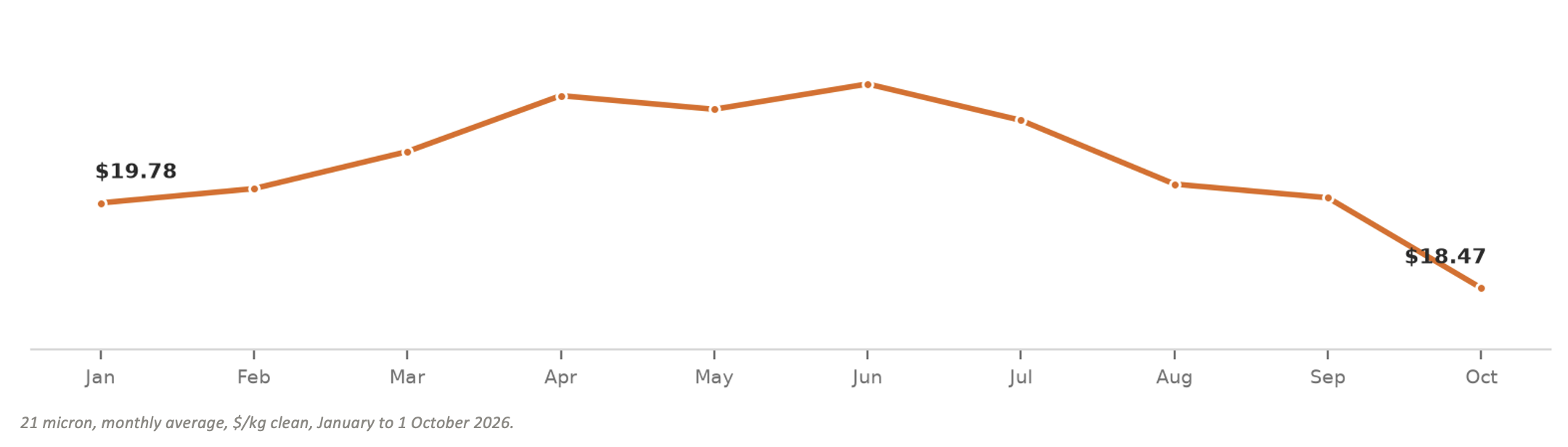
Twenty one micron is $18.47. In June it was $21.61. That is $3.14 off in four months and the last sale was the biggest single fall of the run, so I understand why it feels like the floor has gone.
Here is the part worth holding onto. $18.47 still sits at the 85th percentile of the last five years, which means that in five years of weekly quotes, only 15 percent of them were higher than where you are now. On ten years it is the 78th. The five year range runs from $12.43 to $21.61, so you are a long way nearer the top of it than the bottom. This is a high price that has come off a very high price, and that is a different thing from a bad market.
What has actually happened is that fine wool has pulled away from you. The gap between 17 micron and 21 micron is what the trade calls the spread, and it is simply one price minus the other. It is $7.45 a kilo today, which is 40 percent of the 21 micron price. A week ago it was $6.94. At the end of August, $5.24. In July, $4.76. This time last year it was $3.29. It has widened in every single week of this run and the last week was the biggest move of the lot.
So the question that decides your season is not whether 21 micron is cheap. It is how much further that gap can open, and whether 21 micron comes back up with 17 when it does.
How Far The Spread Can Go
This is not a feeling, so I have tested it. Every season since 2012/13 I have taken how much the 21 micron volume moved against how much the spread moved, using AWTA’s own bale counts. Thirteen pairs with nothing missing. The relationship is strong and it holds up when you drop any single season out of it.
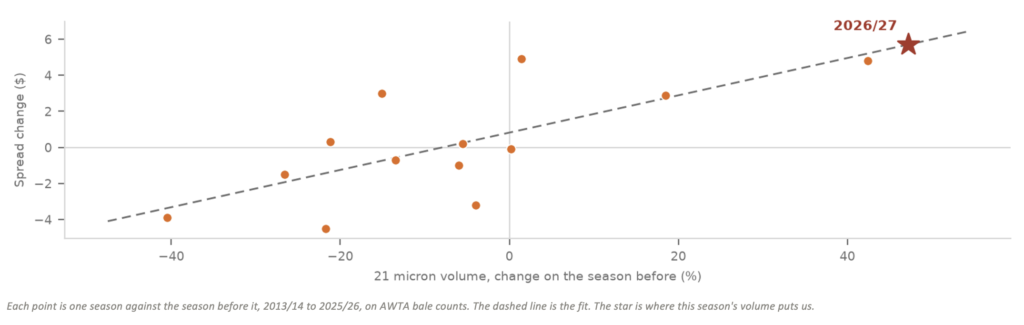
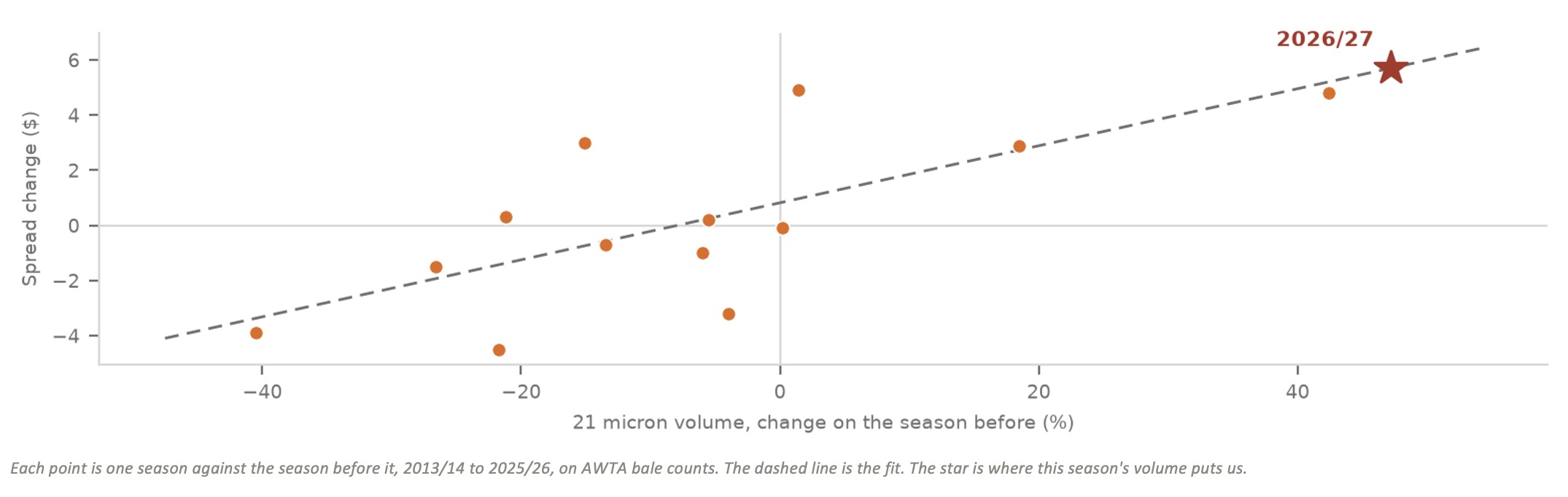
One thing to be clear about before the numbers: what comes out of this is a SEASON AVERAGE, not today’s price. This season’s spread has averaged $5.29 so far, because it was $4.76 back in July and only reached $7.45 this week.
Put this season’s extra 47.2 percent of 21 micron through the relationship and it says the season should average $9.10. For a season to average that, the spread has to sit around $10.37 for the rest of the year. Measure the same thing on the band’s share of the clip rather than its tonnage and it says $7.94 for the season, needing about $8.82 from here. Today we are at $7.45, which is under both of them. So the widening is not finished, and the tonnage route says there is a good deal of it left.
Come at it from the other end and you get a similar answer. Seventeen micron’s ten year high is $29.37, set in September 2018, which is another $3.45 or 13 percent above today. If 17s ran all the way back to that ceiling and 21s stood still, the spread would be $10.90. Neither route is a target. Both say there is room left but not a great deal of it.
Then the question that actually matters: do 21s come back up with 17s. Across the same thirteen seasons, when 17 micron rises a dollar, 21 micron rises 49 cents. You follow at half pace. Run that $3.45 of upside in 17s through it and 21 micron picks up about $1.90, taking you to $20.37.
Above $20 is a realistic place for this market to be, and I want to be clear about that because $18.47 feels a long way from it today. Over the last ten years 21 micron has spent 23 of 120 months at or above $20, so about one month in five. It is not an exotic level, it is a normal one.
What would change my mind
All of that rests on fine wool staying scarce, and only 20 percent of the season has been tested so far. On last season’s shape there are about 1.2 million bales still to come through the testhouse. The broadening to date is two states: South Australia’s fine share has gone from 28.9 percent of its clip to 14.4 percent, and Victoria’s from 37.3 percent to 28.2 percent. New South Wales has not broadened at all, 42.8 percent fine against 42.7 percent last year, and it has around 435,000 bales still to shear. Western Australia is 35.9 percent against 37.3 percent, barely moved.
So if the wool still to be shorn comes in at its normal fineness, the shortage at the fine end eases as the season goes on and the spread comes back in rather than going further out. That is the one thing I will be watching, and it is why I would not bet a clip on the $9.10.
Where it runs into trouble is higher up. Over those same ten years, the 23 months that 21 micron spent at or above $20 break down as five between $20.00 and $21.00, seven between $21.00 and $21.50, one single month between $21.50 and $22.00, and ten above $22.00. What that tells you is that $21.50 is not a level this market rests at: it either stalls underneath it and turns back, or it clears it and keeps going to $22.00 and beyond, with almost no middle ground. That matters when you set a reserve. If we get back near $21.00, do not put a reserve at $21.75 and expect the market to sit there long enough to fill it, because historically it does not sit there at all. Either take what is on offer under $21.50, or be prepared to wait for a run right through to $22.00. This market was last through that level in June at $21.61.
Why I’d Hold To January
Wool has a seasonal rhythm and it is one of the few genuinely reliable things in this job. The northern hemisphere mills build their order books over our summer, and the Chinese mills buy ahead of the shutdown for Chinese New Year. Both land in the same window, and it shows.
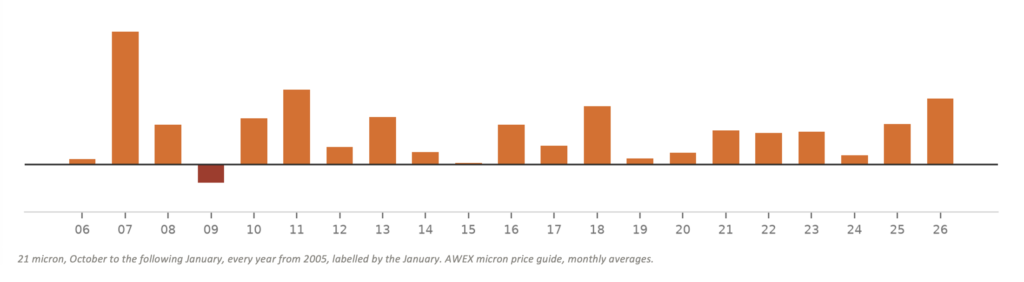
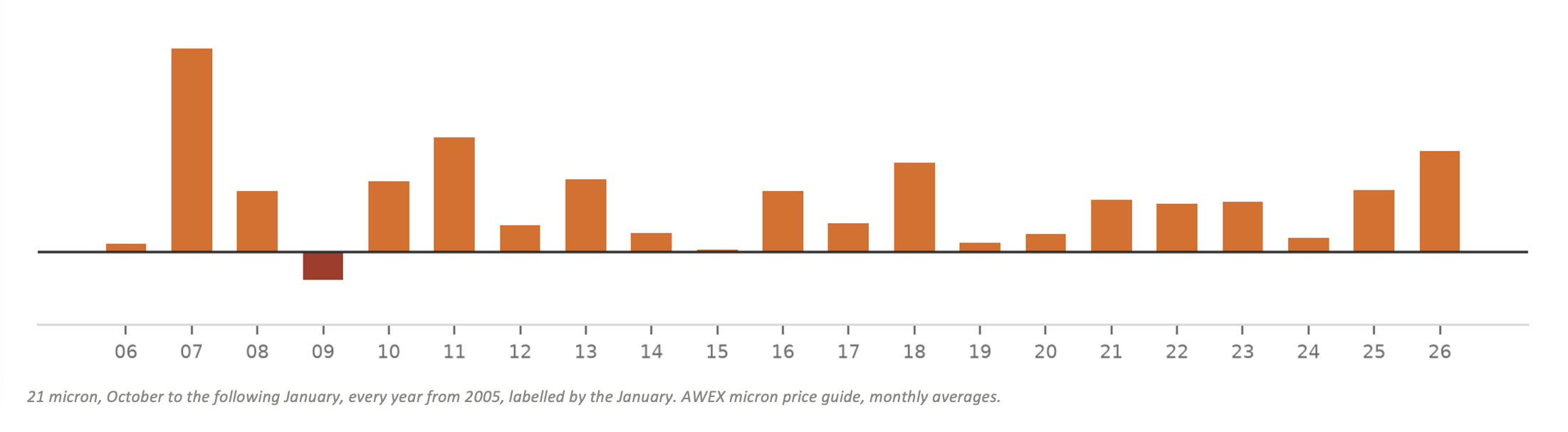
From October to January, 21 micron has risen in twenty of the last twenty one years. The median rise is 7.9 percent and the average 8.1 percent. The only fall was January 2009, down 4.6 percent, at the bottom of the financial crisis, and the next two worst years were up 0.3 percent and up 1.2 percent. In two decades of history the downside of holding is flat, not a hiding.
On today’s $18.47 that median puts you at $19.92 in January, which is almost exactly where the 17 micron pull-through lands you as well. Two different methods, one seasonal and one structural, arriving at about $20.
Chinese New Year falls on 6 February 2027, and the buying window opens around 9 January. Into that window, 21 micron runs 4.9 percent higher on average and is up in 81 percent of years. The month after it: 0.8 percent average, a median of minus 0.3, higher in 48 percent of years. That is a coin toss. The mills buy ahead of the shutdown and then they stop, so Chinese New Year is a deadline, not a target.
One thing cuts the other way. That January lift is a market-wide effect, driven by the northern order book and the run into Chinese New Year. The 47 percent of extra 21 micron volume is specific to your micron and it is the one thing working against it. I still expect the lift. I would just expect it to be smaller than that 7.9 percent median, so think of a few percent rather than eight, which on today’s $18.47 is somewhere around $19.00 to $19.50 in January rather than $19.92.
The World Outside
Wool is bought by factories, so the one honest demand signal is whether those factories are busy. A manufacturing PMI is a monthly survey of purchasing managers that comes out as a single number: above 50 and the sector grew that month, below 50 and it shrank.
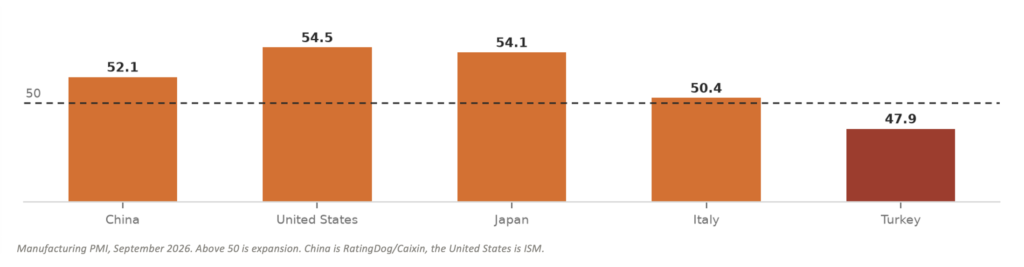
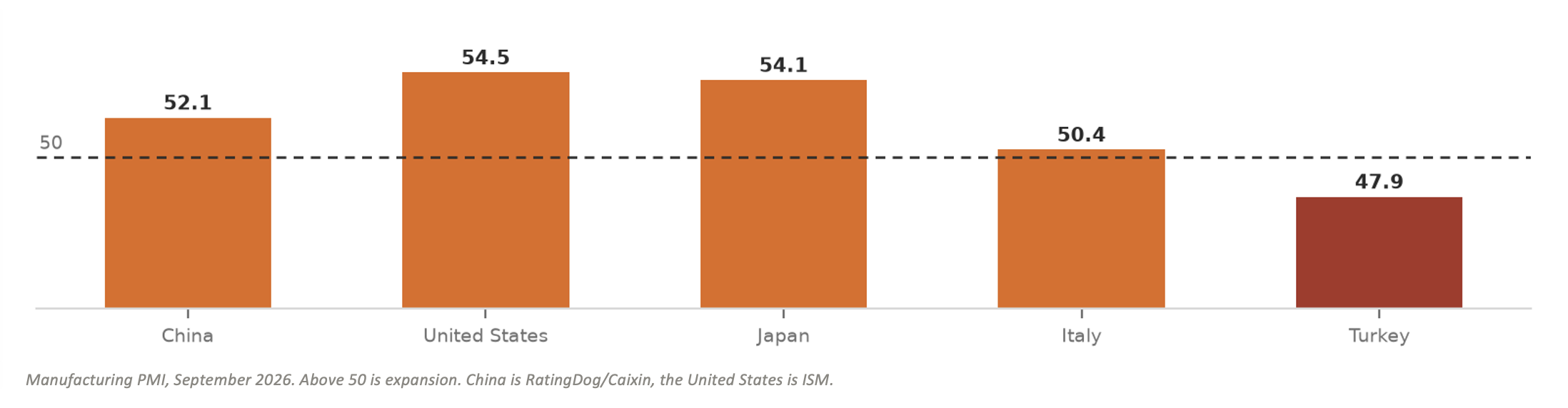
China at 52.1 is the one that counts, because they take around 88 percent of our clip, and that is a five month high. Turkey is the other serious wool processor and it is going the other way at 47.9, now thirty straight months shrinking. The quiet one is oil: Brent averaged $112.95 a barrel in September against $91.08 in August, up 24 percent. Polyester and acrylic are made from oil, so when oil goes up the synthetic alternatives to wool get dearer, and the wool at the broad end that competes with them looks better. That is probably part of why 28s and 30s led the month.
Tariffs, and which one actually reaches you
The 12.5 percent the Americans put on Australia in July is a meat headline, not a wool one. Very little of our raw wool goes to America. It goes to China, and it goes in at 1 percent duty inside a 287,000 tonne quota, which has not changed. The tariff that reaches your cheque is the one on the finished garment: a Chinese made jumper landing in America pays somewhere between 36 and 52 percent, which the mill has to think about when it decides what to pay for your wool. Trump and Xi met in Washington in late September and did not touch textiles or apparel. The date to write down is 10 January 2027, when the current truce runs out, in the middle of our selling season.
The dollar did more for you than you think
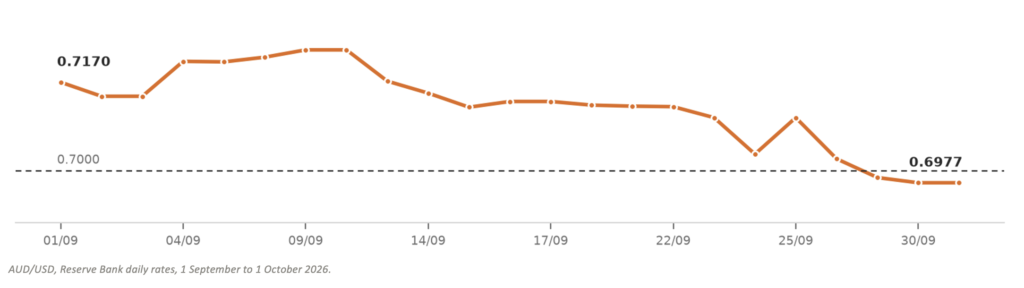
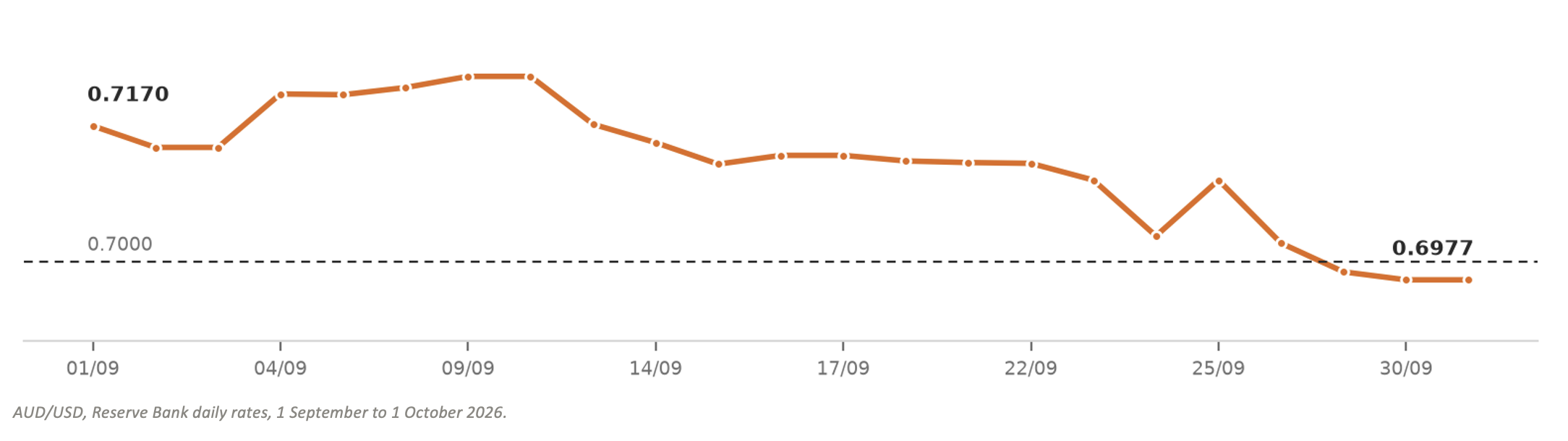
Your wool is bought in US dollars, so when the Aussie falls, the same US price buys more Australian dollars and your cheque goes up without the buyer paying a cent more. The Aussie broke 70 cents this month. F13 sold at 0.7123 on 22 September and F14 at 0.6987 on the 29th, a fall of 1.91 percent across the two sales, and it fell on the very day the Reserve Bank lifted the cash rate to 4.60 percent, because Bullock said at the press conference that policy could be restrictive enough and the market read that as the end of the rate rises.
That was Aussie weakness rather than a strong greenback: the trade weighted index fell 1.7 percent, so we went down against everything. On its own that currency move should have added 34 cents a kilo to 21 micron. Instead 21 micron fell 67 cents a kilo. So the buyer took about a hundred cents a kilo out of the price and the falling dollar handed you back a third of it. Without the currency this month would have looked a great deal worse than it did.
The Month In Summary, And What I Expect From Here
September looked flat on the indicator and was anything but underneath it. Fine wool went up, medium wool went down hard, and the gap between the two widened in every week of the run. That is a supply story rather than a demand one: a good season after two dry ones put diameter on the national clip, so there is less fine wool about and a great deal more 21 micron than there was.
From here I expect the spread to keep widening, but not by a lot more, and I expect 21 micron to lift off $18.47 rather than fall further. The seasonal pattern is firmly in your favour between now and January, the fine end still has room above it, and demand out of China is at a five month high. The one thing that would change my mind is the 80 percent of the clip still to be tested: if that wool comes in at its normal fineness the shortage at the fine end eases and the spread comes back in rather than going out.