Big crops, cheap grain and Australia’s export window

The Snapshot
- Global wheat, corn and soybean markets remain under pressure from large crops and heavy supply.
- Australian grain values have softened, but generally less than offshore futures.
- Russia is still struggling to move wheat, adding to the stockpile risk we examine separately this week.
- Australia exported roughly 46Mt across its major grain and pulse crops last season.
- The opportunity is to move as much of the new Australian crop as possible while Russian wheat remains constrained.
The Detail
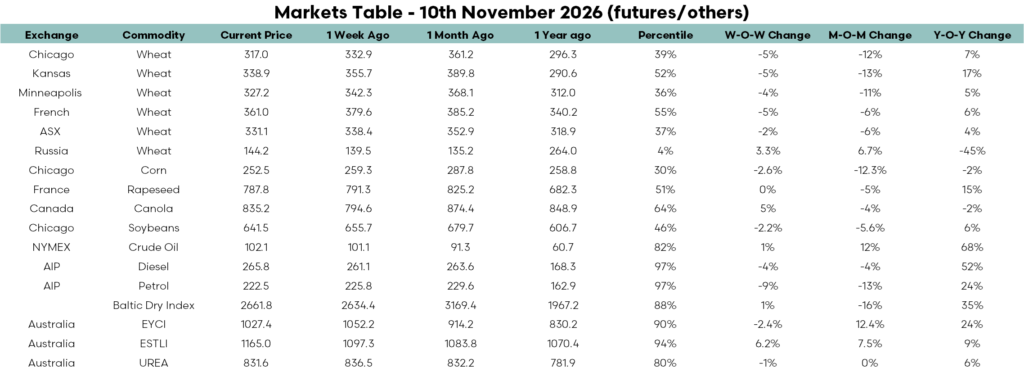
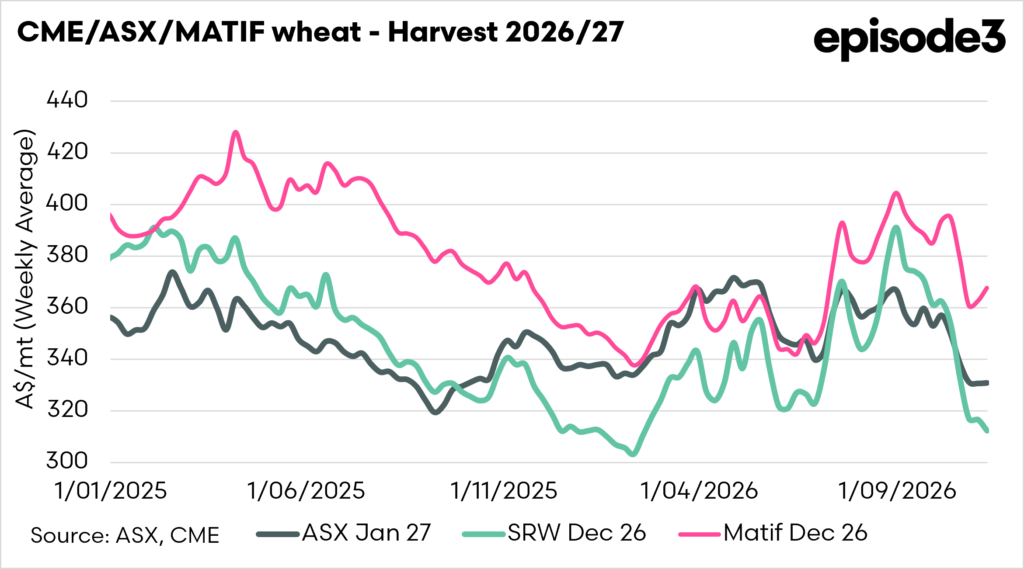
Global grain markets are still struggling to find much enthusiasm. Chicago wheat fell another 5pc over the week and is now 12pc lower over the month, while Kansas and Minneapolis wheat have fallen similarly. Corn lost another 2.6pc and soybeans 2.2pc, with the sheer size of the US harvest continuing to weigh on sentiment.
The US is harvesting its biggest soybean crop on record and second-largest corn crop, which explains plenty of the pressure. Looking further ahead, low prices are beginning to produce some response, with preliminary USDA projections showing US corn area falling by 1.3 million acres next season. Wheat is going the other way, with plantings currently expected to increase by 1.5 million acres, suggesting the supply adjustment in wheat may take longer.
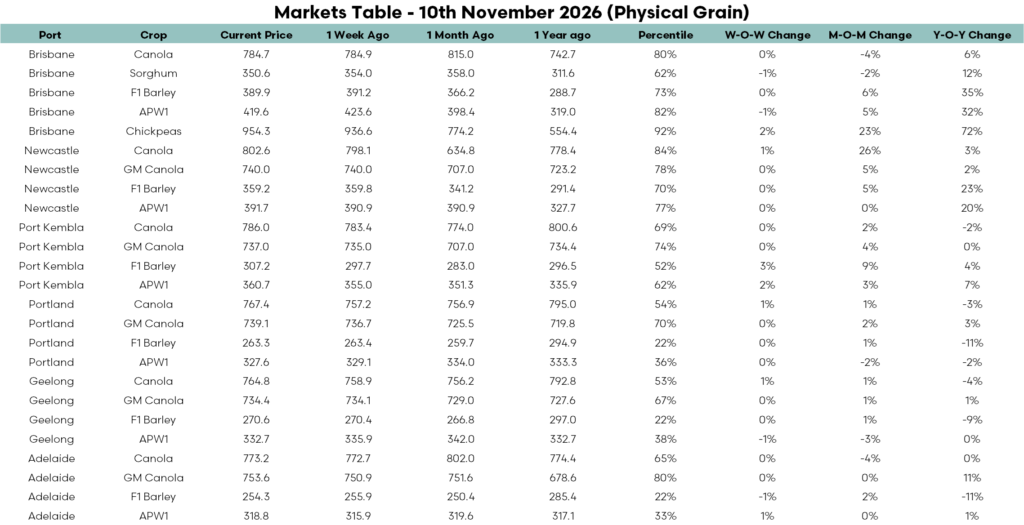
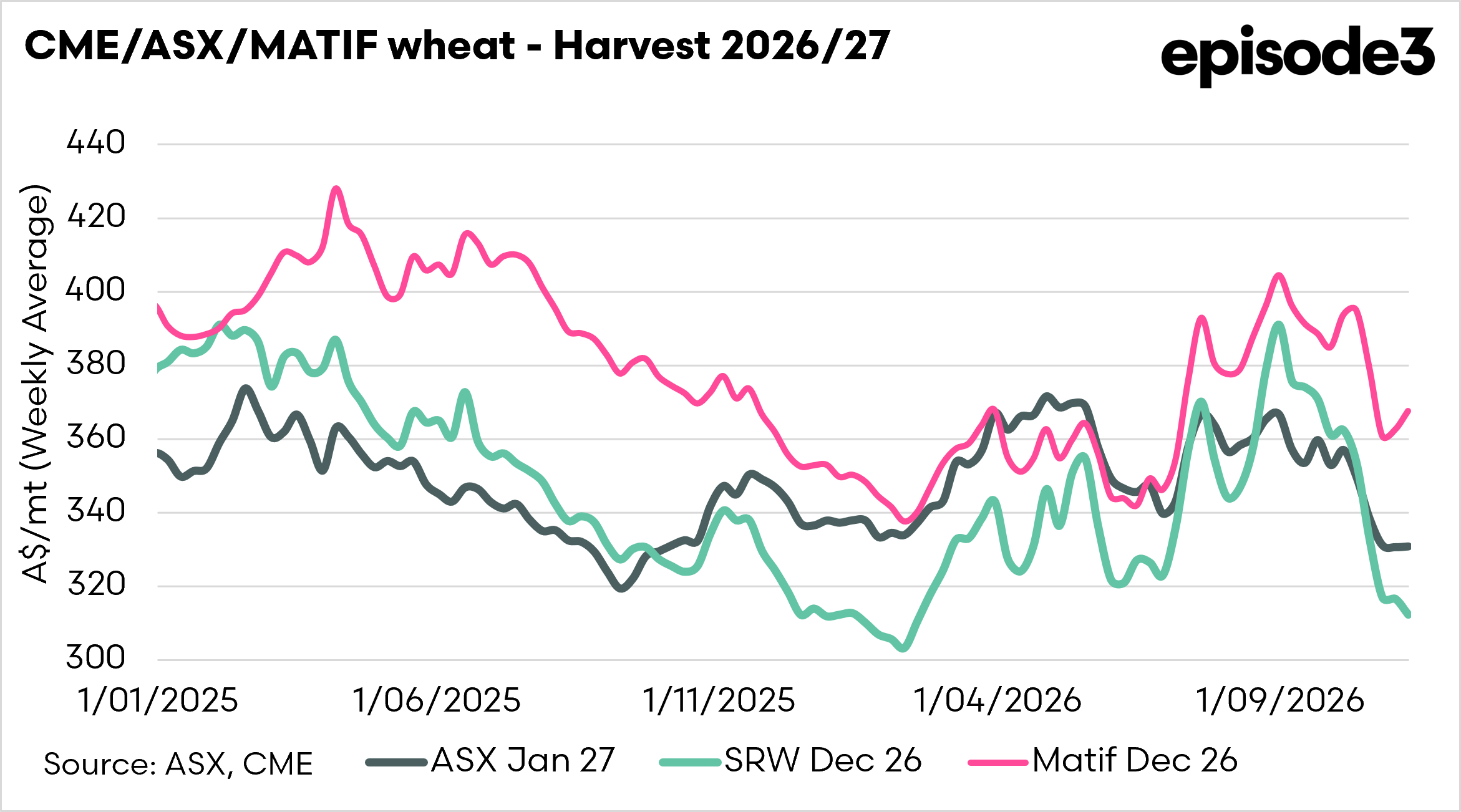
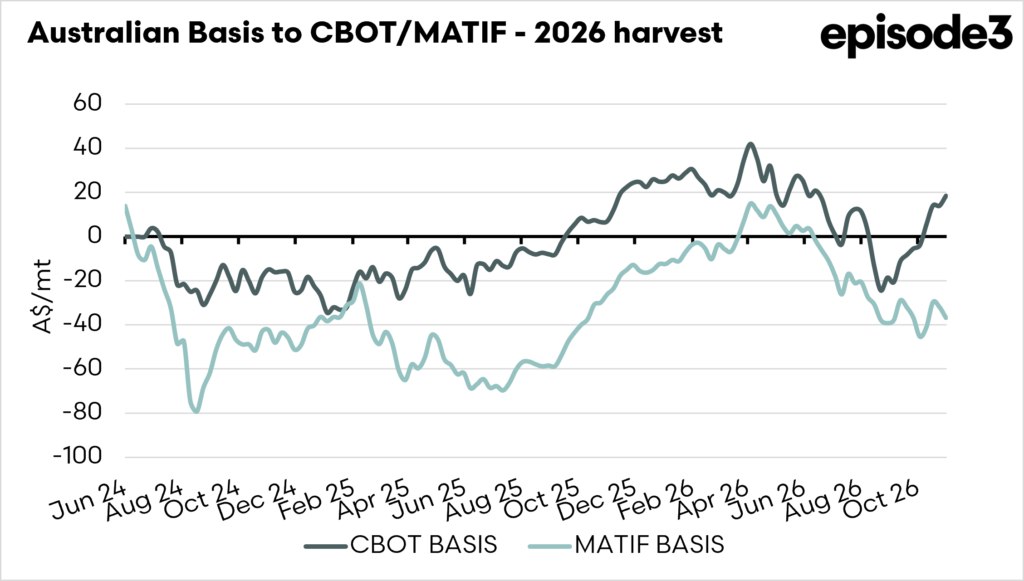
Australia has come under pressure as well, but not to the same extent. ASX wheat fell 2pc for the week compared with declines of 4–5pc across the major overseas wheat contracts. Physical APW1 was mixed, with Brisbane and Geelong slightly lower while Port Kembla and Adelaide firmed.
Southern barley continues to stand out for the wrong reason. Portland, Geelong and Adelaide are all sitting around the 22nd percentile of their historical ranges, which is hardly surprising with another sizeable southern harvest arriving and plenty of grain needing to find a home.
The international supply story is not completely bearish. Ukraine has cut its 2026 grain harvest forecast to 63.7Mt and reduced projected exports by 2.2Mt, largely because of a smaller corn crop.
Russia is the more interesting part of the wheat story, yet again.
In a separate analysis this week, we look at the growing volume of Russian wheat that has not reached the export market this season and what that could mean for Australia. Russian exports are running at roughly half their normal pace, and the difficulty is increasingly not finding buyers but finding routes to get the grain to them.
That problem has become more complicated again, with Lithuania introducing origin testing on Russian and Belarusian grain moving through Klaipeda. Shipments can potentially be held for two months or more while testing is completed, making an alternative Baltic route slower and more expensive.

For Australia, the immediate effect is potentially positive. Less Russian wheat reaching buyers means less competition as our new crop arrives.
The problem, as we explore in the separate Russian wheat article, is that grain which is not exported does not simply vanish. If it accumulates inside Russia, it becomes future competition. Any improvement in Black Sea access or alternative export routes could release more wheat at exactly the time Australia is trying to clear its own crop.
That timing matters because Australia has just completed another enormous export program. Shipments of wheat, barley, canola and sorghum reached 41.1Mt in 2025/26, and adding oats, chickpeas, lentils and lupins takes the total across those major crops to roughly 46Mt.
Barley was the standout, with exports reaching a record 11.48Mt, more than 25pc above the previous high. China took 9.23Mt, or just over 80pc of the program. Wheat exports reached 21.97Mt, although they were 6pc lower despite a larger crop.
Those figures are a useful reminder heading into the new harvest. Australia has proven it can physically shift a huge volume of grain, but the demand still needs to be there. Last season, China did much of the heavy lifting, particularly across barley, sorghum and oats.
Fertiliser is at least becoming a little less threatening. Urea has softened, with Australian imports already covering 104pc of forecast seasonal requirements, while local urea values eased to around A$832/t. Phosphates are also drifting lower, and potash remains under pressure, although ammonia is still expensive because of tight supply and elevated gas costs.
Australia therefore has something of an export window. Russian wheat is constrained, Ukrainian export expectations have been reduced, and our new crop is arriving.
The job now is to use that window.
Australia has already shown it can move the volume. The question is how much we can get out before Russia eventually finds a way to move theirs.