Market Morsel: India will make the pulse of lentils beat.

Market Morsel
While attention has been focused on Northern Hemisphere harvests and global trade tensions, another important market driver is unfolding across India. The annual southwest monsoon has made a sluggish start, raising questions over summer crop production and future import demand. For Australian growers, particularly those producing pulses, the next few weeks matter.
The monsoon delivers around 70 per cent of India’s annual rainfall and underpins much of the country’s agricultural production. Nearly half of India’s farmland relies on rainfall rather than irrigation, making the timing and intensity of the season critical. This year, rainfall has been around 42 per cent below normal since early June, with some regions recording deficits of more than 90 per cent. Summer crop planting is also running almost 23 per cent behind last year.
The largest delays have been seen across rice, soybeans, corn and cotton. Rice plantings are around 25 per cent lower than this time last year, soybean area is down 65 per cent, and corn is down 16 per cent. However, it is not panic stations yet. India’s planting window remains open through July, meaning widespread rain over the coming weeks could allow farmers to catch up.
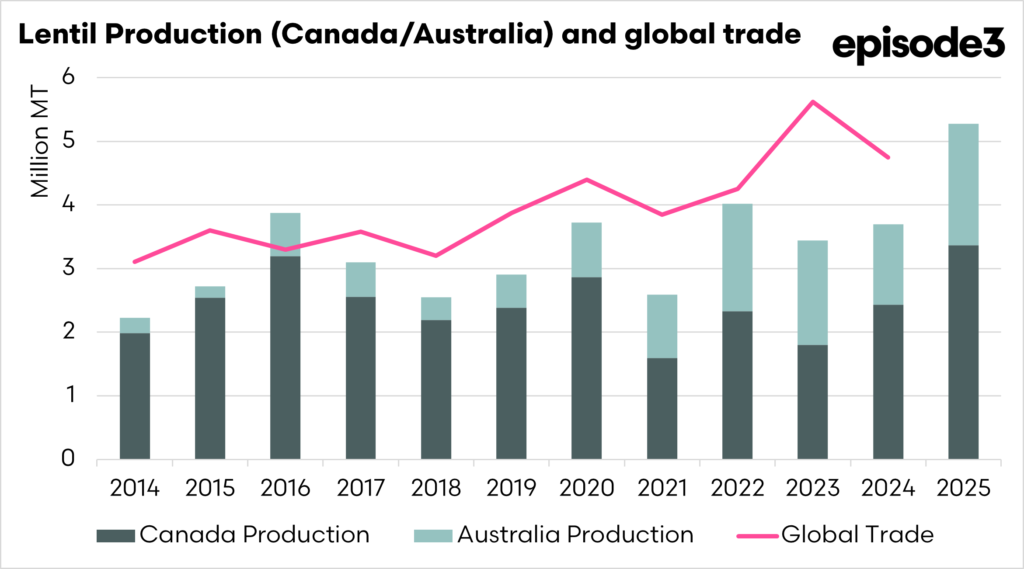
For Australian growers, the pulse market is worth watching closely. India is one of the world’s largest pulse consumers and regularly turns to imports when domestic production falls short. While India will first draw on government stocks and source supplies from nearby exporters, a more serious production shortfall could increase demand for imported lentils. Australia would be well placed to benefit if that demand strengthens later in the marketing year.
The monsoon also matters beyond pulses. India is the world’s largest rice exporter and one of the biggest importers of vegetable oils, so production outcomes can influence global trade flows across several commodities. A recovery in July rainfall would likely calm the market quickly. A continued deficit would add another layer of uncertainty to a market already balancing Northern Hemisphere harvests, geopolitics and a developing El Niño.
For now, it is too early to assume India’s crop is in trouble, but it is also too early to dismiss the risk. For Australian farmers, the Indian monsoon is worth watching because it can shift demand quickly once the market decides the crop risk is real.