Exclusive: EP3 Launch Fert Tracker
Australian agriculture has long run with a fundamental blind spot. By the time official import data on fertiliser reaches the market, it is already two to three months old. Decisions worth millions of dollars are being made on information that is, by any measure, ancient history. Episode 3 (EP3) has set out to change that.
The agricultural market intelligence firm, which has built its reputation on delivering independent pricing analysis and import data to the fertiliser sector, has launched a prototype real-time vessel tracking tool for nitrogen fertiliser imports into Australia. It is the latest step in EP3’s ongoing mission to bring genuine transparency to a market that has historically had very little of it.
A Market That Needed Honest Eyes
EP3 has been at the forefront of fertiliser market transparency for years, delivering import data, pricing benchmarks and independent analysis that give growers, traders, government and retailers a clearer view of the market they work in. That work matters. A market with better information functions more fairly, and Australian agriculture deserves nothing less.
The fertiliser sector has suffered from a lack of transparency for too long. Pricing has at times been opaque, supply signals have been unclear, and by the time data arrives through official channels, the moment to act has often passed. EP3 has been chipping away at that problem, and this tracker represents a significant new capability.
The parallels with the Iran situation are instructive. When that crisis sent diesel markets into a period of intense anxiety, EP3 was already offering transparency on fuel imports from the very start. Fertiliser is a far more complex supply chain to map, involving dozens of origin countries, transhipment hubs and vessel types. But the principle is the same: in times of market stress, real-time intelligence is not a luxury; it is a necessity.
How It Works
The tracker integrates data from multiple commercial and public maritime sources, aggregating vessel movement intelligence across every bulk carrier declared for an Australian port. Each vessel is then processed through a proprietary rules-based analytical engine, cross-referencing origin ports, trade routes, vessel specifications, cargo history and destination patterns against a continuously refined database of global fertiliser trade flows.
The system assigns each vessel a probability score from 0 to 100, weighted across multiple independent signals. No single variable determines the outcome. It is the convergence of evidence that drives the confidence rating. The result is a living, dynamic picture of what is moving toward Australian shores, updated in near real-time.
Vessels are classified as High Confidence or Medium Confidence. High Confidence means the evidence is strong: the vessel’s origin, size, route and port schedule all point clearly to a fertiliser cargo. Medium Confidence means the signals are positive but not yet fully corroborated. As a prototype, EP3 is transparent about the distinction and will continue refining the system as it matures.
What the Data Is Showing Right Now
It is important to note that this tool is a prototype. The figures below represent the system’s current best assessment based on available data, and they should be read in that context. As the tool is refined, accuracy and coverage will improve. These numbers are indicative, not definitive, and are subject to change as new information comes to hand.
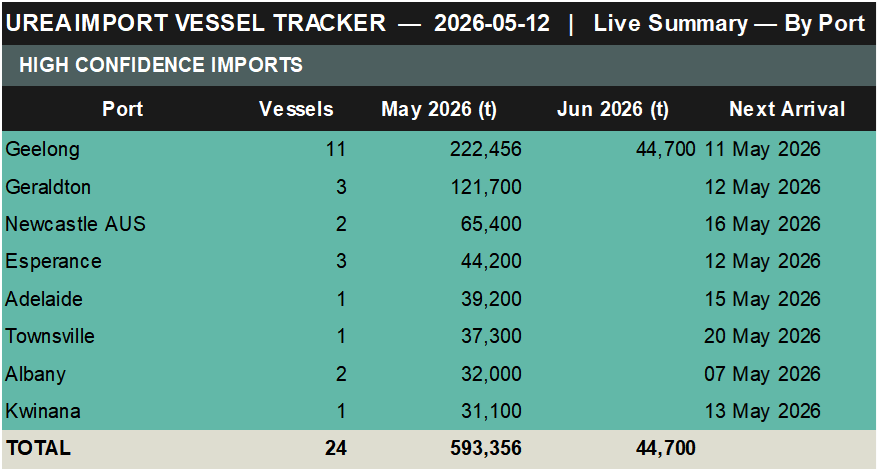
With that warning clearly stated, the most recent snapshot, dated 12 May 2026, identifies 24 high-confidence vessels carrying an estimated 593k tonnes of fertiliser bound for Australian ports in May, with a further 45k tonnes expected in June. Geelong leads with 11 vessels and more than 222k tonnes inbound. Geraldton, Newcastle, Esperance, Adelaide, Townsville, Albany and Kwinana all feature, painting a national picture of supply that has simply never been available to the market in real time before.
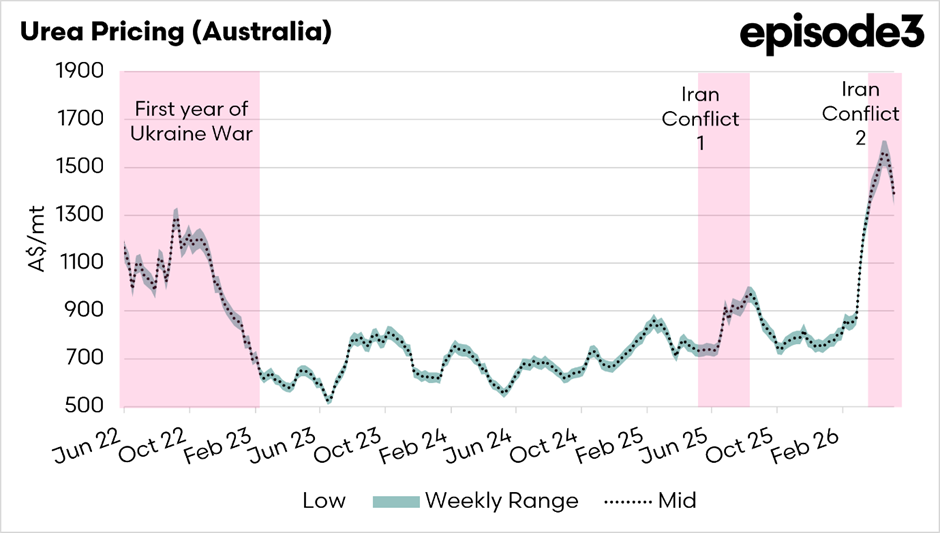
On a pricing note, the past few weeks have been ‘positive’ as the replacement price for urea in Australia has dropped from a peak of A$1560 three weeks ago, to A$1385 as the market struggles with demand destruction as farmers cut back on their purchases, not just locally but globally.
Made Possible by Industry Support
This project was made possible by GRDC whose financial support enabled EP3 to fund a tool that benefits the entire supply chain. Independent analysis of this kind does not come without cost, and without that support, this level of market intelligence would remain out of reach for the industry stakeholders who need it most.
EP3 will be updating the tracker regularly. The fertiliser market now has a new set of eyes. They will stay open.
The Grains Research and Development Corporation (GRDC) has provided investment in the research and development (R&D) underpinning EP3 to support the acceleration and adoption of new fertiliser technologies in the Australian grains industry.