
Two wars, one expensive harvest

The Snapshot
• Australian diesel prices rose sharply after the Iran war began.
• Diesel rose much faster than crude, widening the cost pressure on fuel users.
• The diesel-crude gap averaged around 102 c/L before the war and 148 c/L afterwards.
• Ukrainian attacks remain part of the supply risk, but the timing points much more strongly towards Middle East disruption.
• Growers paid expensive diesel bills at seeding and are now facing another major fuel requirement at harvest.
The Detail
Australian grain growers have already put this crop in the ground using expensive diesel. Now harvest is arriving, bringing another large fuel bill for headers, chaser bins, trucks and contractors. Unfortunately, telling the header to wait until diesel gets cheaper is not much of a marketing strategy.
Diesel prices rose sharply after the Iran war began on 28 February 2026. Ukrainian attacks on Russian refineries, ports, and other energy infrastructure had been occurring throughout 2025, yet Australian terminal gate diesel prices remained relatively stable. Once the Middle East conflict escalated, that changed very quickly.
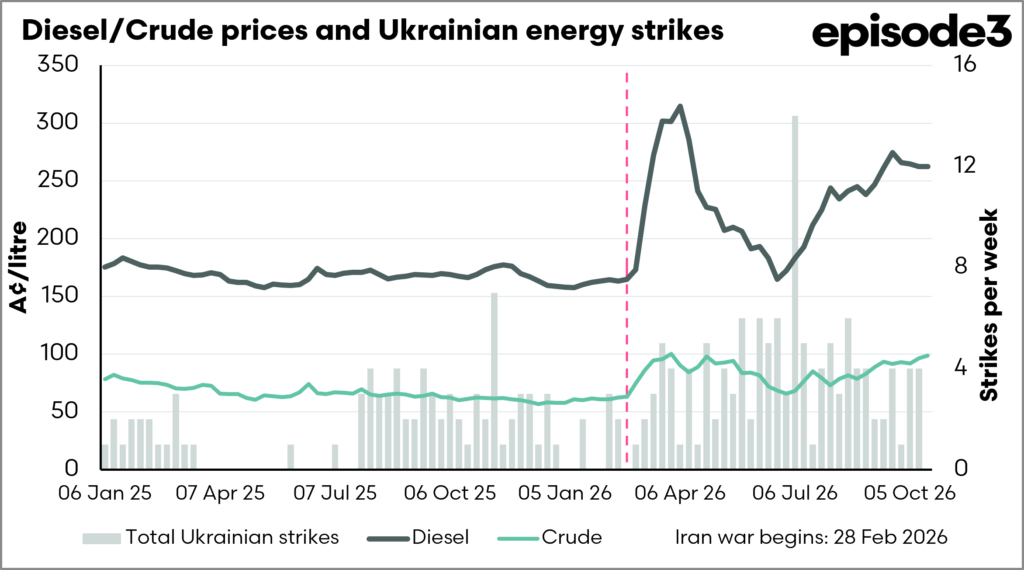
The chart tells the story reasonably well. Australian terminal gate diesel generally sat between about 155 and 185 c/L through much of the earlier period despite repeated Ukrainian strikes on Russian energy infrastructure. The major move came after the start of the Iran war, when diesel pushed above 300 c/L and separated sharply from crude.
Prices subsequently fell back before rising again, so this has not been one uninterrupted march higher. What has persisted, however, is a much wider gap between crude oil and the finished diesel price.
Across the 59 full weeks before the Iran war, Australian terminal gate diesel averaged about 168 c/L, while crude averaged around 66 c/L. Over the 34 full weeks after the war began through 19 October, diesel averaged about 234 c/L and crude about 85 c/L. I have excluded the week containing the start of the war because it straddles both periods.
That means diesel averaged roughly 66 c/L more during the war period, while crude increased by only about 20 c/L. More importantly, the average gap between diesel and crude widened from around 102 c/L to 148 c/L, an increase of approximately 46 c/L.
The first shock was even sharper. Comparing the eight full weeks before the war with the first eight full weeks afterwards, diesel increased by around 104 c/L, while crude rose by about 29 c/L. The gap between the two widened by roughly 75 c/L.
That does not mean every extra cent can simply be stamped “Iran” and filed away. Fuel markets are not that obliging. But pretending the timing is meaningless requires a fair bit of effort.
These are Australian terminal gate prices, so they give us a wholesale view of the fuel market rather than the exact price a farmer pays on farm. The gap between diesel and crude is also not a conventional refinery crack spread. Taxes, freight, distribution, and other costs are embedded in the diesel price, while delivered farm prices vary by location and supplier arrangements.
The broader point is more useful than arguing over terminology. Crude oil is the raw material. Diesel is the product that eventually goes into the header, tractor, or truck. Between those two points, it needs to be refined, shipped, insured, stored and distributed. If any part of that chain gets messy, and much of it is messy right now, diesel can move far beyond crude.
That is where the Middle East matters.
The Iran war and disruption around the Strait of Hormuz have put pressure not only on crude supply but also on refined fuel movements. Buyers seeking replacement cargoes have had to compete for alternative supply and shipping routes. Freight, insurance and uncertainty all become more expensive when one of the world’s most important energy corridors is under threat.
The risk has also spread beyond Iran. Houthi attacks on Saudi infrastructure threaten production and processing elsewhere in the region, while insecurity around the Red Sea puts another major shipping route under pressure. So, the market is not only pricing the disruption that has already happened. It is also pricing the possibility that the next thing breaks.
Ukraine still belongs in this discussion. Attacks on Russian refineries can reduce the finished fuel available for export, while strikes on ports, storage, and other infrastructure can disrupt supply chains. Ukraine is defending itself against Russia’s invasion, and attacking infrastructure that supports the Russian war effort forms part of that conflict. That does not mean international fuel markets are unaffected.
The data does not strongly support the convenient idea that Ukraine is responsible for most of the Australian diesel surge.
Those attacks were already occurring throughout 2025, well before the Iran war and well before Australian diesel prices sharply broke higher. If Ukrainian strikes were the dominant explanation, we would expect a clearer diesel response during that earlier period. Instead, diesel was relatively stable while those attacks were already underway.
We also tested whether allowing for delayed crude-price movements or the number of recorded Ukrainian strikes helped explain added diesel price increases. There was no consistent relationship. That does not mean the strikes have no impact. One major refinery outage can matter far more than several minor attacks, and simply counting strikes tells us nothing about how much refining capacity was lost.
But blaming Ukraine for the bulk of the price move because it makes for a neat explanation is getting ahead of the evidence.
The stronger signal is in the timing. Ukrainian attacks contribute to overall supply risk, but the much larger break in Australian diesel prices followed the start of the Iran war and the escalation of Middle Eastern energy and shipping disruptions. We can’t neatly divide the increase into an Iran bucket and a Ukraine bucket, though that would make life easier, but the evidence points much more strongly to the Middle East as the bigger driver of the recent shock.
For Australian grain growers, that matters because falling crude does not automatically mean diesel will fall by the same amount. Watching crude and assuming diesel must obediently follow it lower is a bit like watching wheat in Chicago and assuming the local cash bid will do the same thing. Sometimes it will. Quite often it will not.
For diesel to become materially cheaper, the gap between crude and finished fuel also needs to narrow. That requires more reliable refining capacity, more reliable shipping routes and less competition for replacement cargoes.
The unfortunate part is the timing. Growers already paid high fuel costs to put this crop in, and the harvest now brings another substantial diesel requirement. There’s little room to defer that expense when the crop is ready, and the forecast says go.
The sooner genuine peace comes in both conflicts, the better the chance those pressures begin to ease. Even then, damaged infrastructure won’t repair itself overnight, and disrupted trade routes won’t instantly return to normal.
Cheaper diesel should eventually come. It would just be useful if it arrived before everyone finished harvesting.