
Did Australia kill off the US sheep industry?

Market Morsel
The United States is again questioning whether imported lamb has damaged its domestic sheep industry, with Australia sitting squarely in the firing line. The US International Trade Commission is investigating whether increased imports of fresh, chilled and frozen lamb are a substantial cause of serious injury, or threat of serious injury, to US producers. Australia matters because it is the dominant supplier of imported lamb into the US market, accounting for around three-quarters of imported sheepmeat supply.
That raises an obvious question. Did Australian sheep meat imports kill off the US industry?
Looking at nearly four decades of production and trade data, the answer appears to be no. In fact, there is a reasonable argument that Australian and New Zealand lamb could be part of the solution to rebuilding the US sheep meat category, rather than the cause of its problems. The timing of the decline is important.
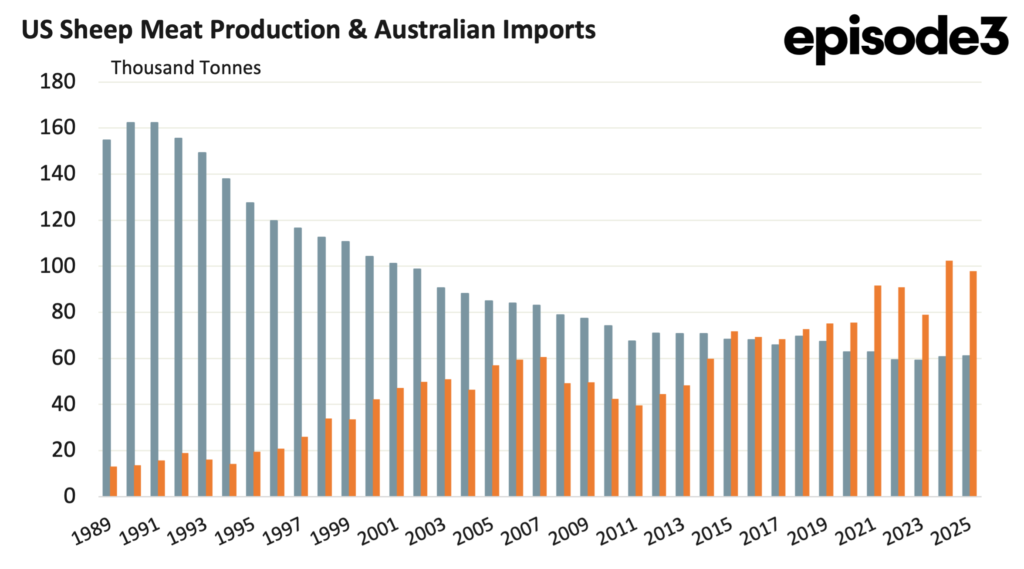
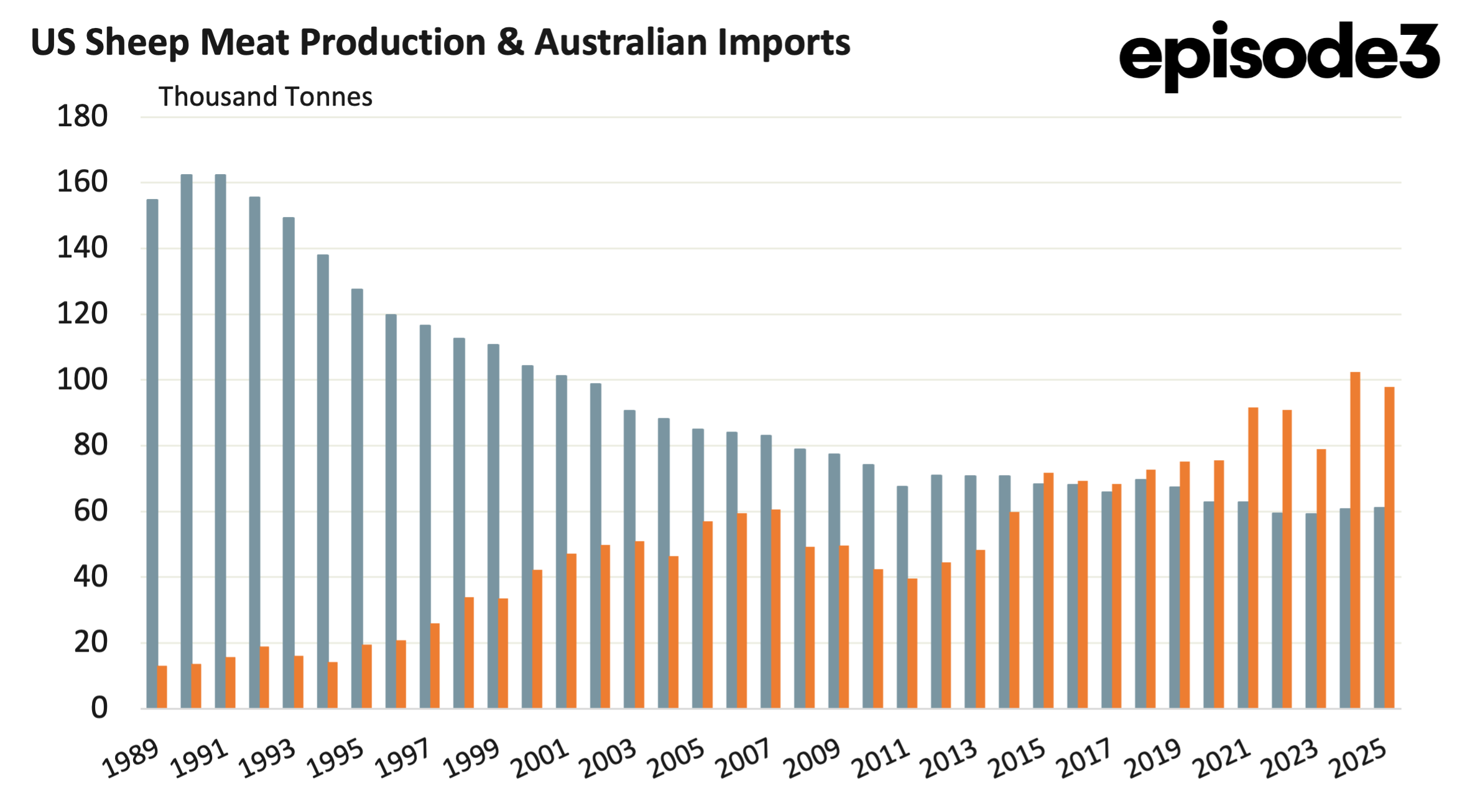
US sheep meat production was around 155,000 tonnes in 1989 and briefly exceeded 160,000 tonnes in the early 1990s. From there it entered a long structural decline, falling towards 100,000 tonnes around the turn of the century and eventually settling near 60,000 tonnes in recent years. Australian imports moved in the opposite direction, but importantly, they did so with a substantial lag.
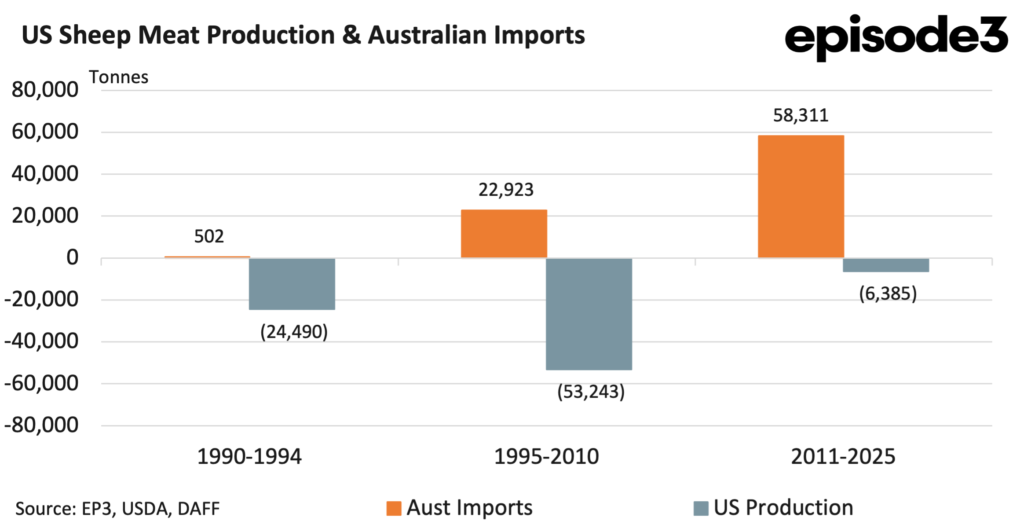
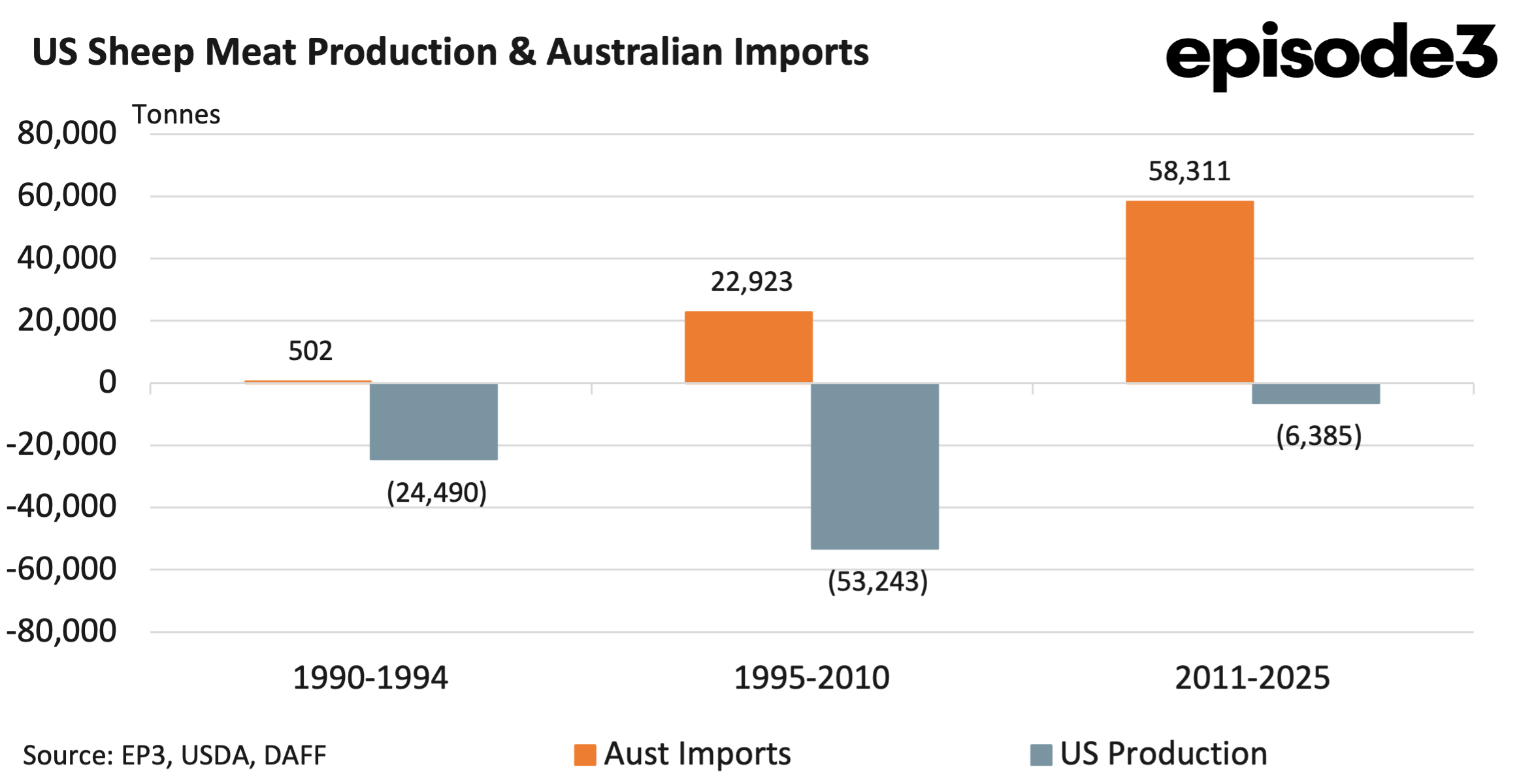
Between 1990 and 1994, US sheep meat production declined by approximately 24,490 tonnes. Over the same period, Australian shipments into the US increased by just 502 tonnes. It is difficult to blame Australian competition for that phase of contraction. The domestic industry was shrinking significantly while Australian supply was barely changing.
The pattern continued between 1995 and 2010. US production fell by another 53,243 tonnes, while Australian imports increased by 22,923 tonnes. Notably, this lift in Australian imports didn’t even fully replace what was lost to US production during 1990 to 1994. Across the entire 1990 to 2010 period, US production therefore declined by roughly 77,700 tonnes while Australian imports grew by only around 23,400 tonnes. Australian product replaced less than one-third of the domestic production that disappeared. Something much bigger than Australian imports was clearly driving the long-term contraction of the US sheep sector.
The relationship changes after 2010. Between 2011 and 2025, US production declined by only another 6,385 tonnes, while Australian imports increased by 58,311 tonnes. By this stage Australia had become a major supplier, but most of the structural decline in US production had already occurred.
The data looks less like Australia destroying the US industry and more like Australian supply increasingly filling the gap created by falling domestic production. USDA itself notes that imported lamb has helped offset declining American production while supporting relatively stable per-capita consumption. This leads to another question that is arguably more important than who supplies the existing market. Why not make the market bigger?
Americans currently consume only around 500 grams of sheepmeat per person each year. Against the enormous quantities of beef, pork and chicken consumed in the US, lamb remains an exceptionally small protein category. At roughly 500 grams per person across a population of around 340 million, annual sheep meat consumption equates to approximately 170,000 tonnes. If consumption could increase to just 1 kilogram per person, the US market would require around 340,000 tonnes annually. That would create demand for an additional 170,000 tonnes of sheepmeat, almost three times current US domestic production.
Finding that extra product would not be straightforward. Australia already supplies customers across Asia, the Middle East, Europe and its domestic market. New Zealand faces its own livestock supply constraints, while the US sheep flock has been shrinking for decades. None of the three producers could simply switch on another 170,000 tonnes overnight. That is why consistent imported supply may help the US sheep industry.
Retailers are more likely to dedicate shelf space to lamb if they can source it reliably throughout the year. Restaurants are more likely to keep lamb on menus when product quality and supply are consistent. Consumers are more likely to experiment with lamb when they encounter it regularly rather than as an occasional niche product. Australian and New Zealand lamb can therefore help build familiarity with the category. That does not mean imported lamb has no competitive impact on US producers. Large volumes of imported product can influence pricing and may make expansion harder for some domestic businesses.
But restricting imports creates another risk. If lamb becomes harder to source or materially more expensive, American supermarkets and restaurants have plenty of alternatives. Lamb does not just compete against other lamb. It competes against beef, pork and chicken. Reducing imported supply could therefore protect a larger share of a very small market while simultaneously making that market harder to grow.
The US has tried protection before. A safeguard tariff-rate quota was imposed on Australian and New Zealand lamb in 1999, yet US sheepmeat production continued its long-term decline through the following decade. Protection did not fix the structural problem then, and there is no guarantee it would do so now. The better opportunity may be cooperation rather than contraction. If US consumption could move from around 500 grams towards 1 kilogram per person, there would potentially be room for more Australian lamb, more New Zealand lamb and, importantly, substantially more American lamb.
The issue may therefore have been framed the wrong way. Australia does not appear to have killed the US sheep meat sector. The bigger question is whether imported lamb can help create a US sheep meat market large enough for everyone to grow.