
Global lamb pricing update Sep 2026

Lamb pricing update - September 2026
Global lamb prices were generally softer through September, although the size of the movement varied considerably between markets. Australia recorded the largest percentage decline among the markets in our comparison, while New Zealand prices held steady and the Northern Hemisphere markets experienced relatively modest falls.
Australian lamb prices eased from 1,172 A¢/kg in August to 1,142 A¢/kg during September, a decline of around 2.6pc for the month. That continued the correction from the elevated levels reached during winter, when tight domestic supply and strong processor competition pushed Australian lamb prices to some of their highest nominal levels on record. Despite the September decline, Australian prices remain historically strong, but the softer month has changed Australia’s position against each of the other global markets.
Across the Tasman, New Zealand was the most stable market during September. NZ lamb prices averaged around 960 A¢/kg in both August and September, effectively unchanged over the month. With Australian prices falling and New Zealand holding steady, the Australian premium to NZ lamb narrowed from 22pc in August to 19pc in September. That continues a significant compression in the trans-Tasman spread from earlier in the year. Australia was trading at a 40pc premium to New Zealand as recently as April, when Australian lamb averaged 1,188 A¢/kg compared with just 850 A¢/kg in New Zealand.
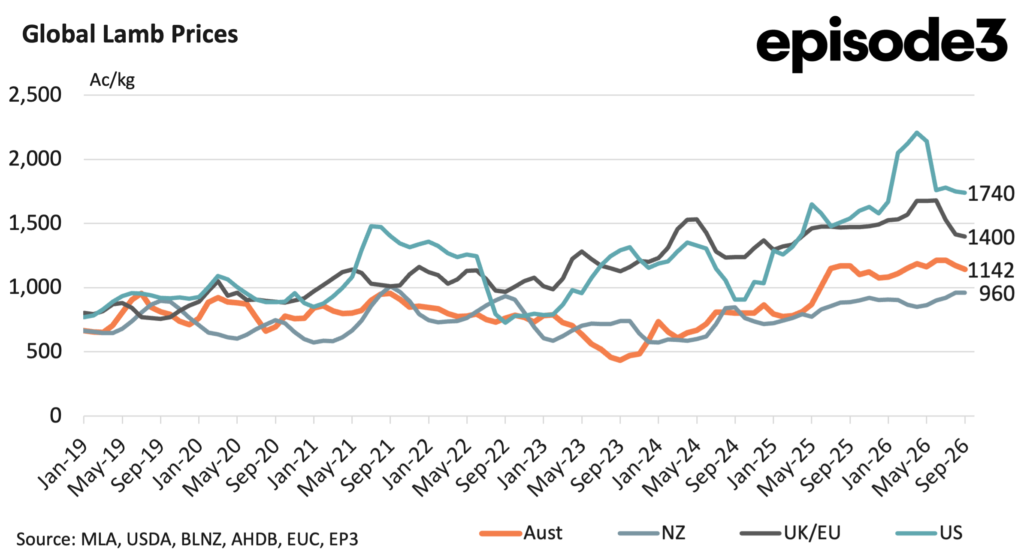
The UK market also continued to soften during September, although the pace of decline was much slower than the sharp correction experienced during August. UK lamb prices eased from around 1,375 A¢/kg in August to 1,350 A¢/kg in September, a decline of approximately 1.8pc. That follows the much larger fall from 1,565 A¢/kg in July as the exceptionally strong British market of earlier in 2026 unwound. Even with the latest decline, the UK remains above Australian pricing. Australia was trading at a 17pc discount to the UK during August, with that gap widening slightly to 18pc in September as Australian prices declined at a faster rate.
European lamb prices were even more stable. The EU heavy lamb benchmark eased from around 1,455 A¢/kg in August to approximately 1,450 A¢/kg during September, a decline of just 0.3pc. However, the relative Australian discount to Europe widened from 19pc to 21pc because of the larger fall in Australian values. Combining the UK and EU markets, the broader benchmark eased from 1,415 A¢/kg to 1,400 A¢/kg, representing a decline of just over 1pc for September.
The United States also remained relatively steady after the much larger price correction seen earlier in the year. US lamb values eased from approximately 1,750 A¢/kg in August to 1,740 A¢/kg in September, a decline of around 0.6pc. The US therefore retains its position as the highest-priced market in the comparison by a considerable margin. Australia’s discount to US lamb widened from around 33pc in August to 34pc during September.
The September movements therefore represent something of a change from the convergence story that dominated the previous few months. During winter, sharply falling UK and US prices brought Northern Hemisphere values closer to Australia, while strengthening New Zealand prices narrowed the gap from below. In September, most international markets effectively stabilised while Australia continued to soften. That has left Australia slightly cheaper relative to the UK, EU and US, while simultaneously reducing its premium over New Zealand.
For exporters, that is not necessarily a poor outcome. Australian lamb remains 18pc below UK values, 21pc below the EU and 34pc below the US, maintaining a substantial price advantage against the major Northern Hemisphere markets. At the same time, the narrowing premium over New Zealand improves Australia’s relative competitiveness against its closest major export rival. The key question through spring will be how much additional Australian lamb supply emerges as seasonal turnoff builds. If Australian prices continue to soften while Northern Hemisphere markets stabilise, the international price spreads could begin widening again. September has left Australia cheaper against the Northern Hemisphere markets, while New Zealand continues to quietly close the gap from below.