
Goatmeat export update April 2026
April 2026 - Goat Meat Export Update
Australia’s goat meat export performance in April 2026 highlighted a market continuing to operate above historical norms, even as demand patterns across key destinations remained uneven.
Total exports for the month reached 4,169 tonnes, up 4 percent compared with April last year and sitting 45pc above the five-year average. The result confirms that while volatility persists across individual markets, the broader goat meat sector continues to trade from a structurally stronger base than in previous cycles.
The United States further strengthened its position as the dominant destination for Australian goat meat exports in April. Shipments totalled 2,247 tonnes, accounting for more than half of total export flows during the month. Volumes into the US were 45pc higher than April last year and sat 63pc above the five-year average, underlining the exceptional demand conditions currently underpinning the market. The US continues to provide the key source of stability and growth for Australian goat meat exporters, with strong consumer demand across ethnic and food service channels absorbing a substantial share of available supply.
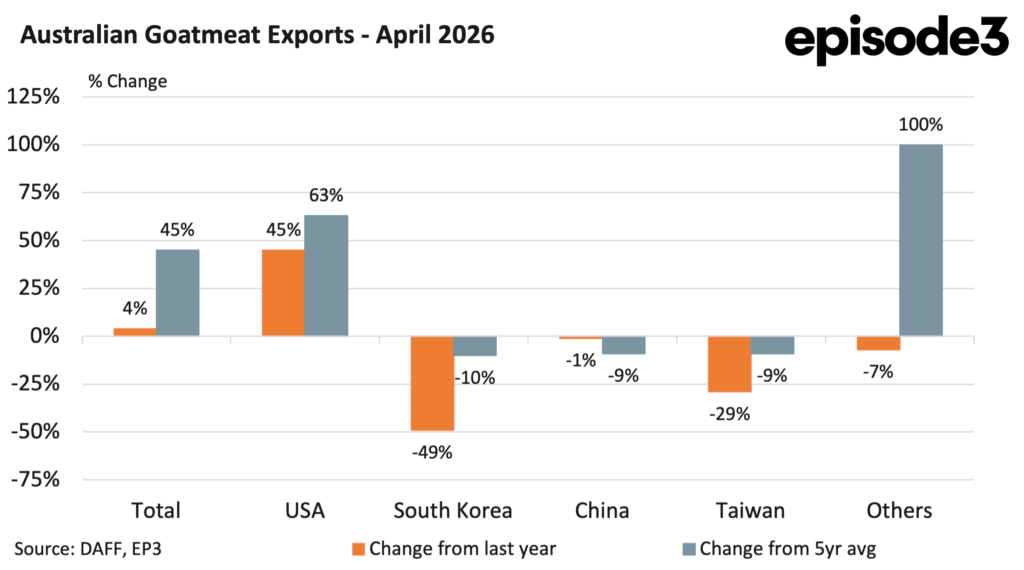
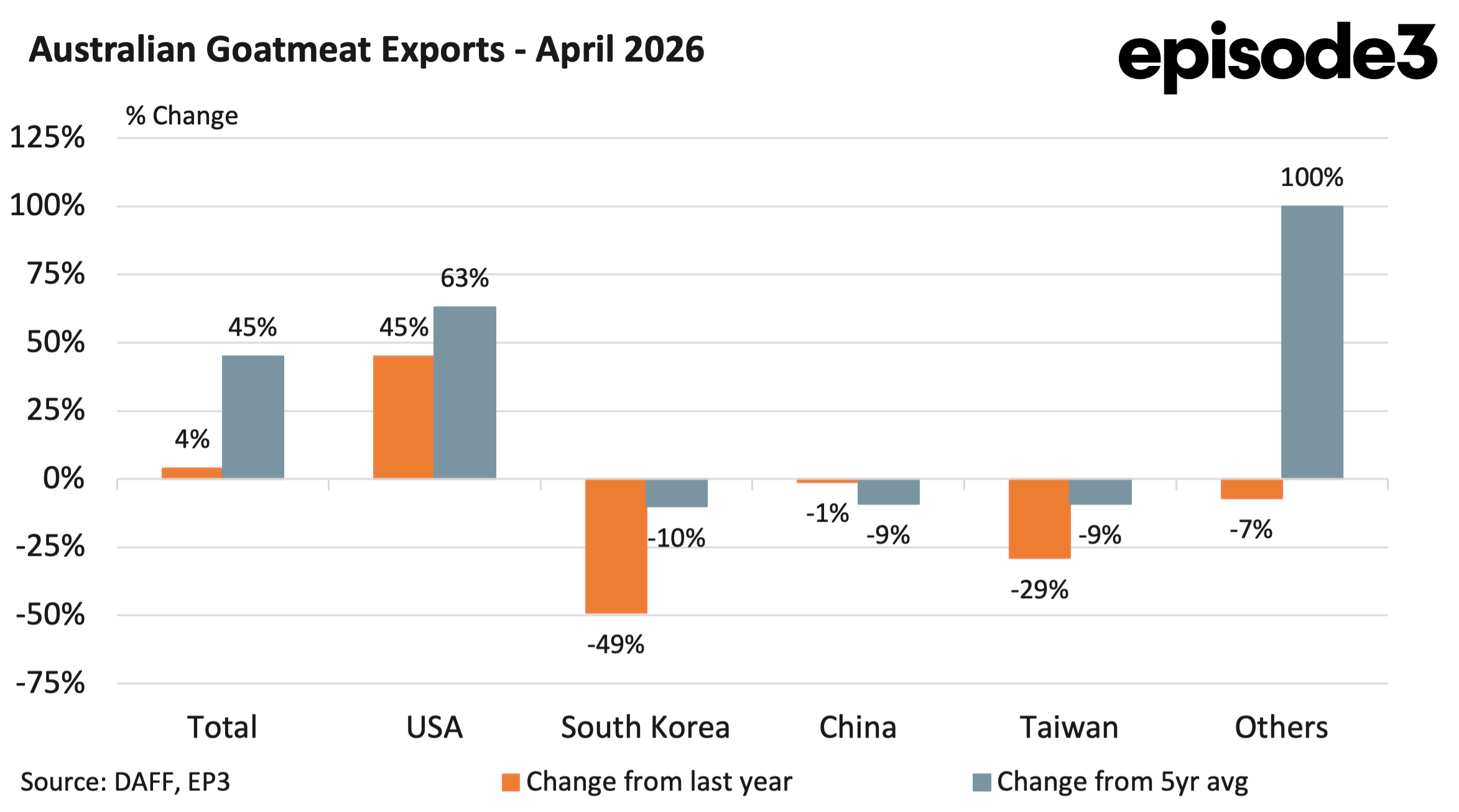
China remained a comparatively minor destination in April, with exports totalling 268 tonnes. Volumes were largely unchanged from last year, down just 1pc, but remained 9pc below the five-year average. This suggests that while China has stabilised after the sharp declines seen earlier in 2026, it still sits below historical participation levels and is not currently playing a major role in supporting overall export growth. The market remains opportunistic and comparatively volatile within the broader export mix.
South Korea saw a notable pullback in April. Export volumes reached 408 tonnes, down 49pc compared with last year and 10pc below the five-year average. This marks a continuation of the softer demand pattern evident in recent months and indicates that South Korea is currently contributing less consistently to the export program than it has during stronger periods of trade. While still an important secondary market, the April result highlights the sensitivity of South Korean demand to shifting market conditions.
Taiwan also recorded softer trade flows during April, with exports totalling 200 tonnes. Volumes were 29pc lower than last year and 9pc below the five-year average. Like South Korea, the Taiwan result reflects weaker short term demand conditions, although the market remains a relatively stable destination over the longer term and continues to provide an outlet for Australian product.
Exports to all other destinations combined reached 1,045 tonnes in April. While this category was 7pc lower than last year, it remained a remarkable 100pc above the five-year average. This continued outperformance against historical norms highlights the growing importance of diversification across a wide range of smaller and emerging destinations.
Even though some individual secondary markets have softened, the broader spread of export demand continues to provide resilience and support the industry’s structurally higher export profile. April 2026 reinforces the key themes that have emerged throughout the year.
The goat meat export sector remains heavily anchored by the United States, which continues to absorb increasing volumes and provide the primary source of growth. At the same time, flows into several Asian destinations remain more volatile, with softer demand from Korea and Taiwan offsetting some of the gains seen elsewhere. Despite these fluctuations, total exports continue to sit well above historical averages, reflecting the broader expansion of Australia’s goat meat industry and the increasing diversification of its export markets.
The April figures also demonstrate how concentrated the current export structure is centred around the US market. While diversification across secondary destinations remains important, the extent of US demand growth means that movements in American buying patterns now have an increasingly significant influence on overall export performance.