
Goatmeat export update June 2026
June 2026 - Goat Meat Export Update
Australian goat meat exports held firm during June 2026, with total shipments reaching 4,209 tonnes. Volumes were 6 percent higher than June last year and sat 57pc above the five-year average for the month, reinforcing the view that the sector continues to operate from a structurally higher base than was typical in earlier years. The result was again driven by strong demand from the United States, which remains the dominant destination for Australian goat meat.
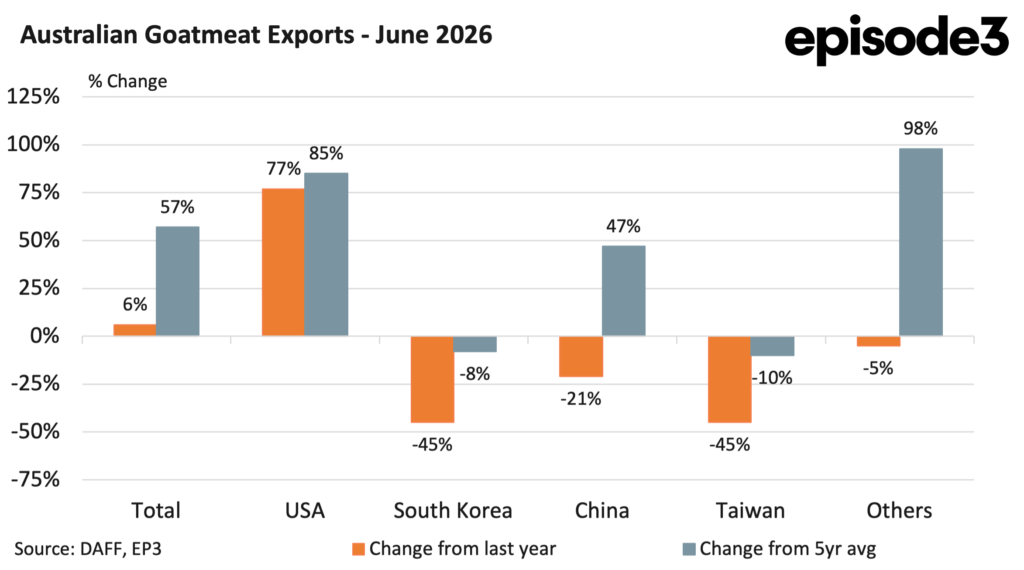
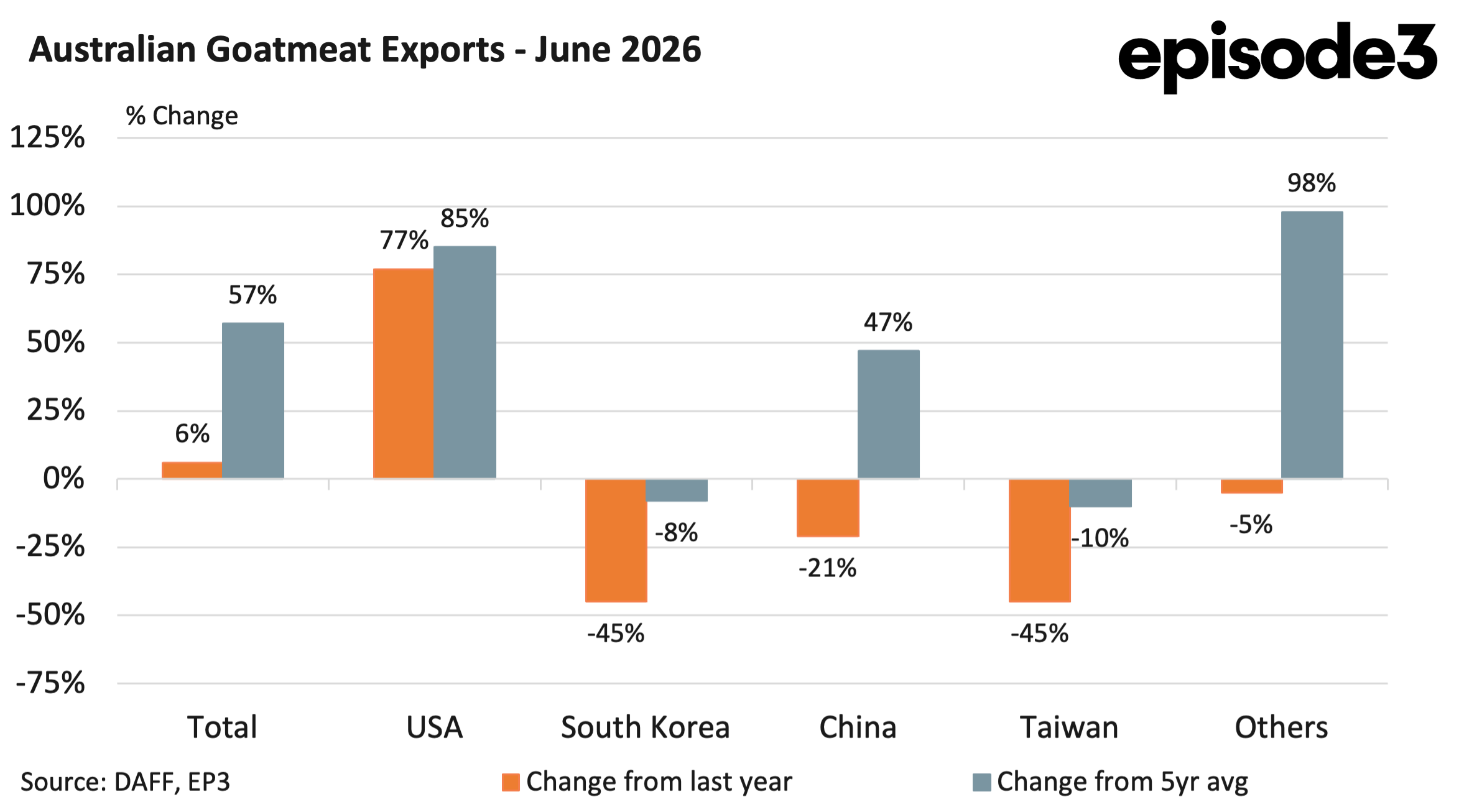
The US took 2,221 tonnes during June, accounting for just over half of total exports. Shipments were 77pc higher than the same month last year and 85pc above the five-year average, making the US the clear source of growth within the monthly trade. The strength of American demand continues to underpin Australia’s goat meat export program. Demand remains supported by established ethnic and cultural consumption patterns, while Australia holds a strong position as a reliable supplier into a market with limited domestic production. The scale of the June increase also suggests that the US market is not simply maintaining demand but absorbing a larger share of available Australian product.
South Korea received 487 tonnes during June. Volumes were 45pc lower than June last year and 8pc below the five-year average, extending the softer trend seen across recent months. Korea remains an important secondary market, but the June result highlights the volatility that can occur outside the dominant US trade. Shipment timing can influence monthly comparisons, though the weakness against both last year and the longer-term average suggests underlying demand was also more subdued.
China took 358 tonnes of Australian goat meat during June. Shipments were 21pc lower than a year earlier but still sat 47pc above the five-year average. This continues the mixed pattern evident through 2026, with China underperforming recent elevated trade levels while still taking substantially more product than was typical over the longer term. China remains a relatively small outlet compared with the US, but its position above the five-year average shows that it continues to play a meaningful role within the broader diversification story.
Taiwan imported 204 tonnes during the month. Volumes were down 45pc year on year and 10pc below the five-year average. Taiwan has generally provided a modest but relatively stable outlet for Australian goat meat, although June was clearly weaker than normal. Alongside the softer Korean result, this placed more of the burden for monthly export growth on the US and the wider group of secondary markets.
Exports to all other destinations combined totalled 939 tonnes. This was 5pc below June last year, but still 98pc above the five-year average. That strong comparison with historical levels highlights how much broader the market base has become. Even without year-on-year growth during June, the collective contribution from smaller markets remains almost double the longer-term norm.
Canada is one destination worth watching within that broader group. Its share of Australian goat meat exports has increased from 8.1pc last year to 13.8pc so far in 2026. That represents a material lift in relative importance and suggests Canada is emerging as more than a minor outlet. While it remains well behind the United States in absolute scale, the increase provides additional diversification within North America and may offer another dependable destination as the trade develops.
The June figures show a sector that remains heavily reliant on the US, but not exclusively so. The American market continues to provide the growth engine, while China and the combined secondary markets remain well above historical norms. South Korea and Taiwan were weaker, yet total exports still finished comfortably above both last year and the five-year average. For Australian goat producers, the central question is whether US demand can maintain its current pace while newer destinations such as Canada continue to expand. Based on the first half of 2026, the market mix continues to broaden even as the US holds dominance, leaving the goat meat trade in a stronger position than the headline volume alone might suggest.