
Goatmeat export update February 2026
February 2026 - Goat Meat Export Update
Australia’s goatmeat export performance in February 2026 continued to reflect a market adjusting to shifting demand patterns, with total volumes easing year on year but remaining well above historical norms.
Total exports for the month declined 17 percent compared with February last year, indicating a moderation in throughput following the elevated flows seen through parts of 2025. Despite this, exports were still 67pc higher than the February five year average, reinforcing the point that the sector is operating from a structurally higher base than in previous cycles. The headline result is therefore one of short term softness layered over longer term expansion.
The United States remained the key anchor market for Australian goatmeat exports in February. Shipments were down 17pc compared with the same month last year, mirroring the broader easing in total exports. However, volumes into the US were still 29pc above the five year average, highlighting the continued importance of this market in absorbing Australian supply. While demand appears to have softened at the margin, the US remains a consistent and reliable outlet, particularly for higher value product segments.
South Korea saw a more pronounced contraction in February export flows. Volumes declined 55pc year on year, signalling a significant pullback compared with early 2025. In contrast to January, shipments into Korea were also 16pc below the five year average, suggesting that February represented a genuine period of weakness rather than simply a normalisation from elevated levels. This result points to volatility in secondary markets and highlights their sensitivity to short term demand shifts.
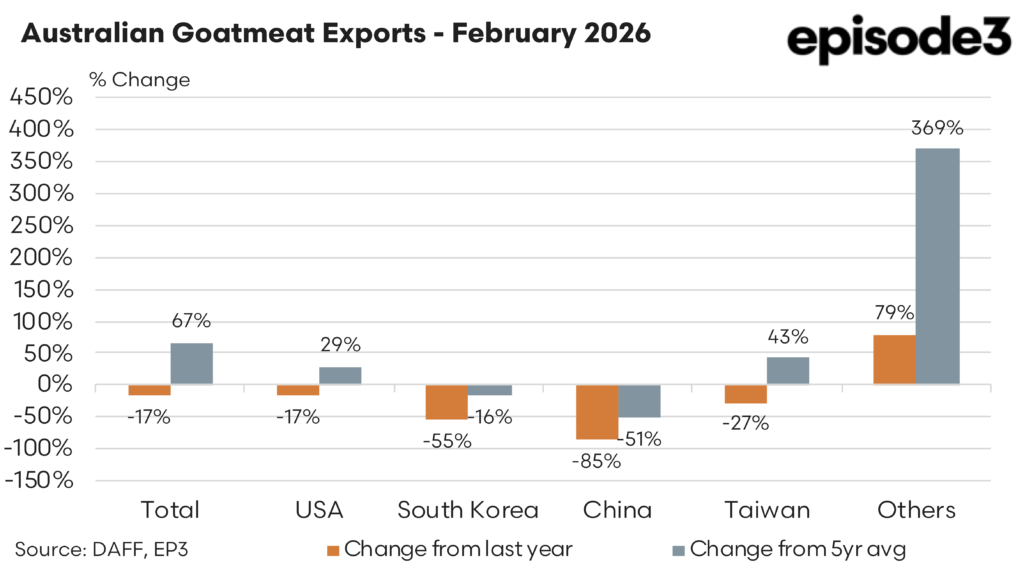
China remained largely absent from the Australian goatmeat export program in February. Exports were down 85pc compared with last year and 51pc below the five year average. While not as extreme as the near collapse observed in January, the February data confirms that China has not re-emerged as a meaningful destination in the early part of 2026. This continued weakness has removed what was previously an opportunistic but occasionally important market for Australian exporters.
Taiwan presented a more balanced picture. Export volumes were 27pc lower than February last year, but still 43pc above the five year average. This suggests that while trade has softened in the short term, underlying demand remains solid relative to historical levels. Taiwan continues to play a steady role within the export mix, providing some stability amid more volatile movements in other Asian markets.
The most notable feature of the February data was again the strength in the “other markets” category. Exports to these destinations were 79pc higher than February last year and an extraordinary 369pc above the five year average. This segment now represents a substantial share of total shipments and reflects ongoing diversification across a wide range of smaller or emerging markets. The growth in these destinations has been critical in offsetting the decline in more traditional markets such as China and, to a lesser extent, Korea.
February 2026 reinforces the themes evident in January, which highlighted that the goatmeat export sector is not contracting in a structural sense, but rather redistributing its flows across a broader set of markets. While year on year comparisons remain negative across most individual destinations, the continued strength relative to the five year average highlights the expansion of the industry over time.
The increasing reliance on a diverse group of secondary markets provides resilience, but also introduces a different type of volatility, as demand becomes less concentrated and more sensitive to changes across multiple smaller destinations.