
Goatmeat export update July 2026
July 2026 - Goat Meat Export Update
Australian goatmeat exports took a sizeable step backwards during July, with total shipments falling to 3,246 tonnes shipped weight. That was 41pc below July last year, although volumes remained 6pc above the five-year average for the month. July was weak compared with the exceptionally strong export volumes seen during 2025, but the result was not particularly poor when viewed against the longer-term performance of the industry. It was also a sharp slowdown from the first half of 2026. Goatmeat exports had been running comfortably above historical levels, with June shipments of 4,209 tonnes sitting 57pc above the five-year average. July therefore represents a significant monthly correction.
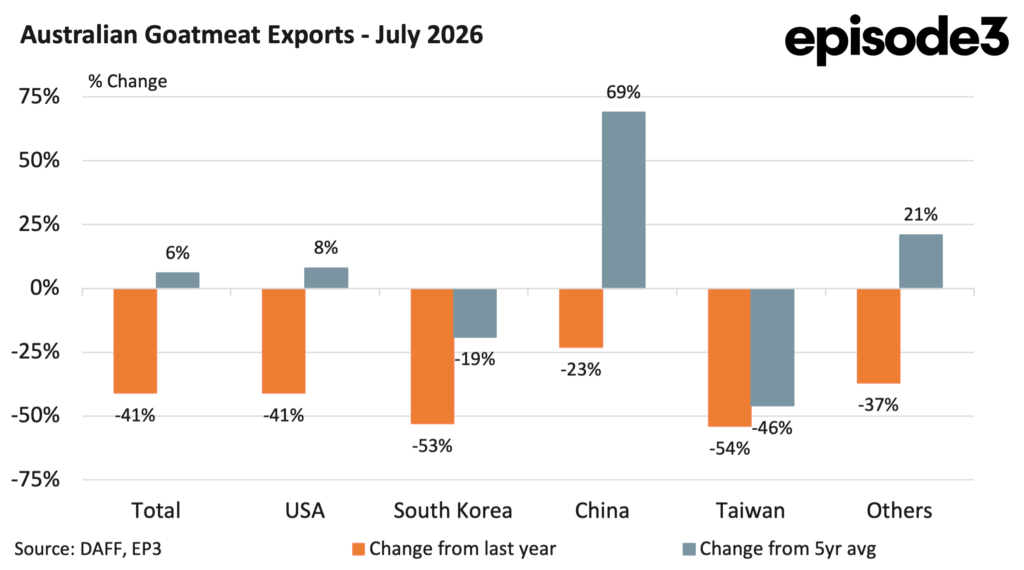
The United States remained comfortably Australia’s largest goatmeat destination, taking 1,648 tonnes during July. That was 41pc below July last year but still 8pc above the five-year average. The US accounted for just over half of July shipments, demonstrating how important the market remains despite the year-on-year decline.
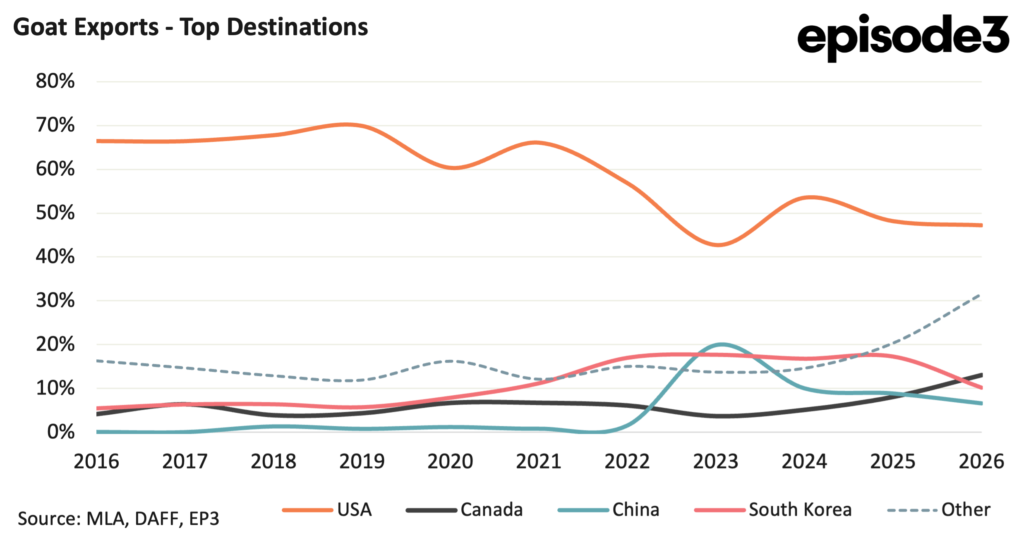
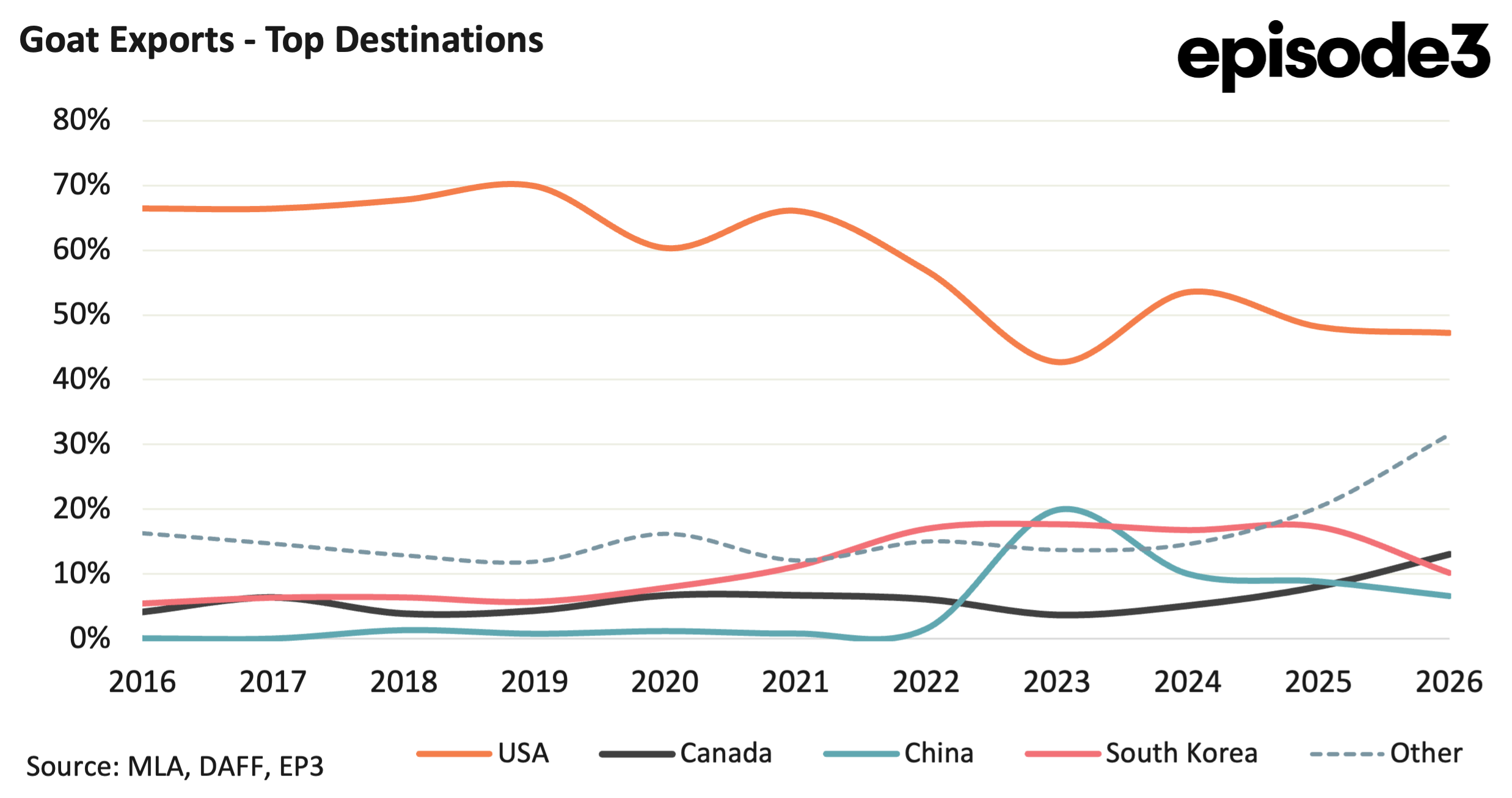
However, one of the longer-term trends in the goatmeat trade has been a gradual reduction in Australia’s reliance on the US. In 2016, around two-thirds of Australian goatmeat exports were directed to the US. Its share has progressively declined and sits at around 47pc so far in 2026.
This does not necessarily represent weakening US demand. Australian goatmeat exports have expanded and diversified, allowing other destinations to take a greater share of the trade.
South Korea received 492 tonnes during July. Shipments were 53pc below July last year and 19pc below the five-year average.
The result continues a softer period for South Korea after the market emerged as an increasingly important destination during the first half of the decade. Its share of Australian exports increased from around 5pc in 2016 to approximately 17pc during 2023-25, before slipping back towards 10pc so far in 2026.
China produced almost the opposite result. Exports to China reached 381 tonnes during July, 23pc below last year’s level but a substantial 69pc above the five-year average. This highlights the importance of looking beyond the year-on-year comparison. While shipments were down against a strong 2025 result, China remains considerably more active than it has typically been at this time of year. China’s longer-term contribution to Australian goatmeat exports has been volatile. Its share surged towards 20pc during 2023 before easing to around 9pc in 2024 and 2025 and closer to 6pc so far during 2026.
Taiwan remained weak, receiving just 102 tonnes. That was 54pc below July last year and 46pc below the five-year average.
Taiwan has generally been a smaller destination than the US, South Korea or China, but the scale of July’s decline reinforces the broader weakness across several established Asian markets. The remaining destinations collectively took 624 tonnes. These flows were 37pc below last year but remained 21pc above the five-year average.
That broader group is becoming increasingly important as the goatmeat trade diversifies. One market worth particular attention is Canada.
Canada accounted for only around 4pc of Australian goatmeat exports a decade ago, but its share has steadily increased. After representing 8.1pc of total shipments during 2025, Canada has lifted towards 13pc of exports so far in 2026. That puts Canada broadly alongside, and currently ahead of, South Korea as Australia’s second most significant individual goatmeat destination by share during 2026.
It is a considerable change in the structure of the trade and provides another outlet beyond the traditionally dominant US market. July’s numbers therefore tell two stories. The immediate story is one of weaker export volumes. Shipments fell sharply compared with last year, with declines recorded across the US, South Korea, China and Taiwan. The US alone shipped around 1,150 tonnes less Australian goatmeat than during July 2025.
The longer-term picture is more encouraging. Despite falling 41pc year-on-year, total July exports remained 6pc above the five-year average. The US was 8pc above average, China was 69pc above average and the collection of other destinations was 21pc above average. It suggests July was more a retreat from unusually strong recent volumes than a collapse in underlying export demand. Perhaps more importantly, Australia’s goatmeat export base continues to evolve.
The US remains the anchor market, but its dominance has gradually declined as markets including Canada, South Korea and China have developed. July was unquestionably a softer month for Australian goatmeat exports. Yet with overall shipments still above historical norms and the destination mix considerably broader than it was a decade ago, the longer-term export story remains more positive than the headline 41pc annual decline initially suggests.