
Old people are the future of the meat industry

Population ageing is reshaping who buys food, and food producers should be paying attention.
Most conversations about food demand start with a simple sum: more people, more mouths to feed, which makes commonsense. But there’s a number hiding underneath population growth that doesn’t get nearly enough airtime: the average age of that population.
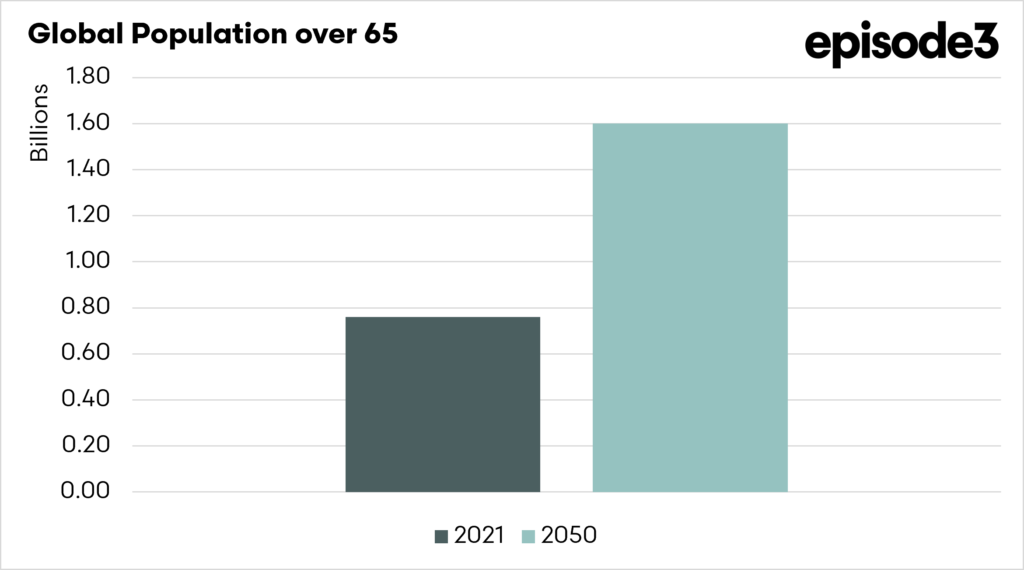
By 2050, the number of people aged 65 and over is expected to more than double, from 761 million in 2021 to 1.6 billion. That’s not a rounding error in a UN report. It’s a fundamental reshuffling of who the global consumer actually is.
Everyone knows children need protein to grow. Fewer people clock that the other end of the age spectrum needs it too, just for a different reason. Older adults need more protein per kilogram of body weight than someone in their thirties, not to build anything new, but to hang onto what they’ve already got. The numbers back this up plainly. Under Australia’s own nutrient reference values, a man in his twenties or thirties needs around 64 grams of protein a day. Past 70, that jumps to 81 grams, over 25% more. Women go from 46 grams per day to 57 grams per day. Muscle, strength, immune function, all of it erodes with age unless protein intake keeps pace, and the official guidelines already say as much.
Scale that up. Apply that same gap across the projected 1.6 billion people aged 65 and over by 2050, and it works out to roughly an extra 8 million tonnes of protein required each year, just from the shift in individual need as the population ages. That’s before population growth or rising incomes add a single extra person to the table. It’s a rough estimate rather than a precise figure, but it gives a sense of the scale involved.
The usual protein story is an income story: get richer, eat more meat and dairy. Still true, still driving a lot of the growth across Asia. But ageing is a second engine bolted onto the same trend, one that keeps running even where population growth has stalled or gone backwards. A shrinking, greying population can still be a growing protein market. On a per-person basis, it might need more, not less.
This isn’t just a livestock story, either. Beef, lamb, pork, poultry, dairy, and eggs are the obvious categories, but grain growers are in it through feed demand, pulse growers through plant protein, and oilseed producers through meal markets. Processors, exporters, retailers: nobody in that chain sits this one out.
None of it happens automatically, of course. Older consumers still need the income to act on it, the access to buy it, and often the advice to prioritise it. Cost-of-living pressure could cap how much high-quality protein makes it onto the plate, even as health systems push the other way, encouraging protein intake as part of healthy ageing policy. Supply, currency, trade access, consumer taste, all of that still decides where prices land in any given year. What’s changed is that there’s now a slow structural current running beneath the usual cycles, and it’s pushing in one direction.
Australia is well placed here. We already export significant volumes of high-quality protein to markets ageing faster than almost anywhere else: Japan, South Korea, and increasingly China, with Southeast Asia not far behind. These aren’t buyers chasing calories anymore. As they age, they’ll care more about nutrition, safety and consistency, and that shift in what they value matters as much as how much they buy.
Population growth, rising incomes, urbanisation, food security: protein’s never needed just one argument in its favour. Ageing is simply the one that doesn’t get enough credit, and it’s backed by numbers.
The next food challenge isn’t just feeding more people. It’s feeding the older ones. And older bodies need more protein, not less.