
Processors pull back as lamb prices slide
Market Morsel
The latest Sheep and Lamb Slaughter Index shows a mixed supply picture through September, with some regions processing more stock while others have tightened considerably. Importantly, there is little evidence yet of a broad national spring surge in slaughter, despite sheep and lamb prices falling across most processor categories over the past four weeks.
For sheep, slaughter increased in four of the six states, but the movements varied considerably between the major producing regions. Western Australia recorded the strongest improvement, with the sheep slaughter index rising from 26pc in August to 41pc in September. South Australia also strengthened from 39pc to 45pc, suggesting processors in these two states have had greater access to sheep than during the previous four-week period. Victoria was effectively steady, easing slightly from 25pc to 24pc, while New South Wales tightened more noticeably from 25pc to 18pc. Tasmania increased from 12pc to 19pc, while Queensland moved from 58pc to 68pc, although the larger eastern and southern producing states remain more important to the overall national supply picture.
The result is not a simple story of the winter sheep shortage suddenly disappearing. There has clearly been some improvement in availability, particularly in Western Australia and South Australia, but NSW sheep slaughter remains low and Victoria has shown virtually no change. Mutton prices have nevertheless continued to retreat from the exceptional levels reached during winter. The Mutton Indicator declined by around 69c over the past four weeks to approximately 798c/kg cwt. That represents a substantial correction from the extraordinary winter highs, when extremely limited sheep availability forced processors to compete aggressively for stock. Some improvement in sheep supply has contributed to that correction, but the SLSI suggests additional supply alone does not fully explain the price decline.
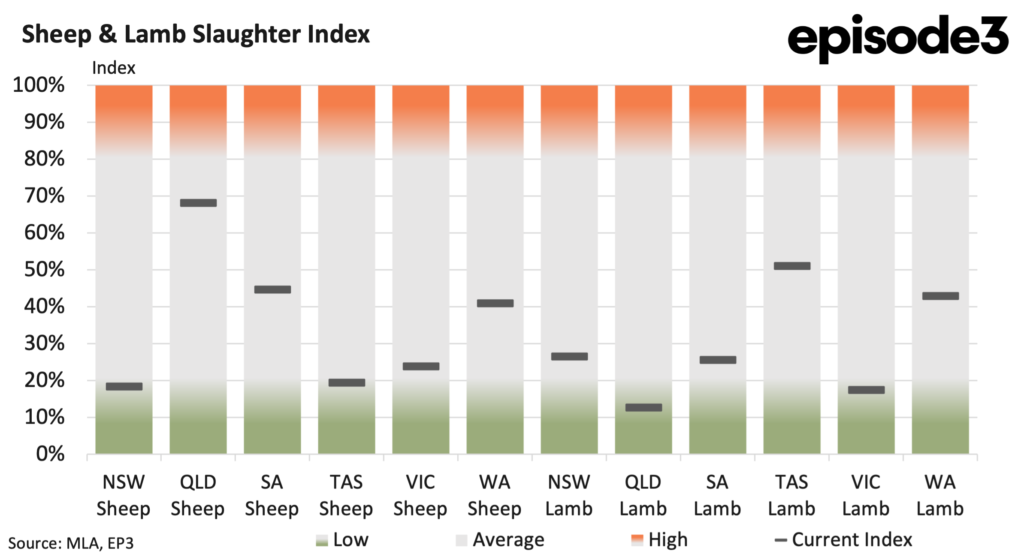
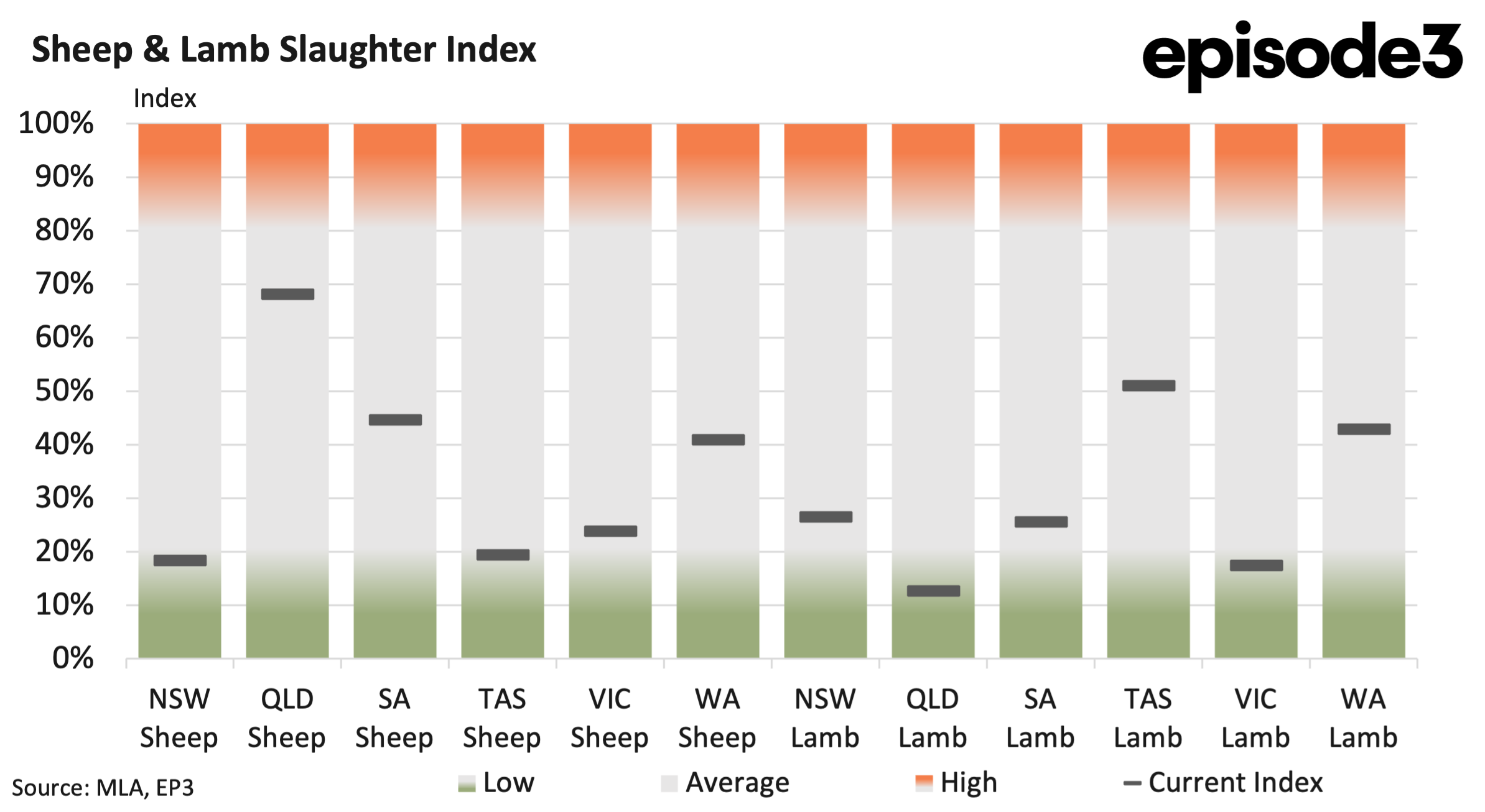
The lamb slaughter figures provide an even clearer example of the mixed supply environment. The standout movement was NSW, where the lamb slaughter index fell sharply from 81pc in August to just 26pc in September. That is a substantial reversal after NSW had previously emerged as the major source of additional lamb supply during winter. Recent yarding data had also shown more NSW lambs being offered through saleyards, making the sharp reduction in processor throughput particularly notable.
Western Australia moved in the opposite direction, with lamb slaughter increasing strongly from 27pc to 43pc. Tasmania also increased from 42pc to 51pc, while South Australia edged higher from 23pc to 26pc. Victoria remained relatively tight, with lamb slaughter easing from 21pc to 17pc. The overall lamb picture is therefore difficult to describe as a conventional spring flush. There is more processor throughput in WA, Tasmania and to a lesser extent SA, but that is being offset by substantially lower NSW slaughter and continued tight conditions in Victoria.
Despite this mixed supply picture, processor lamb prices have fallen broadly over the past four weeks. Heavy lamb declined by around 53c to approximately 1,076c/kg cwt, while light lamb fell by around 42c to 1,020c/kg cwt. Merino lamb also lost approximately 42c to sit near 1,014c/kg cwt. Trade lamb recorded the largest decline among the main processor lamb categories, falling by around 84c over four weeks to approximately 1,086c/kg cwt.
The important point is that these price falls have occurred without a corresponding national surge in lamb slaughter.b That suggests the current correction is increasingly about the demand side of the ledger, with export demand also relatively subdued, particularly compared with the strength in livestock prices experienced through winter. With processors struggling to extract sufficient value from the other end of the supply chain, their willingness to continue chasing sheep and lambs at extreme winter prices was always going to be tested.
The latest price movements suggest that resistance is becoming increasingly apparent. Restocker lamb provides an interesting exception. The Restocker Lamb Indicator rose by about 57c over the past four weeks to approximately 1,130c/kg cwt, while all the major processor categories moved lower. That suggests producer demand for suitable lambs remains relatively strong even as processor buying pressure has weakened.
The September SLSI therefore points towards a market where some of the extreme winter scarcity has eased, but supply alone does not explain the magnitude of the recent price correction. After spending much of winter competing aggressively for scarce livestock, processors are now showing greater resistance to those elevated prices as difficult trading conditions and softer export demand limit what can be paid for stock. Spring supply is beginning to emerge in some regions, but the flush has not arrived in force. For now, the bigger change appears to be that buyers are simply less willing to chase the market than they were during winter.