
Sheepmeat export update June 2026
June 2026 - Sheep Meat Export Update
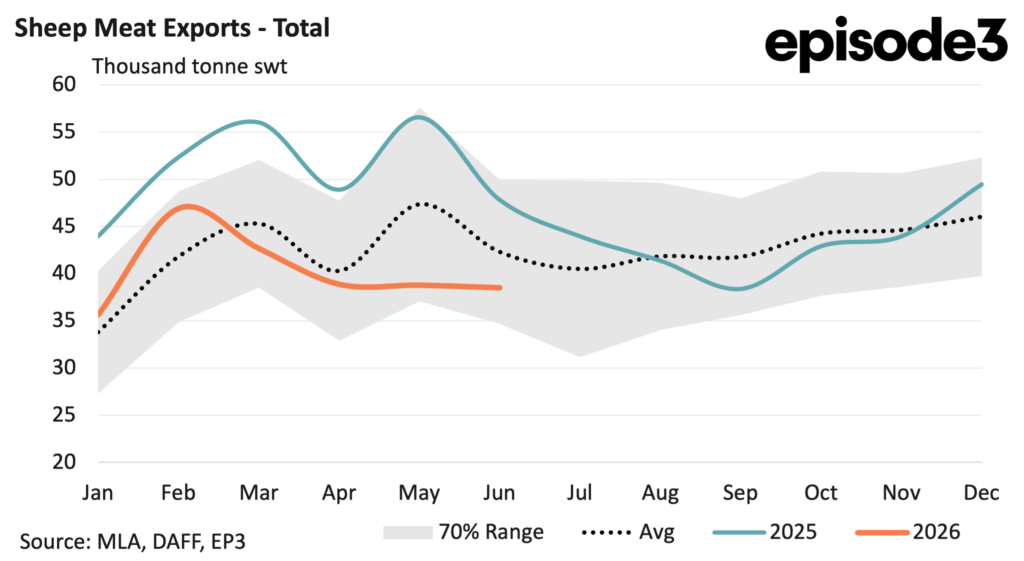
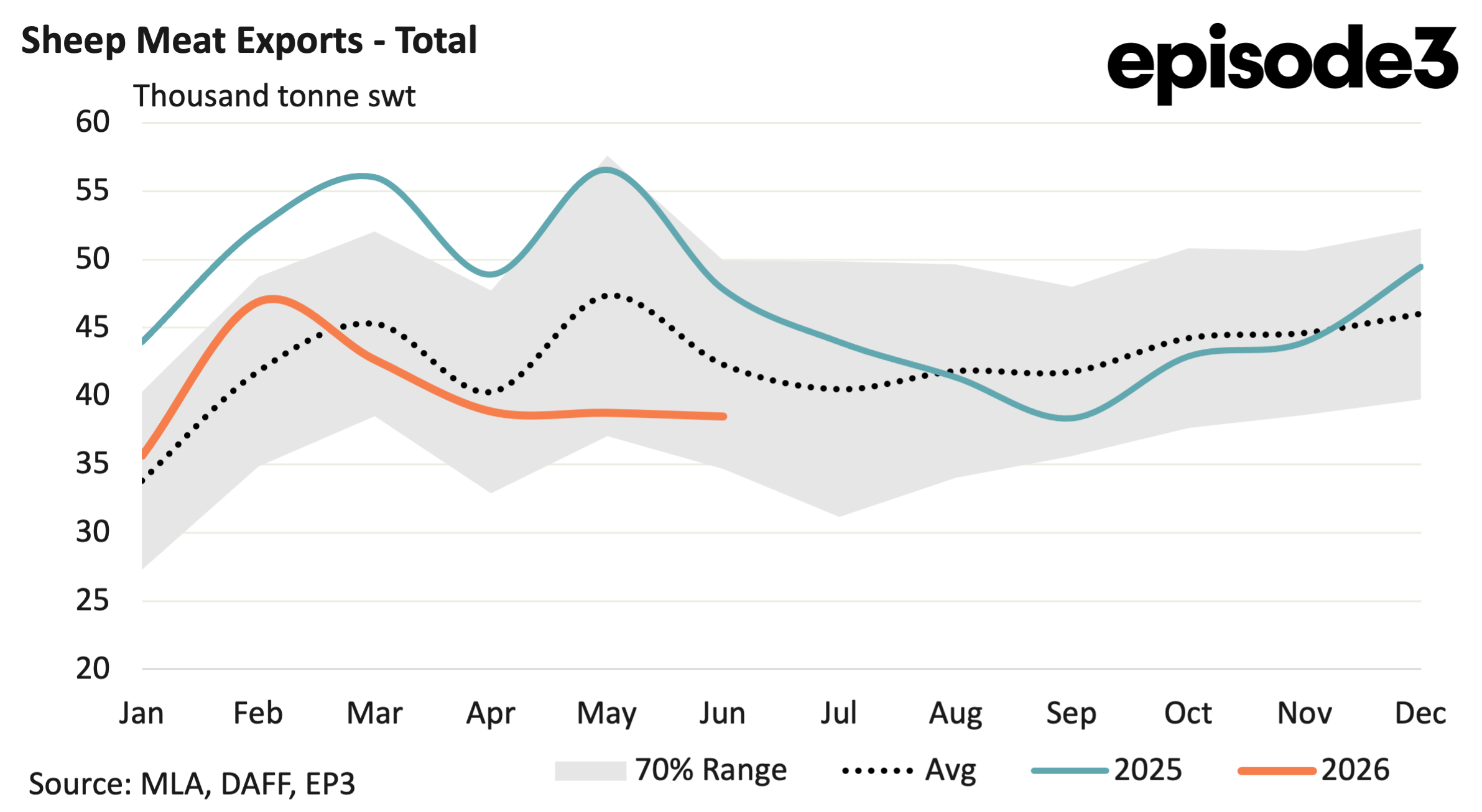
Australian sheep meat exports remained relatively steady during June 2026, with total shipments reaching 38,495 tonnes shipped weight. While volumes were 19pc below the exceptionally strong levels recorded in June last year, they were only 9pc below the five-year average, suggesting export demand is beginning to normalise after an unusually strong period of supply. The June figures show a market that is becoming increasingly balanced.
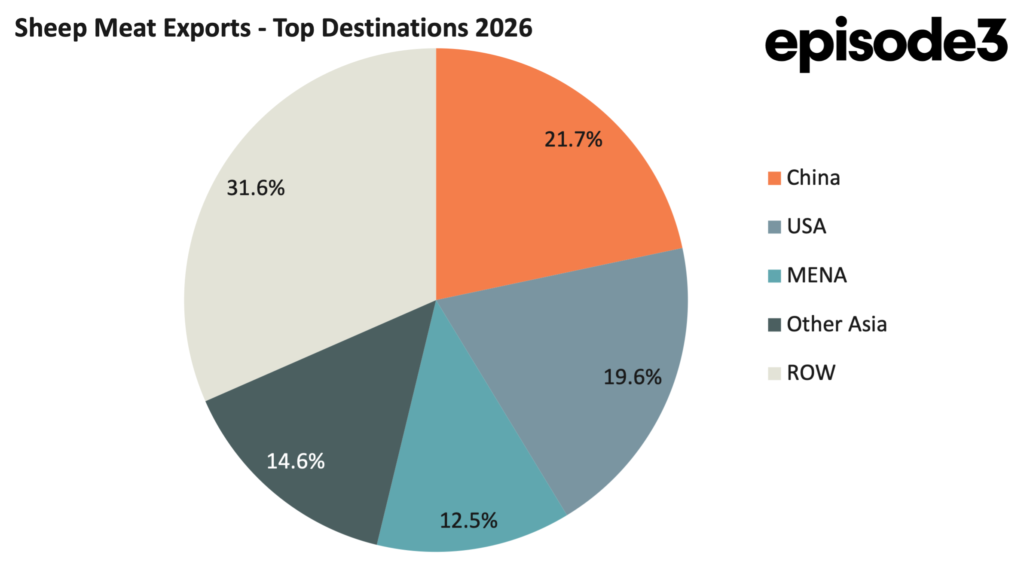
China continues to hold its position as Australia’s largest sheep meat customer, the United States remains a dependable premium destination, and conditions across the Middle East appear to be gradually improving after a difficult start to the year. China retained its position as Australia’s largest sheep meat export destination during June, taking 9,682 tonnes, or 21.7pc of exports so far in 2026.
Monthly shipments were only marginally below both last year and the five-year average, down just 1pc and 2pc respectively. That stability is significant given the volatility seen across many global protein markets this year. While Chinese economic conditions remain mixed, demand for Australian sheep meat has remained comparatively resilient, allowing exports to track close to historical norms even as overall shipments remain below last year’s elevated levels.
The United States again provided a reliable outlet for Australian lamb, importing 8,077 tonnes during June. Shipments were effectively unchanged from last year and sat 2pc above the five-year average. The consistency of the US market has become one of the defining features of Australia’s sheep meat trade over the past 18 months. Despite economic uncertainty and higher retail prices, American demand has remained remarkably steady, providing exporters with an important premium market for high-quality lamb cuts.
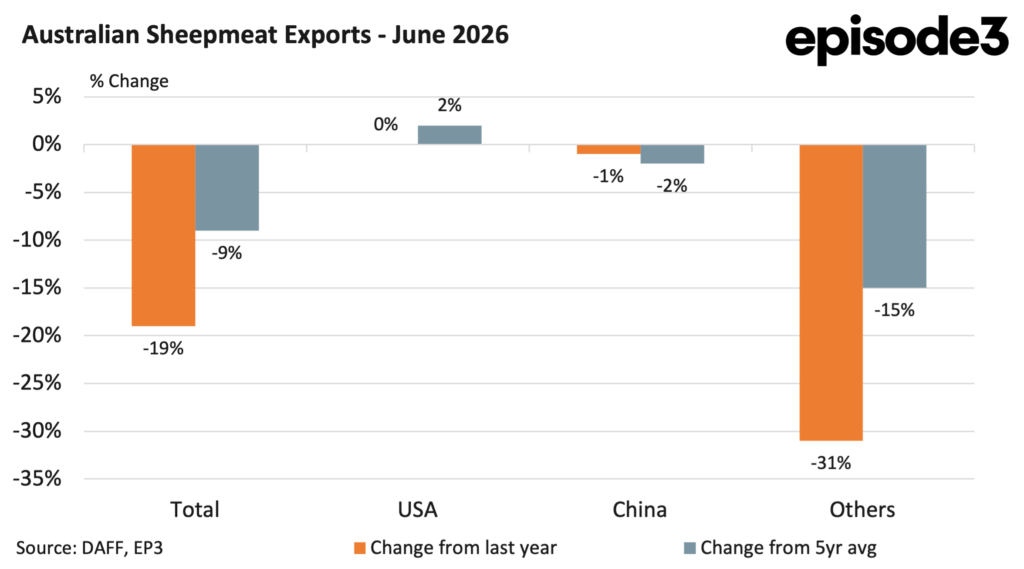
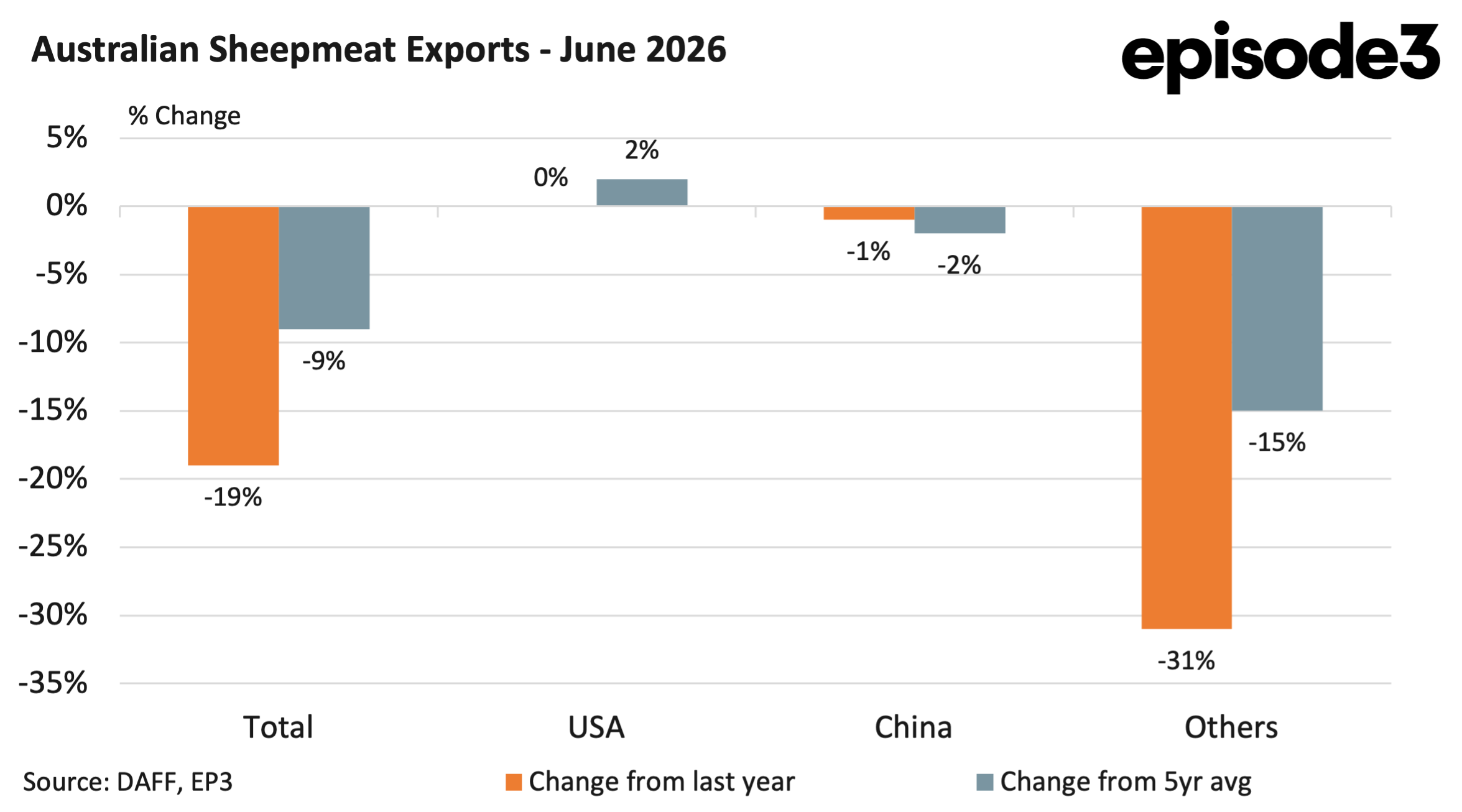
Combined shipments to all other destinations totalled 20,736 tonnes during June. Although this category was 31pc below last year’s unusually high level, it remained only 15pc below the five-year average, reflecting generally solid demand across a broad range of export markets.
The Middle East continues to warrant close attention. While many destinations remain below historical import levels, June provided further evidence that buying activity is beginning to recover. Among lamb markets, the United Arab Emirates remained a key area of weakness, with imports sitting 25pc below the five-year average during June. Jordan was 20pc below average, while Qatar remained 26pc under its historical level. However, Bahrain provided one of the more encouraging stories of the month with their lamb exports from Australia surging to 60pc above the five-year average after several months in which trade had been minimal or virtually absent. Although Bahrain is a relatively small market in volume terms, the rebound suggests some Middle Eastern buyers are gradually returning as supply chains normalise and market confidence improves.
The mixed regional performance indicates that recovery across the Middle East is unlikely to occur evenly. Individual markets continue to respond differently to domestic economic conditions, consumer demand and inventory levels. Nevertheless, compared with conditions earlier in 2026, there are increasing signs that the region is beginning to stabilise.
Looking across the first half of 2026, Australia’s sheep meat export portfolio remains well diversified. China accounts for 21.7pc of exports, the United States 19.6pc, the Middle East 12.5pc, other Asian markets 14.6pc and the remainder of the world just over 31pc.
That diversification continues to provide an important source of resilience for the industry. Weakness in one region has generally been offset by stronger demand elsewhere, allowing exporters to maintain relatively consistent shipment volumes despite changing market conditions.
The June result also highlights the contrast between 2025 and 2026. Last year produced exceptionally strong export volumes that sat well above historical averages for much of the year. By comparison, 2026 has tracked much closer to long-term seasonal norms, with exports remaining within the normal trading range despite sitting below last year’s elevated benchmark. As the second half of the year approaches, the key watchpoints will remain Chinese demand, the pace of recovery across Middle Eastern markets and the ability of the United States to continue absorbing premium Australian lamb.