
Slaughter activity lifts as sheep and lamb prices refuse to buckle
Market Morsel
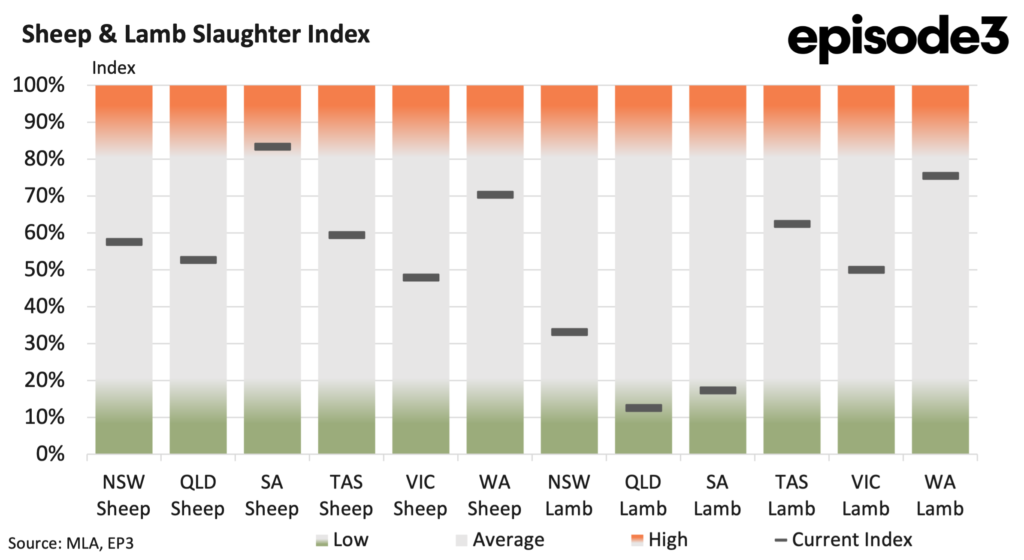
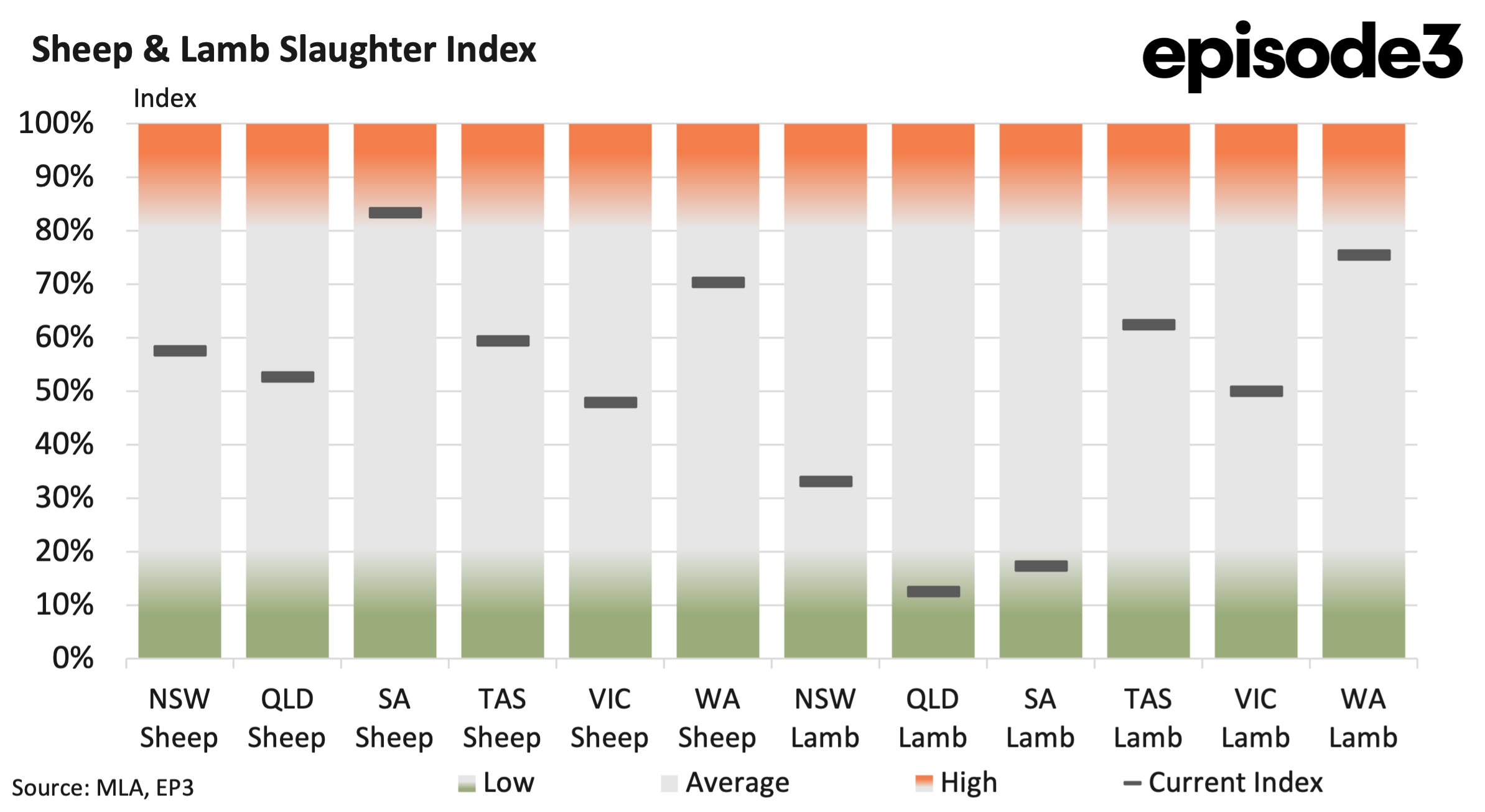
The seasonal increase in Australian sheep and lamb processing activity became considerably more apparent during October, with the latest Sheep and Lamb Slaughter Index (SLSI) showing substantial gains across several of the nation’s major producing states. What makes the latest figures particularly interesting is that the increased slaughter activity has been accompanied by strengthening livestock prices, rather than the seasonal price pressure that might ordinarily be expected as more stock moves through the system. The SLSI measures slaughter activity relative to historical levels, providing an indication of whether processing is running above or below typical conditions.
Between September and October, the sheep slaughter index increased across five of the six states monitored, with particularly strong gains in South Australia, Western Australia and NSW. South Australia recorded the largest increase, with its sheep slaughter index jumping from 46pc to 83pc, a rise of 37 percentage points. Western Australia also recorded a substantial lift, moving from 45pc to 70pc, while NSW increased from 30pc to 58pc. Victoria’s sheep slaughter index climbed from 29pc to 48pc, while Tasmania increased from 20pc to 59pc. Queensland was the exception, declining from 62pc to 53pc. Given that NSW, Victoria, South Australia and Western Australia account for the bulk of Australian sheep production, the increases across these states are particularly significant.
The lamb slaughter picture was more mixed, although there were some notable developments. Western Australia recorded the strongest October lamb slaughter index at 75pc, up from 43pc in September. Victoria also experienced a substantial increase, with its lamb index rising from 26pc to 50pc, while NSW increased from 17pc to 33pc. South Australia moved in the opposite direction, with its lamb slaughter index falling sharply from 37pc to 17pc.
The divergence between sheep and lamb processing in South Australia is particularly interesting, suggesting that the composition of livestock moving through processing facilities has changed considerably. The recent article on Sheep and Lamb Yarding Index (SLYI) provides another piece of the puzzle. October yarding indices also showed increased activity across much of southern Australia, particularly Victoria, Western Australia and South Australia. The combination of stronger saleyard activity and higher slaughter index readings suggests the seasonal increase in livestock movement is now evident across multiple parts of the supply chain.
Yet prices have shown remarkably little inclination to weaken. Over the past four weeks, the national heavy lamb indicator has increased by 42 c/kg carcass weight, while trade lambs have gained nearly 26 c/kg. Restocker lambs have strengthened by almost 37 c/kg, reaching approximately 1,230 c/kg, while mutton has increased by more than 34 c/kg. These are substantial gains at a time when both yarding and slaughter indices suggest increased livestock activity. The strength in restocker lamb prices is particularly noteworthy, as it suggests producers remain willing to compete with processors for available lambs.
Mutton prices are equally interesting, given the increased sheep slaughter activity across the major producing states. If the additional processing activity were associated with an overwhelming supply of sheep, some downward pressure on mutton prices might ordinarily be expected. Instead, prices have continued to improve, suggesting processor demand is currently sufficient to absorb the additional turnoff.
There is also a broader structural consideration. Australia’s sheep flock has been contracting following several years of elevated turnoff, meaning the seasonal increase in slaughter activity may be occurring against a smaller underlying pool of available livestock. That could help explain why prices are responding differently from what might traditionally be expected during spring. The key distinction is between increased seasonal activity and genuinely abundant livestock supply. The SLSI and SLYI suggest more sheep and lambs are moving through the system, but neither index independently establishes that national supply is plentiful.
For producers, the immediate message is encouraging. The spring turnoff is becoming more evident, particularly across the major sheep-producing states, but the additional activity has not yet translated into weaker livestock values. The question heading towards summer is whether processing demand can continue absorbing seasonal supply, or whether the cumulative increase in turnoff eventually begins to weigh on prices. For now, the market appears to be handling the spring supply increase remarkably well, but this may not persist for much longer.