
Yardings rise as sheep and lamb prices retreat.
Market Morsel
The latest Sheep and Lamb Yarding Index shows a significant increase in livestock offerings through the mid-July to mid-August period, but the accompanying price movements suggest the additional supply has arrived at a time when demand is struggling to keep pace.
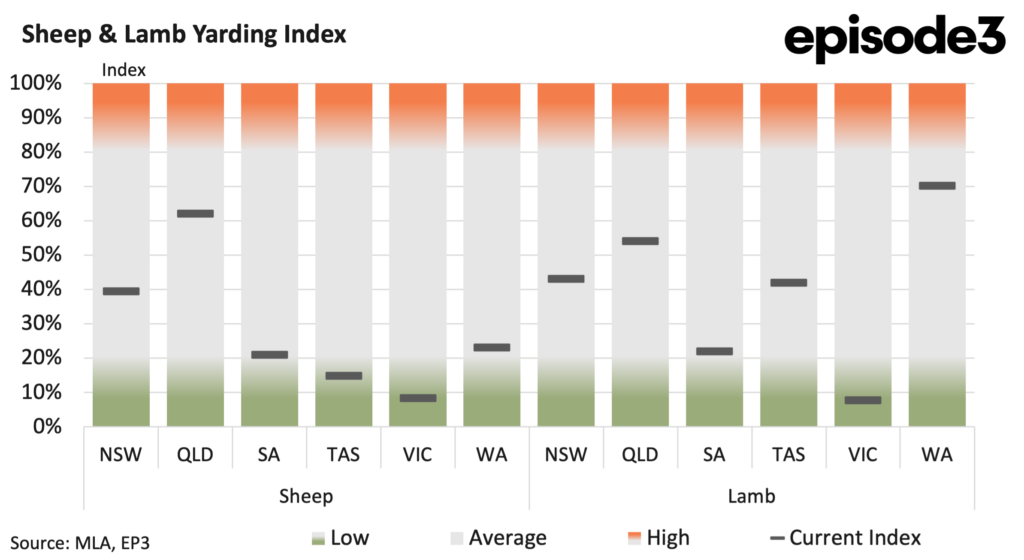
After the widespread tightening evident during June yardings increased across almost every major producing state, with the change particularly pronounced for lambs.
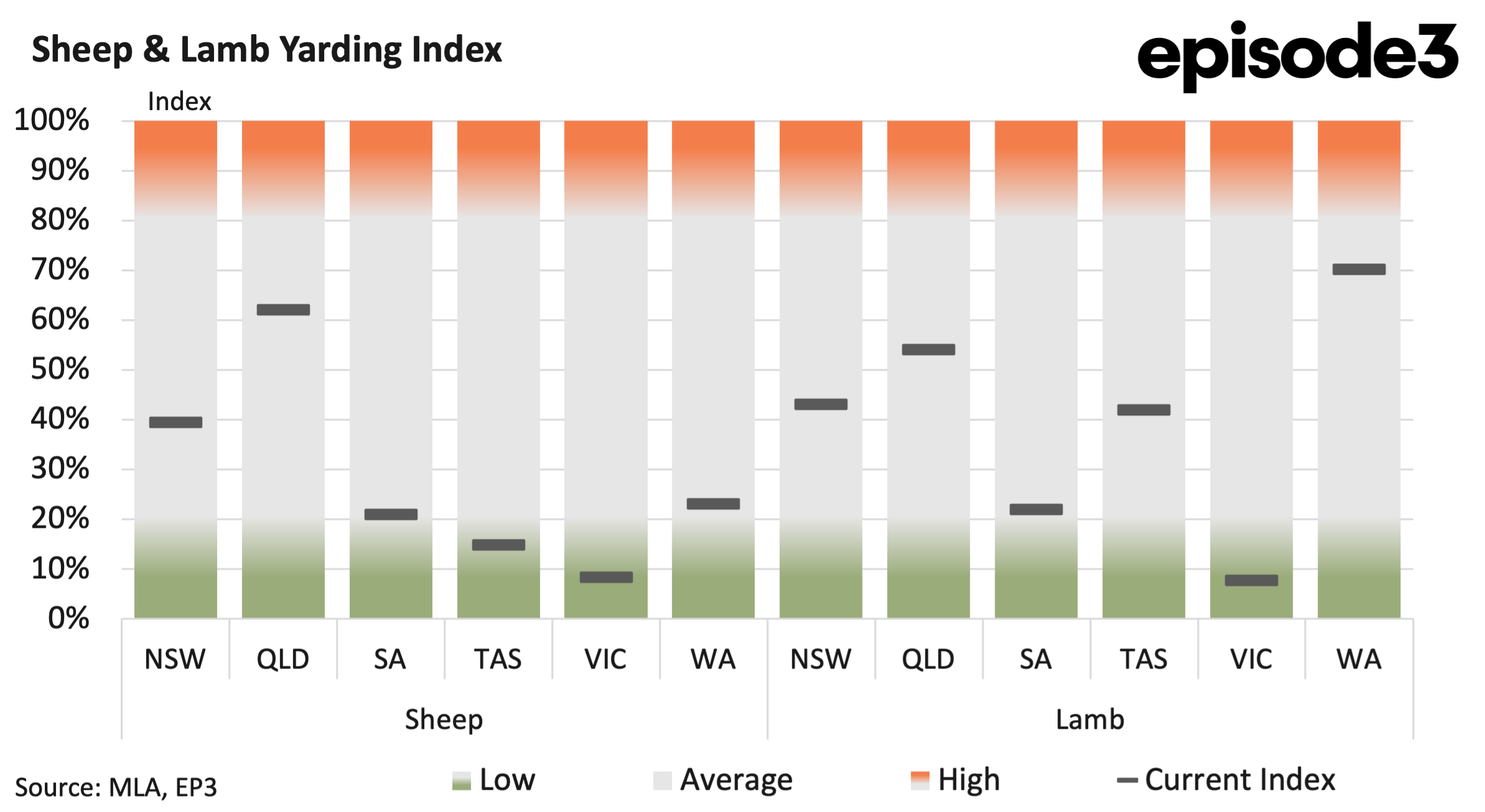
Sheep yardings increased strongly in New South Wales, rising from 23pc in the June to July period to 39pc in July to August. Queensland also recorded a substantial increase, moving from 44pc to 62pc, while Tasmania rose from 40pc to 51pc. Western Australia was broadly steady, edging from 22pc to 23pc, while South Australia remained unchanged at 21pc. Victoria was the only state to record a decline, with sheep yardings slipping from 11pc to just 8pc, reinforcing the exceptionally tight sheep supply conditions that have persisted there throughout much of 2026. While the increases in New South Wales and Queensland are significant, sheep yarding levels remain relatively subdued across several southern regions.
The larger change during the latest period has occurred in lamb supply. New South Wales lamb yardings more than doubled from 19pc to 43pc, indicating that considerably more lambs have begun moving through saleyards. Queensland followed a similar pattern, rising from 27pc to 54pc, while Tasmania increased from 28pc to 42pc. South Australia also lifted from 17pc to 22pc and Victoria moved from 14pc to 18pc. Western Australia remains the strongest lamb supply region despite easing from 56pc to 70pc when comparing the two periods, with the latest reading continuing to show considerably stronger availability than most eastern states. The latest yarding figures represent a clear change from the previous update, when sheep and lamb offerings were tightening across almost the entire country.
The increase in stock coming forward has coincided with a correction in livestock prices. Heavy lamb prices have declined by around 9c over the past four weeks to sit near 1,122 per kilogram carcase weight. Trade lamb has fallen by approximately 16c to around 1,182 per kilogram, while Merino lamb has declined by roughly 57c. Light lamb has recorded the largest fall, dropping by around 97c over the four week period to approximately 1,062c per kilogram. Restocker lamb prices have also weakened by about 82c, suggesting that the softer market has not been limited to processor categories. Mutton has joined the downward move, falling by approximately 98c over the month to around 810c per kilogram carcase weight.
The alignment between increased yardings and falling prices provides a much clearer market signal than was evident during some earlier periods this year. More livestock is being offered to buyers at the same time as demand conditions have become less supportive, reducing the need for processors and restockers to compete as aggressively for available stock.
The July export numbers reinforce this interpretation. Australian sheepmeat exports remained subdued during July, with total shipments of 31,217 tonnes sitting well below both year ago and five-year average levels. China and the United States both recorded weaker flows, while shipments to the broader group of export destinations also remained under pressure. Demand across the Middle East and North Africa was particularly uneven, with improvement in selected markets offset by continued weakness elsewhere. Overall, the export data points to a softer demand backdrop at a time when livestock availability has started to improve.
This means the recent price correction cannot be viewed purely as a supply story. Earlier in the year, prices were able to remain elevated despite subdued exports because livestock availability was sufficiently tight to keep processors competing for stock. More sheep and lambs are now appearing through saleyards, while processors are dealing with export markets that are absorbing less Australian product than either last year or normal seasonal levels. The combination has taken some of the heat out of livestock competition. There is also likely to be a price sensitivity element within the export market itself.
Australian lamb and mutton remain historically expensive, and elevated livestock costs ultimately feed through into the price processors need to achieve from overseas customers. The latest price correction may therefore represent the market beginning to rebalance after the exceptionally tight supply conditions and elevated livestock values seen through winter. Importantly, this does not mean Australia has suddenly moved into an abundant sheep and lamb supply environment. Yarding index scores remain relatively low in several states, particularly for sheep in Victoria, South Australia and Western Australia. More livestock is becoming available just as export demand has weakened, and that combination has been sufficient to shift bargaining power away from producers and towards buyers.